
Your Ad Here
Union Pacific Railroad


Union Pacific Railroad


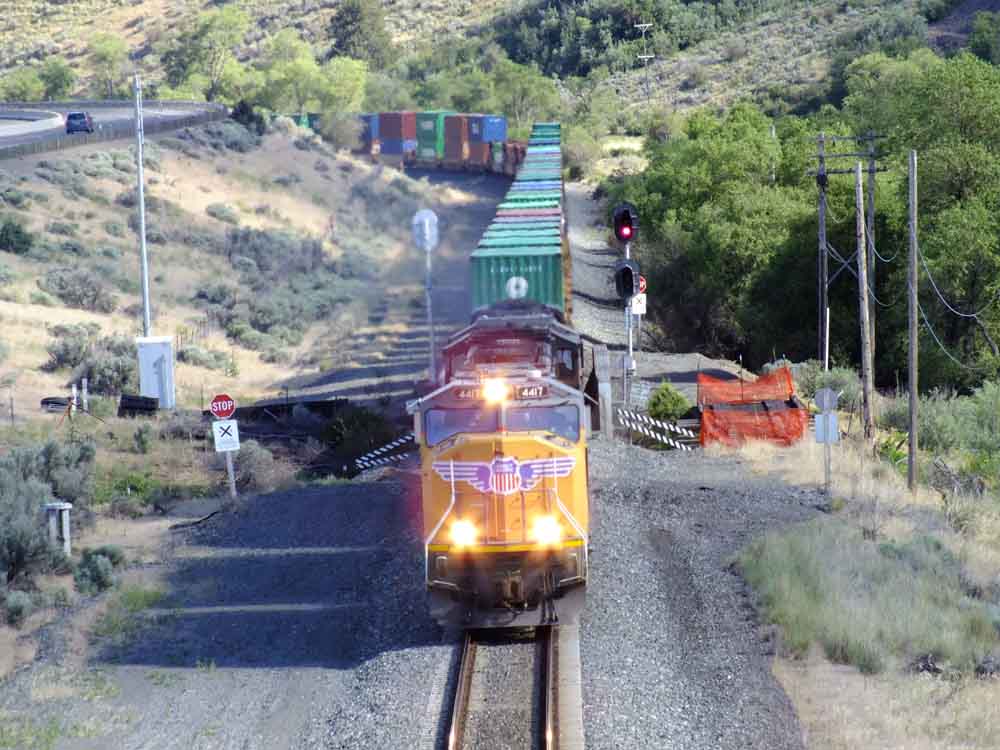
A westbound Union Pacific intermodal train cruising through Hood River. Jeff Moore photo.

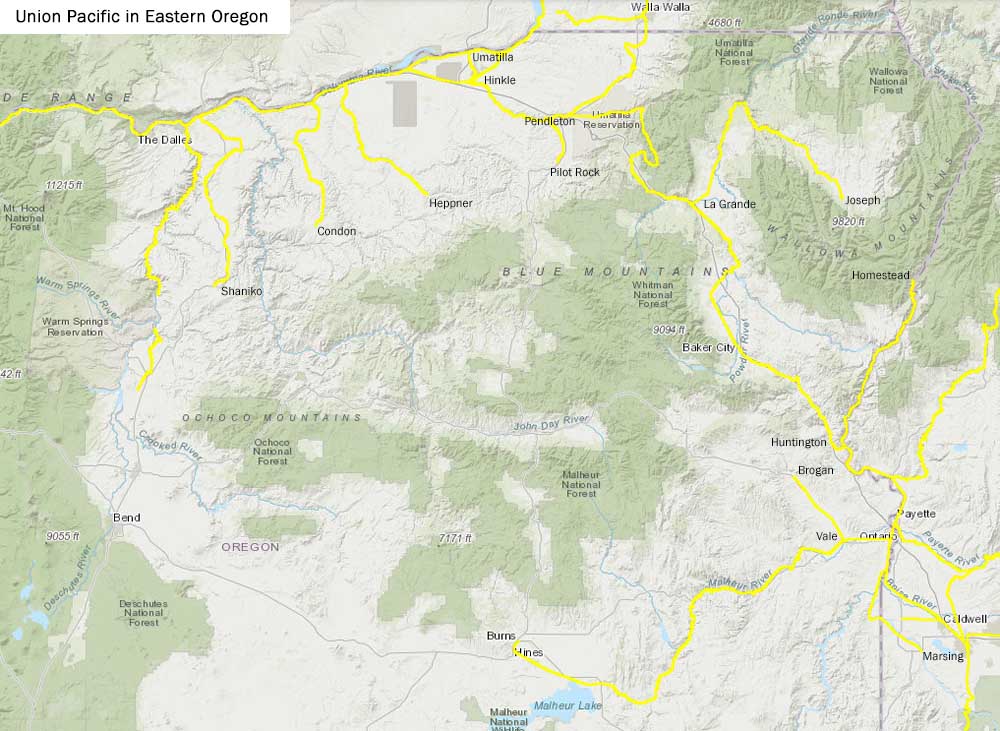
Map


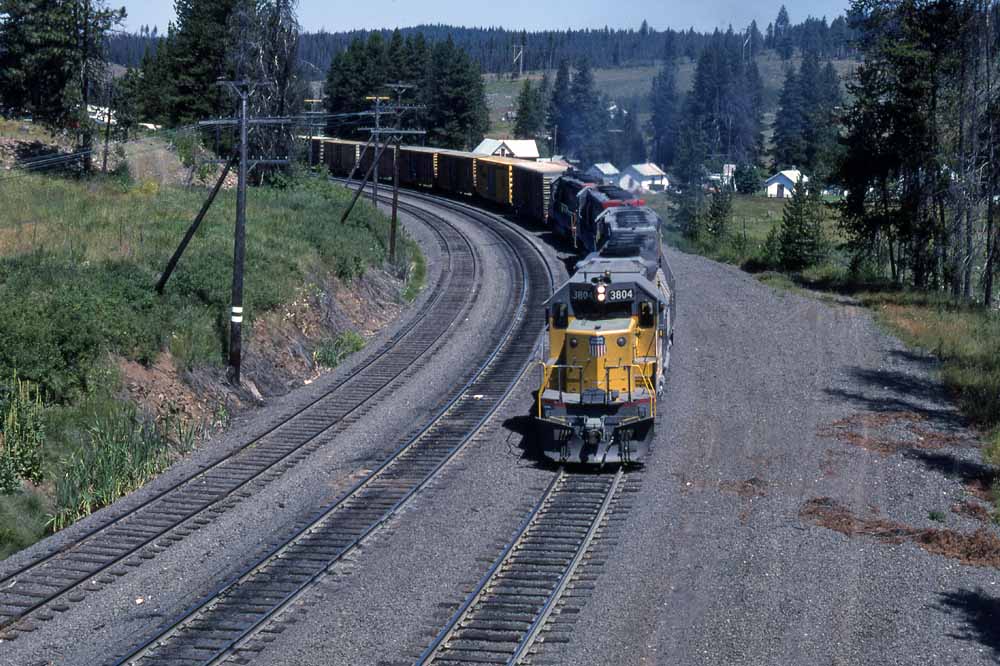
Of all the railroads serving Oregon’s High Desert country, the Union Pacific has arguably had the biggest impact on the region. The Congress of the United States created the UP in 1862 and tasked the company with constructing the eastern portion of the Transcontinental Railroad. Construction started in Nebraska in 1865, and the westward building rails of the UP met the eastward building rails of the Central Pacific Railroad at Promontory Summit, Utah, on 10 May 1869.

Following the completion of the Transcontinental Railroad the UP set about to expand its system. One of these expansions took the rails of the UP into the Oregon country over a subsidiary known as the Oregon Short Line. The UP presence in central and eastern Oregon can be broken down into the mainline and the various branchlines. The history of each part of the system are outlined below.

On 11 September 1996 UP dramatically expanded its operations all across the west when it completed purchasing the Southern Pacific Railroad. Please see that page of this website for information on those lines since the UP assumed control.


Mainline- Oregon Short Line/Oregon Railway & Navigation Company

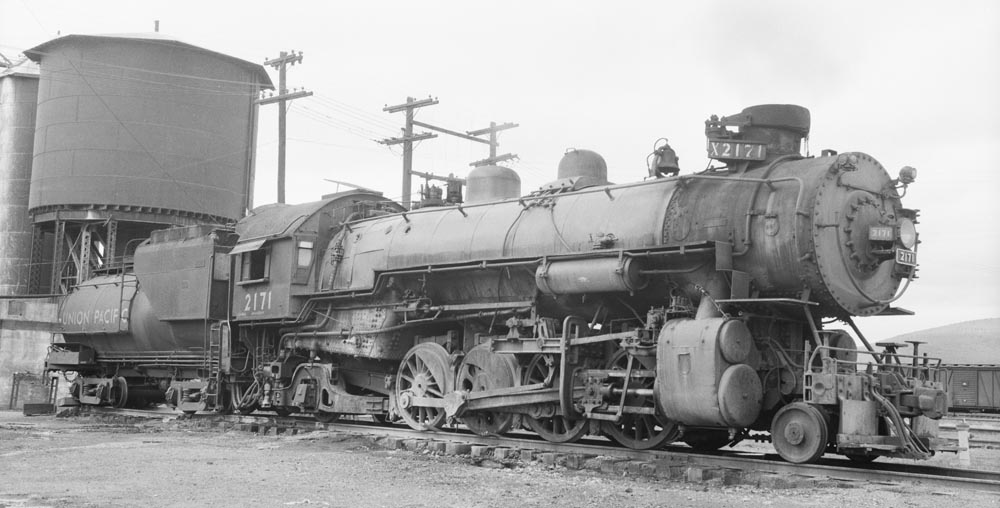
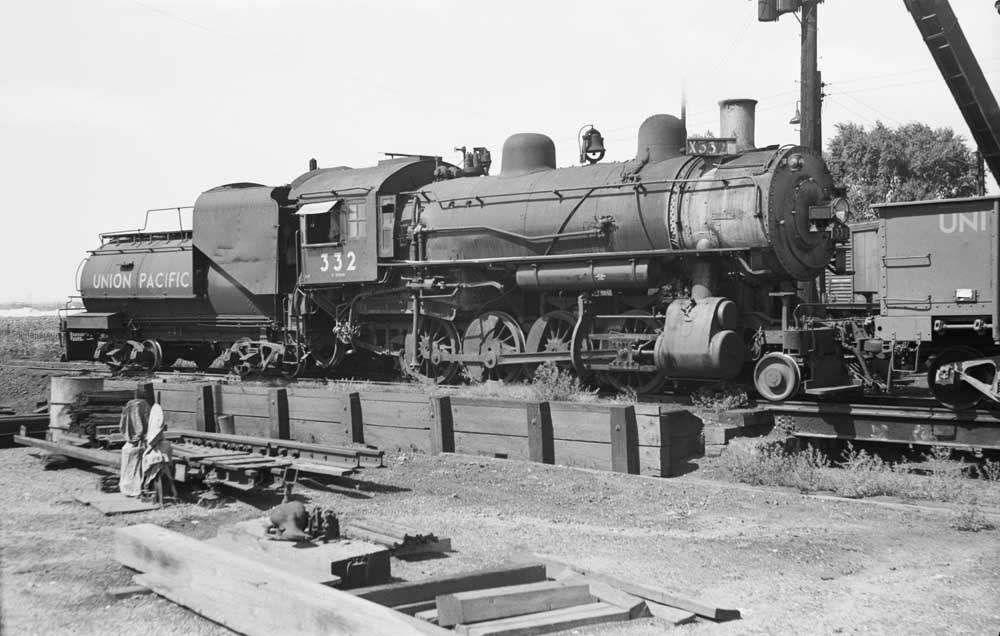
The Oregon Portage Railroad was the first railroad laid down in the state of Oregon. The company built a short stretch of track along the Columbia River at Cascade Rapids to transport river traffic around the obstacle. A small 0-4-0T type steam locomotive, named the Oregon Pony, became the first steam locomotive in service in the Northwest when it went into service on this short railroad in 1862. The same year saw the Oregon Portage Railroad purchased by the Oregon Steam Navigation Company, which set out to build another short portage railroad around Celilo Falls, just east of The Dalles, OR.

By 1879 the Oregon Steam Navigation Company was part of the vast northwest transportation empire controlled by Henry Villard. Villard merged the OSN with his Oregon Steamship Company to form the Oregon Railway & Navigation Company (OR&N). The OR&N had a short subsidiary railroad, the narrow gauge Walla Walla and Columbia River Railroad, which operated a few miles of track around Walla Walla, WA. One of the first acts of the OR&N was to extend the WW&CR rails westward to The Dalles, OR, both to supplement water transportation and to keep the westward building Northern Pacific Railroad from using this route to complete its line west to the Pacific Ocean.

The rails of the WW&CR and the Oregon Portage Railroad were converted to standard gauge and linked together by April 1881. Once the line to the east was completed, the OR&N next focused on building westward to the city of Portland. This stretch of the railroad required a lot of trestle and rock work, including a number of tunnels. A silver spike ceremony held on 4 October 1882 at Bonneville marked the completion of the through route from Portland to Walla Walla. By 1883 the Northern Pacific was using the OR&N to reach the ocean ports at Portland while it completed its own line across the Cascade Range at Stampede Pass. This arrangement lasted until around 1887.

In 1879 the Union Pacific struck an agreement with Villard to connect the rails of the OR&N with those of the Union Pacific transcontinental mainline at Granger, Wyoming. No concrete actions took place until 1881, when UP incorporated the Oregon Short Line. The OSL charter called for a line running from Granger, WY to Baker City, OR. Construction of the OSL westward and the OR&N eastward commenced shortly afterwards. However, relationships between the two companies deteriorated, and both companies laid out plans to build past each other. However, the two sides came to agreement in February 1883 to join their rails at Huntington, OR.

The OR&N reached Pendleton, OR on 31 August 1882 and Baker City, OR in August 1884. The last spike connecting OR&N and OSL rails was finally driven at Huntington on 25 November 1884. The OSL acquired control of the OR&N in 1887, and UP had its through route to the Pacific Ocean.

The old OSL and OR&N rails through the Blue Mountains and along the Columbia River continue to be an important part of UP’s system today.


An eastbound Union Pacific freight near Cascade Locks. Jeff Moore photo.


Burns Branch

The rising waters of Malheur Lake eventually inundated 15 miles of the Burns branch between Crane and Burns. The speeder is sitting at the eastern end of the damaged track at Milepost 131.2, near the old station site of Albritton and approximately five miles west of Crane, on 24 May 1986. Tom Moungovan photo, courtesy of Wayne Monger.

The failure of Harriman's Cross State Railroad project in 1913 found the end of UP’s portion of the proposed line in the Malheur River canyon west of Vale, OR. Despite the setback, construction continued westward, with Juntura reached by 1914 and Crane reached in 1916. The completion of the line to Crane marked the beginning of several decades of litigation in which the State of Oregon attempted to force the UP to expand its eastern Oregon network so that the central portion of the state could be opened up to settlement and development. The efforts of the state led to the Interstate Commerce Commission issuing an order in 1930 instructing the UP to build a new line from Crane to a connection with the Southern Pacific somewhere in the Eugene area. The Great Depression made constructing this route economically unrealistic, and the ICC withdrew the order in 1933. The State of Oregon then went to the courts in an attempt to force the ICC te re-issue the order, but the Supreme Court ruled in favor of UP and the ICC in 1935. The only further expansion of the UP into central Oregon came in 1924 following the acquisition of the Malheur Railroad.

One branchline running 23.3 miles from Vale northwest to Brogan was built off of the Burns branch. This line was completed in 1910. The line survived primarily on agricultural traffic. The 5.2 miles at the end of the line, from Jamieson to Brogan, was officially abandoned in 1964; the balance of the line survived on sugar beet traffic until 1979, when the beet traffic shifted to trucks and the line was abandoned.

The Burns branch moved predominately agricultural traffic until 1930, when the huge Edward Hines Lumber Company sawmill in Burns commenced operations. Forest products then became the principle traffic moved over the line, although agricultural traffic remained important through the 1950’s, when it shifted to trucks. Service over the line through the 1950’s was provided by a mixed train, Train Numbers 459 and 460, that made the 157-mile trip between Ontario and Burns in eight hours.

Traffic handled out of Burns went into a steep decline at the dawn of the 1980’s. 1979 saw 4,955 outbound and 89 inbound loads handled to or from Burns. By 1980 this figure was down to 2,336; 1981 saw 848 loads, and the first three months of 1982 saw 221 loads. UP closed the Burns depot in mid-1982, with the switching and weighing of cars in Burns contracted out to the Oregon & Northwestern Railroad. The agency functions formerly handled in Burns was transferred to the depot in Ontario.

A good portion of the 30 mile stretch between Crane and Burns was built along the shores of Malheur Lake, and up until the early 1980’s the lake had given the railroad very little trouble. A series of wet winters caused the water level to start rising, and by the early months of 1984 the railroad grade was threatened. Rumors started circulating that UP planned to abandon the line to Burns, but these rumors were denied by UP. However, the rising lake levels continued to inch closer to the tracks, and UP notified all shippers in Burns that it would cease operations once the water reached the level of the ties. Trains operating in late February reported water over the tracks in a couple locations, and on 8 March 1984 a UP crew gathered up everything that could be moved and headed east, leaving Burns without rail service. Those cars that could not be taken out in the last train were either cut up for scrap or trucked out to Crane, which once again became the new end of track.

UP announced that it would re-build the trackage and resume service to Burns once the waters receded, but after the lake levels dropped no efforts were made to repair the flood damage. Some local and state politicians talked about forcing UP to resume service, but no actions were taken. UP finally decided to divest itself of the line, and in 1986 the entire Burns branch was placed on the list of branchlines available for sale or lease. A deal was initially struck with Intermountain Western Industries of Boise, ID, that would have seen the Burns branch conveyed to the new Intermountain Western Railroad along with a package of other branchlines in eastern Oregon and southern Idaho. The Intermountain Western purchased and painted a few locomotives and did some other work necessary to start operations, but the deal fell apart at the last minute.

One of the principles behind the Intermountain Western was Western Railroad Builders of Ogden, Utah. WRB was interested in the Burns branch, and after Intermountain Western deal fell through the company negotiated with UP to purchase the line. A contract to buy the line was signed in the early part of 1989, and the Interstate Commerce Commission approved the sale on 13 April 1989. Technicalities and legal delays prevented the sale from going through for a number of months, and WRB finally took possession of the line and commenced operations on 6 November 1989. The new company was known as the Oregon Eastern Division of the Wyoming/Colorado Railroad. Click on the link; the page on that operation will open in a new window.


Heppner Branch

The second to last Heppner turn switching the Kinzua Corp. sawmill in Heppner in June 1994. Photo by and courtesy of Marc Entz.

The Heppner Branch extended 45 miles south from a connection with the mainline at Heppner Junction to the town of Heppner. This line was completed in 1889. Traffic over the line was primarily agricultural until 1953, when Kinzua Pine Mills completed a large sawmill in the town. Lumber and woodchips from the sawmill then became the largest source of traffic handled over the line.

Operations over the line in the final years of the branch saw trains operating out of The Dalles, OR on Tuesdays and Thursdays. The Heppner local would run 59 miles east on the mainline to Heppner Junction before turning south. However, Kinzua Corp. was not shipping enough traffic to warrant maintaining the line, and in late 1993/early 1994 Union Pacific initiated abandonment proceedings for the line. The last train ran on 30 June 1994 when a light locomotive ran down to retrieve a single empty bulkhead flat from the Kinzua Corp. mill. The branch was officially abandoned and salvaged a short time later, except for the first three quarters of a mile from Heppner Junction that remains in place today and is used only for car storage.


Condon Branch

A loaded trash train rolling up the Condon Branch towards the Gilliam County landfill. Photo by and courtesy of Robert W. Scott.

The Condon depot, now a historical museum. Photo by and courtesy of Robert W. Scott.

The 44-mile long Condon Branch was completed in 1905 from a junction with the mainline at Arlington south to the agricultural town of Condon. Traffic over the line was primarily agricultural until 1928, when the Condon Kinzua & Southern completed its line from Condon south to Kinzua, OR. Forest products off of the CK&S became the primary source of traffic handled until 1978, when the big sawmill in Kinzua closed and the short line was abandoned. The decline of carloadings received from the CK&S prompted UP to close the Condon depot in 1975.

Agricultural traffic, primarily grain, kept the trains running to Condon through the late 1980’s. By the early 1990’s operations over the line were non-existent, and UP applied to abandon the line. The only remaining shipper on the line, Condon Grain Growers, argued against the abandonment, stating that UP’s inability to guarantee a certain number of cars during the past two years prevented it from loading any cars. The ICC rejected this argument with the comment that a problematic car supply did not explain why nothing had been shipped over the railroad in 18 months. UP’s last run to Condon took place in late summer 1992, when some light engines made the long run up the branch to retrieve a cut of grain hoppers ordered but never loaded by Condon Grain Growers. The ICC granted permission to abandon the line in September 1992, and the rails were removed in 1993.

A little over eleven miles of the branch remains in place today, from Arlington to the 2,000 acre Gilliam County Landfill. The landfill receives trash by rail from major metropolitan areas up and down the west coast, and that traffic keeps operations over the remnant of the line healthy.


Shaniko Branch

The Columbia Southern Railway Company came into existence in March 1897 with plans to build a line from the UP mainline at Biggs Junction south into central Oregon. The first part of the line, from Biggs Junction to Moro, was completed by December 1898. The new town of Shaniko, 70 miles from Biggs Junction, was reached in May 1900. There were many plans to extend the line south towards the Prineville area, but rough country immediately south of Shaniko made further construction prohibitive. Union Pacific provided most of the financing to build the railroad through its Oregon Railway and Navigation Company subsidiary, and by 1906 the Columbia Southern was fully controlled by the parent company.

Railroad headquarters were established in Shaniko, and the company built an extensive shop complex that employed 80 people at one time. Shaniko was the closest railhead to the vast expanses of central Oregon, and most of the trade to and from the region passed over the rails of the Columbia Southern. The busiest years of the railroad were 1910 and 1911, when UP relied on the railroad to transport a lot of men and material on their way to help build the Des Chutes Railway, which was battling with the Oregon Trunk Railroad for control of the Deschutes River canyon. The completion of the joint Oregon Trunk/Des Chutes line to Bend in 1911 diverted most of the through traffic off of the Columbia Southern, and the line entered a steep period of decline.

Passenger service to Shaniko ended in 1936, and the line from Shaniko north to Kent was abandoned in 1943. The line was further cut back to Grass Valley, and all operations south of Biggs Junction ended in 1964/1965 when a flood in Hay Canyon destroyed a large portion of the remaining line. The ICC granted permission to abandon the last remnants of the Columbia Southern on 20 June 1967.


Bend Branch/Des Chutes Railway

Details of the construction of this line are covered in the BNSF & Predecessors section of this website. UP continues to operate over the Bend branch, with a local freight running a couple times a week down the line as far as Redmond, where the company serves several shippers. UP continues to have trackage rights into Bend, but rarely has reason to use them since the last of the Bend sawmills closed.


Photos of the Union Pacific

Heppner Branch photos by Marc Entze

Burns Branch photos by Wayne Monger


References

Books

"Main Streets of the Northwest: Rails from the Rockies to the Pacific". T.O. Repp, Trans-Anglo Books, 1989.

"Stations West, The Story of the Oregon Railways", Edwin D. Culp, Caxton Printers, 1972.

"Shaniko: From Wood Capital to Ghost Town", Helen Guyton Rees, Binford & Mort, 1982.

"When the Railroad Leaves Town: American Communities in the Age of Rail Line Abandonment, Volume 2". Joseph P. Schwieterman, Truman State University Press, 2004.

Periodicals

"Condon Kinzua & Southern, Oregon's now-abandoned lumber-hauling shortline" by Michael R. Polk, November 1978 Pacific RailNews.

News Articles from the following:

Pacific RailNews


More on the Web

Union Pacific's Corporate Homepage

UP Condon Branch Some contemporary picture of the remnants of Union Pacific's Condon branch on Brian McCamish's Abandoned Railroads homepage.

Dan Schwanz's Northwest Trains Some fine photography of the region, with many links to other sites.


Create your own free Rail Blog or Website!

Advertise | About Us | Contact Us | Sign up for our Newsletter

Your Ad Here