



 |
Somerset &
Dorset Joint Railway Wrong-Road Signals |
|
|||||
|
|||||||
This page deals specifically with a particular type of 'Wrong-Road' Signal used on the Somerset & Dorset Joint Railway (S&DJR). General information about the different types of S&DJR signals and signal arms can be found in a separate RailWest page on S&DJR Signals.
 One feature of
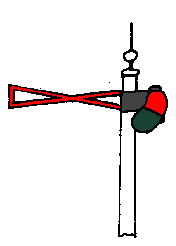
S&DJR signalling was the use of a particular pattern of 'wrong-road' signal, where
the signal arm was in the form of a large elongated 'X'. Consequently this
type of signal has been called colloquially a 'bow-tie' or 'cross-arm'
signal because of the distinctive shape of the arm (the term 'backing
signal' has been used also but that is more usually appropriate to the
Great Western Railway), but
it is probable that its formal name was 'wrong-road' signal because of its
function to control movements in the 'wrong' direction; in practice the S&DJR
appears to have described them simply as 'shunt' signals.
One feature of
S&DJR signalling was the use of a particular pattern of 'wrong-road' signal, where
the signal arm was in the form of a large elongated 'X'. Consequently this
type of signal has been called colloquially a 'bow-tie' or 'cross-arm'
signal because of the distinctive shape of the arm (the term 'backing
signal' has been used also but that is more usually appropriate to the
Great Western Railway), but
it is probable that its formal name was 'wrong-road' signal because of its
function to control movements in the 'wrong' direction; in practice the S&DJR
appears to have described them simply as 'shunt' signals.
It is often stated erroneously that these signals were unique to the S&DJR; in fact this pattern of signal was a feature of the signalling contractors Stevens & Sons (who supplied equipment for many S&DJR signalling installations) and it appeared on other railways equipped by them (including the London & South Western Railway (L&SWR)). After Stevens & Sons closed the L&SWR bought equipment made to their designs from other signalling manufacturers; one surviving arm was made by the Railway Signal Company Ltd, but it is not known who made any of the other 'wrong road' used on the S&DJR.
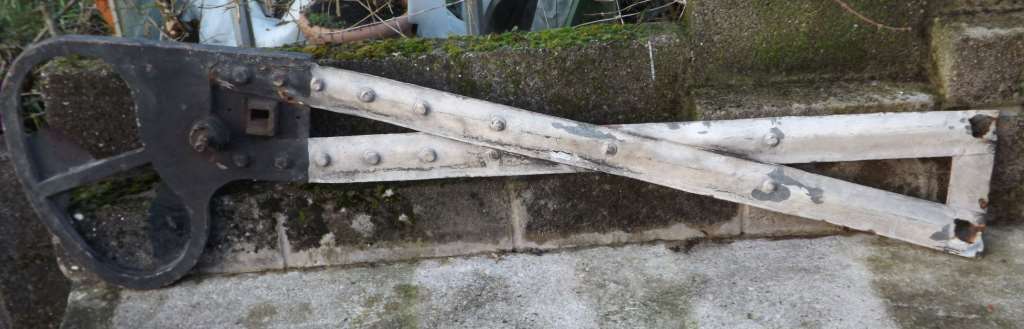
The S&DJR 'wrong-road' signals were all 'lower quadrant' signals, where the arm was lowered to indicate 'proceed' - click here for a sketch of the arm dimensions based on a surviving example. In the 'on' position (with the arm horizontal) a red light was exhibited. Some records suggest that these signals showed a purple light when in the 'off' position as an alternative to green, but in the absence of suitable colour photographs it has been difficult to clarify this point. Certainly a surviving example has the usual 'blue' glass used to provide a 'green' indication in conjunction with the yellow of an oil-lit signal lamp.
As there were examples of this pattern of signal at Midford and Evercreech Junction, two locations which were popular with railway photographers, they do appear in many pictures of the S&DJR. Consequently there has been a tendency for them to receive far greater attention in any references to S&DJR signalling than is justified really by their actual limited presence on the line. Research so far indicates that only 5 examples of these 'wrong-road' signals existed on the S&DJR at various times, of which 3 survived into British Railways days until final closure of most of the S&DJR in 1966.
This Register lists, in line order, all known examples of a S&DJR 'wrong-road' signal. More details about each signal are given in the relevant notes after the table.
Register of S&DJR Wrong-Road Signals |
||
|---|---|---|
| Location | Signal No | |
| MIDFORD | 5 PULL | Notes |
| 5 PULL R | Notes | |
| EVERCREECH JUNCTION NORTH | 21 | Notes |
| TEMPLECOMBE No 3 JUNCTION | 16 | Notes |
| 17 | Notes | |
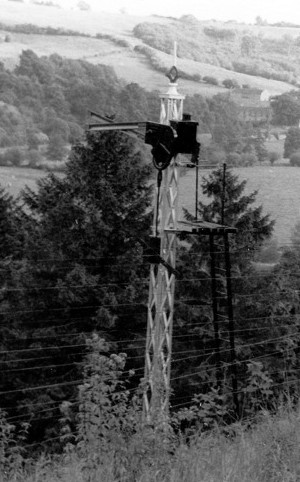 Signal 5PULL was situated on the platform at
Midford station and controlled 'wrong-road' movements onto the Up line of the
double-track section to Wellow.
(Click here to see a signal diagram for
Midford during the British Railways period.) It was not part of the original
installation when a new signal-box was opened at Midford in 1892 in conjunction
with the doubling of the line to Wellow, but probably it was in use by
about 1900. It would appear that this signal always had a metal lattice post,
whereas the other signals at Midford originally had wooden posts (later
replaced); click the photo to see a larger image.
Signal 5PULL was situated on the platform at
Midford station and controlled 'wrong-road' movements onto the Up line of the
double-track section to Wellow.
(Click here to see a signal diagram for
Midford during the British Railways period.) It was not part of the original
installation when a new signal-box was opened at Midford in 1892 in conjunction
with the doubling of the line to Wellow, but probably it was in use by
about 1900. It would appear that this signal always had a metal lattice post,
whereas the other signals at Midford originally had wooden posts (later
replaced); click the photo to see a larger image.
It was a common problem at Midford that north-bound Up goods trains running through the single-line section to Bath Junction might struggle to climb the gradient towards Combe Down tunnel and eventually come to a stand. In such cases the train would reverse back to Midford and then, under the authority of signal 5PULL, it could go 'wrong-road' onto the Up line of the double-track section. This action would clear the single-line section for the next Down train, while the engine of the goods train built up a good head of steam for another attempt at the gradient ahead. Signal 5PULL could be used also for a movement into the Up Siding.
A repeater arm for Midford signal 5PULL was provided on 11-June-1929 (S&DJR Signal Instruction 293) and this was mounted as a lower arm on the same post as the Down Home (signal 2) and fitted with an Annett's Shield. This signal was mounted on top of overbridge No 17 (known as the 'Long Arch') at the north end of the station, which restricted the visibility of the main 5PULL signal on the platform, so provision of the repeater arm enabled a train to be 'called past' the Down Home with the latter in the 'on' position. Both the main and repeater arms for 5PULL remained in use until the line closed in 1966.
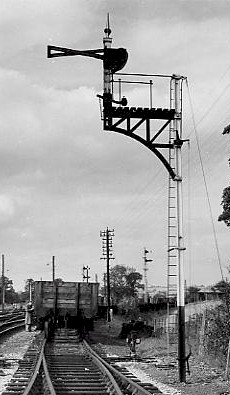 Signal 21
(see image) was located on the outside of the Down Siding (also known as
the Brick & Tile Company's Siding or Cogan's Siding)
close to the junction points where the Down Branch line from Highbridge trailed into the Down
Main. The signal was erected on a left-hand bracket, probably in order to improve
sighting for trains backing around the curve, and the signal post was a S&DJR design made from old rails. The date of
introduction is unknown, but the signal was in existence by 1904, although not necessarily at that
time in the form illustrated. This signal controlled the following movements
(click
here to see a 1949 signal diagram for reference):-
Signal 21
(see image) was located on the outside of the Down Siding (also known as
the Brick & Tile Company's Siding or Cogan's Siding)
close to the junction points where the Down Branch line from Highbridge trailed into the Down
Main. The signal was erected on a left-hand bracket, probably in order to improve
sighting for trains backing around the curve, and the signal post was a S&DJR design made from old rails. The date of
introduction is unknown, but the signal was in existence by 1904, although not necessarily at that
time in the form illustrated. This signal controlled the following movements
(click
here to see a 1949 signal diagram for reference):-
During the British Railways period the range of available movements declined as some of the siding connections were taken out of use, but the signal remained in use until the line closed in 1966. The arm from this signal survives in a private collection and is illustrated below; the arm is marked 'Railway Signal Co Ltd Liverpool L&SWR' on the front of the spectacle plate casting just to the left of the red aspect.
Signal 17 was located adjacent to the Up Goods line and it controlled trains backing out from the Lower Yard onto the Up Main. This signal appears in a S&DJR signal diagram (National Archives file MT6/1063/2 dated 6-February-1902) produced in connection with the new (second) signal-box opened at Templecombe No 3 Junction in 1902, although the signal itself may have existed previously. It was taken out of use on 12-February-1933 (S&DJR Signal Instruction 328) when the signal-box was closed as part of various layout alterations in the Templecombe Junction area.
This signal was a little unusual in its location and use. To the casual observer it might appear at first glance at a plan of the area that this signal applied to the Down Main in order to control trains backing across crossover points 15. In fact it was situated at the lower level of the Goods lines and it is quite clear from the interlocking table attached to the original S&DJR diagram that it controlled forward movements on the Up Goods line through points 14 and 13 onto the Up Main. It was used when long goods trains were being backed out of the yard onto the Up Main (ready to go forward southwards on the Down Main) and therefore the engine was at the end furthest from signal 19.
Note: after Templecombe No 1 Junction signal-box was closed on 16-January-1887, it was no longer possible for goods trains heading southwards to leave the Lower Yard directly onto the single-line towards Henstridge and beyond, but instead they had to back out via No 3 Junction. It is known from S&DJR Signal Instruction 32 that on that date a 'backing out' signal to cover such movements was provided in approximately the same location as the later signal 17, but that new signal was described specifically as being a ringed arm signal. It is probable therefore that the 'ringed arm' signal was replaced by the 'wrong-road' signal 17 at some unknown later date.
Signal 16 On 15-November-1915 (S&DJR Signal Instruction 253) a new two-doll bracket signal was provided at the exit from the Down Goods line adjacent to trap points 12, presumably replacing ground signal 9. The left-hand doll carried an ordinary 'stop' arm which controlled movements backing from the Down Goods line across points 10 onto the Up Main. The right-hand doll was fitted with a 'wrong road' arm and this controlled 'wrong-road' movements from the Down Goods line back along the Down Main; it is believed that lever 16 was brought into use then to work that signal. This bracket signal survived the initial layout alterations in 1933, but was taken out of use later that year on 27th August (S&DJR Signal Instruction 341) when it was replaced by a new bracket signal with two ringed arms to perform the same function.
Postcript...
An example of a S&DJR 'wrong-road' signal, based on the one at Evercreech Jcn North illustrated above, is under construction by the Somerset & Dorset Railway Heritage Trust for operational use at the restored Midsomer Norton South station. The Somerset & Dorset Railway Trust also has a copy of a S&DJR wrong-road signal, but its current whereabouts are unknown.
© CJL Osment 2002-23
Evercreech Jcn signal photograph courtesy the late Ivo Peters, Midford signal
photograph courtesy Duncan Chandler, preserved signal arm photographs
and dimensions sketch courtesy Alan Price, signal graphic courtesy John Hinson.
References
|
|||||||
|
© West Country Railway Archives 2002 Page last updated: 14 April 2023 |
URL:
E-Mail: |
||||||