
Knoxville, Sevierville & Eastern Ry. • Knoxville & Carolina R.R. • Tennessee & North Carolina Ry.
Route Of The "Slow & Easy"

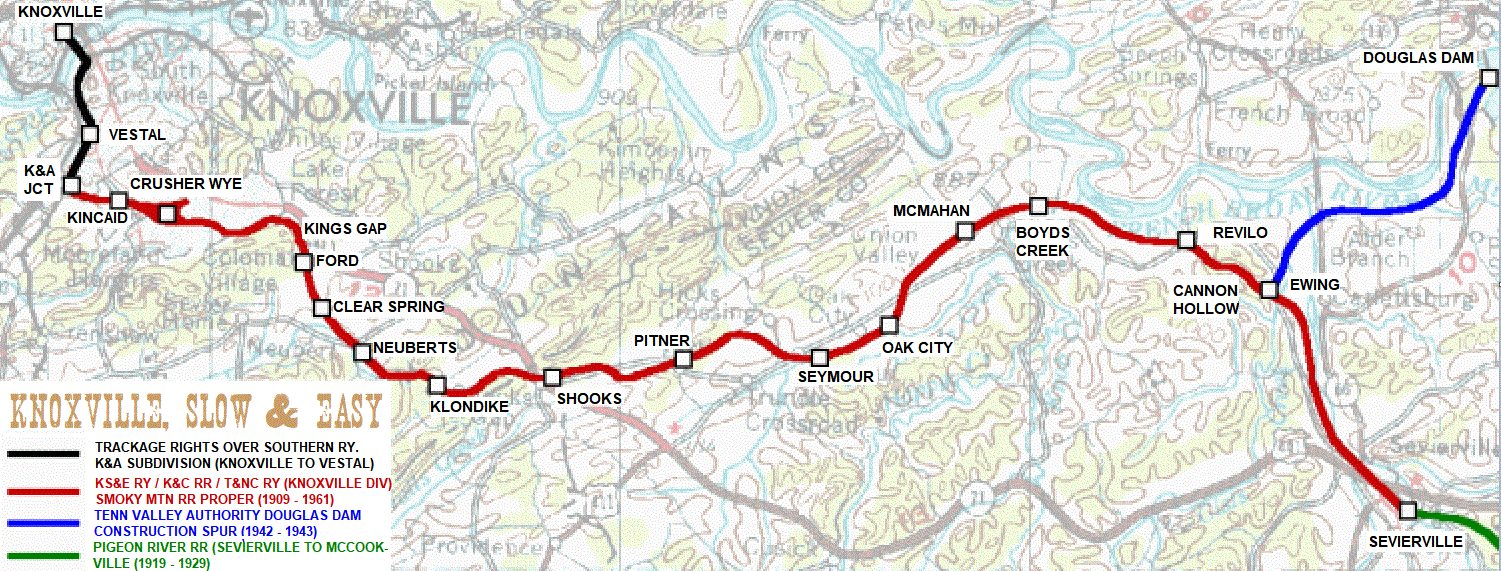
Near "Rocky Top" - Location of Smoky Mountain Railroad and predecessor lines. (Friends Of The Slow & Easy graphic)
Laid to standard (4' 8-1/2") gauge with 56 or 60-pound rail, the Knoxville, Sevierville & Eastern (KS&E) Railway and its successor lines more or
less followed the lay of the land across south Knox and Sevier Counties, Tennessee. In modern-day terms, the route was as follows:
Knoxville to Vestal: via the Norfolk Southern Railway's Knoxville & Augusta (K&A branch) across the Tennessee River, then roughly parallel to Blount Avenue;
Vestal to Moreland Heights community: roughly parallel to, then crossing Martin Mill Pike, then along Charter Doyle County Park's northeast boundary, passing under Magazine Road adjacent to Moreland Heights Elementary School;
Moreland Heights community to King's Gap (Ye Olde Steak House): roughly parallel to and crossing Magazine Road, then parallel to Brown Mountain, then running parallel to U.S. 441 (Chapman Highway) at Ye Olde Steak House;
King's Gap (Ye Olde Steak House) to Shooks: turning away from U.S. 441 (Chapman Highway) at Dick Ford Lane, crossing Abner Cruze Lane and State Route 168 (Governor John Sevier Highway), then bridging Stock Creek (near Breeden Lane), then crossing Tipton Station Road, then running parallel to and crossing Pickens Gap Road, then crossing Highland View Road, then turning parallel to Simpson Road and Bays Mountain, then crossing U.S. Highway 441 (Chapman Highway) in Shooks Gap;
Shooks to Seymour: roughly parallel to and periodically crossing Old Sevierville Pike;
Seymour to Revilo: roughly parallel to and periodically crossing State Route 338 (Boyds Creek Highway);
Revilo to Sevierville: through Cannon Hollow, then roughly parallel to Old Knoxville Highway, crossing U.S. 441 (West Main Street) near the railroad's Sevierville terminal.

Meandering route - Area map of Smoky Mountain Railroad and predecessor lines. (Friends Of The Slow & Easy graphic)
Although the path of the "Slow & Easy" is illustrated by the map above, the following is a 1927 Mechanics' Bank and Trust Company description of the right-of-way in legal-ese:
- "The said right of way and track beginning at or near Vestal in Knox County, Tennessee, thence in a southeasterly direction to King's Gap in Brown's Mountain, a distance of five and one-half miles;
- thence in a southeasterly direction up the valley of Stock Creek and passing Neubert's Mill near the end of the seventh mile from Vestal to Mud Flat School House, which is eight and one-half miles from Vestal;
- thence in a northeasterly direction toward the head waters of Stock Creek to the property of Robert Cruze; thence in a northeasterly direction to the line between Knox and Sevier County, this line being at Shook's Gap in Bays Mountain; thence in a southeasterly direction to Pitner's Gap, the same being a divide of the waters flowing northwestwardly and southeastwardly;
- thence down the valley leading to Boyd's Creek to a point near Fox's Store on the seventeenth mile;
- thence in a northeastwardly direction crossing Boyd's Creek near the stone bridge on the Sevierville Pike on the 20th mile;
- thence in a southeastwardly direction to the lands of Robert Catlett at the mouth of Cannon Hollow, which is on the 23rd mile from Vestal--in a southeastwardly direction to the foothills south of Pigeon River;
- thence southwest and parallel to the river to a point one-half mile northwest of Sevierville, and being twenty-six and one-third miles from Vestal and the ending of the line as located."
The road was constructed in four primary phases:
Phases Of Construction
| 1908 - 1910 |
Vestal to one mile west of Sevierville (KS&E) |
| Early-1910 |
One mile west of Sevierville to first permanent Sevierville depot (KS&E) |
| 1916 - 1920 |
Sevierville to McCookville (Pigeon River Railroad) |
| 1942 |
Ewing to Douglas Dam site (Smoky Mountain Railroad TVA
Spur) |
Places Along The Line
"Over the river and through the woods..." - Smoky Mountain Railroad in more detail. Single left-click on any station or flagstop
to go direct to its description. Use your browser's BACK button to return to the map from the description. (Friends Of The Slow & Easy graphic)
| Milepost |
Station |
Remarks |
"Then" Photos |
"Now" Photos |
| 0 |
Knoxville Terminal |
Located in Second Creek valley at 847 - 848 W.
Main Street. Leased from the Southern Railway. Connected to both the
Southern's Knoxville & Augusta branchline to Maryville and the
Knoxville Belt (present-day Knoxville & Holston River Railroad).
Facilities consisted of:
- Former Atlanta, Knoxville & Northern (later Knoxville,
Cumberland Gap & Louisville) 2-story brick depot (1910 - 1936);
- Wooden section house replacing the brick structure (1936 -
abandonment);
- Diesel fuel tank leased from Tinsley Tire Company (1954 -
abandonment);
- Five yard tracks.
Site was incorporated in the Knoxville
International Energy Exposition (1982 World's Fair) as Australian Pavilion
location. Now used as a University of Tennessee parking lot. |
* |
* |
| 2.2 |
Vestal |
Named for the Vestal family of Knoxville,
including brothers Robert, Edward, and J. Park, officers of the Vestal
Lumber and Manufacturing Company. Location of the switch or turnout where
Smoky Mountain trains turned off the Southern's K&A branch and onto
their own railroad proper. |
* |
* |
| 3.4 |
Kincaid |
Origin of name to be determined. Located near the
railroad's Martin Mill Pike level crossing. |
* |
* |
| About 3.7 |
Crusher Wye / Atlas Spur |
Located on Martin Mill Pike at the present-day
Charter E. Doyle city park. Atlas Spur (off the east leg of the wye)
served Royal Knox Marble Company quarry and crusher just off Stone Road to
the northeast. Westbound locomotives turned here and backed the remaining
three miles to Knoxville Terminal (to be headed in the correct direction
for the next eastbound run to Sevierville) Just east of this location,
powder magazines (hence the name, Magazine Road,) serving the quarry were
constructed into the hillside below present-day Mooreland Heights
Elementary School. Short, parallel railroad siding serving the magazines
still visible in the ravine beneath the school. |
* |
* |
| 4.9 |
Ford |
Named for the family owning the surrounding
property. Located at intersection of Chapman Highway (U.S. 441) and Dick
Ford Lane. |
* |
* |
| 6.8 |
Clear Spring (formerly Lola) |
Named for one of the numerous springs located in
the vicinity. Located just west of Houser bridge over Stock Creek. |
* |
* |
| 8.4 |
Neuberts |
Named for the family owning the surrounding
property. Located near the intersection of Tipton Station and Pickens Gap
Roads. Key service point on the Smoky Mountain line. Facilities consisted
of:
- Water tank;
- Handcar shed.
|
* |
* |
| 9.4 |
Klondike |
Origin of name to be determined. Located on
Pickens Gap Road at Bowman Mountain. Trains purportedly picked up and
dropped off milk cans at Klondike. |
* |
* |
| 12.2 |
Shooks |
Named for Shooks Gap in Bays Mountain. Located
just east of Shooks Gap on Chapman Highway (U.S. 441 / S.R. 71). Rock cut,
completed by Carolina, Knoxville & Western Railroad construction crews
in 1887, was key in determining the route of the KS&E route.
Facilities included:
- Small depot;
- Six-carlength siding, which housed Pacific #110 until its
purchase by Mr. Terry Bloom in 1972 for restoration.
|
* |
* |
| 15.0 |
Pitner |
Origin of the name to be determined. Located at
the intersection of Old Sevierville Pike and Sundial Road. |
* |
* |
| 17.6 |
Seymour |
Originally Newell's Station, later named Seymour
in honor of W.A. Seymour, chief designer of the Knoxville, Sevierville
& Eastern. Located just east of Trundle's Crossroads on Boyd's Creek
Highway. First of three crossings of that highway by the Smoky Mountain
line. |
* |
* |
| 18.5 |
Oak City |
Origin of name to be determined. Location of a small
settlement paralleling Boyd's Creek Highway to the south. Included a
prosperous broom and chair factory, short siding, and general store.
Second crossing of Boyd's Creek highway at grade located just to the
east. |
* |
* |
| 21.0 |
McMahan |
Origin of name to be determined. Located in
center of present-day Boyd's Creek community. |
* |
* |
| 22.6 |
Boyds Creek |
Named for the stream requiring construction of the
largest trestle on the line (85 feet high, 100+ feet long). Located just
north of the present day highway bridge over the Boyd's Creek. Unconfirmed
location of a water tank. |
* |
* |
| 25.0 |
Revilo |
Named (in reverse) for William J. Oliver, KS&E
founder. Located at present-day Revilo Farm, near the northern mouth of
Cannon Hollow. Ol' Smoky's third and final crossing of Boyd's Creek
Highway. |
* |
* |
| 27.6 |
Ewing (formerly Henderson) |
Origin of name to be determined. Located on Old
Knoxville Highway near the southern mouth of Cannon Hollow. Location of
switch leading to the Douglas Dam spur (1942-1943), a short siding, and
rail bridge slightly east. |
* |
* |
| 30.0 |
Sevierville Terminal |
Facilities consisted of:
- Original (temporary) KS&E depot (early-1910),
located on A.C. "Andy" Love property, just south of present-day Sevier County Fairgrounds;
- Second (and first permanent) depot (early-1910 - circa 1918),
located behind present-day Big Lots shopping center on W. Kilby Street;
- Third depot (built for Pigeon River Railroad (circa 1918 - circa
1929), but jointly used by KS&E/K&C/T&NC), located on E.
Bruce Street near the gas company (on the property of the former Murphy College;
Terminal itself, located
behind present-day Foothills Wholesale Furniture store at Main Street
(U.S. 441) and E. Kilby Street:
- Freight house and final depot (circa 1940 - abandonment);
- Engine house;
- "Armstrong" turntable;
- Water tower;
- Coaling ramp;
- Little Pigeon River rail bridge;
|
* |
* |
Sidings (Other Than Knoxville and Sevierville
Terminals)
Using maps, photographs, correspondence, and verbal information, the
following sidings have (so far) been identified on the Smoky Mountain Railroad.
Although this list may grow as new information is received, it is, in all
likelihood, about 90%-complete.
| Siding |
Milepost |
Length |
Capacity* |
Remarks |
| Lester Road (2 sidings) |
2.9 |
500' and 500' |
7 cars each |
Mainline and both sidings crossed Lester Road. Mainline was center
track. North siding was dead end-type, accessed from the west. South
siding was double-ended. One siding contained a car scale, possibly used
for weighing of marble and crushed rock loads leaving Crusher Wye. |
| Atlas Spur |
3.7 |
500' |
9 cars |
Served as north leg of Crusher Wye for engine turning. Also served
Royal Knox Marble Company quarry operation. |
| Mooreland Heights |
3.9 |
120' |
2 cars |
During KS&E-era, served powder magazines built into the hill.
After construction of Mooreland Heights School just above, dead-end siding
apparently was retained, possibly as a storage track. Accessed from the
east. |
| Shooks |
12.2 |
350' |
6 cars |
Double-ended siding served store at the former Burnett's Station. Coal
hoppers were spotted at Shooks when store proprietor Mr. Burnett sold coal
to local residents. |
| Oak City |
18.5 |
400' |
7 cars |
During early-20th Century, dead-end siding served broom and chair
factory. Siding was accessed from the east. |
| McMahan |
21.0 |
600' |
11 cars |
Double-ended siding served local farmers. Livestock loading ramp was
probably located at this siding. |
| Ewing |
27.6 |
Unknown |
Unknown |
Jim Holloway's location of a third rail confirms
existence of this siding, used to spot cars supporting 1942-1943
construction of Douglas Dam. |
| Stokely Cannery |
29.0 |
600' |
11 cars |
Double-ended siding served the cannery, perhaps the line's most
supportive shipper. |
| West Sevierville (2 sidings) |
30.0 |
500' and 350' |
9 and 6 cars |
East siding and mainline crossed U.S. 441 / 411 (Main Street), while
west siding was dead-end. Original (permanent) KS&E depot was located
here. In later years, west siding served a coal yard. |
| Temple's Feed & Seed |
30.8 |
150' |
2 cars |
Dead-end siding, accessed from the west, served Temple mill
operations. |
| A.J. King Lumber |
32.0 |
500' |
9 cars |
Actually a short spur, dead-end track was accessed from the east.
Lumber trains backed into the A.J. King property at about a 30-degree
angle from the mainline. | * In 40' car lengths
For more detailed information about the "Slow & Easy," please E-mail us!
Website design and graphics copyright © 1999 - 2012 Friends Of The Slow & Easy
|