




The Santa
Fe Steam Locomotives
|
||||||||||||||||||||||||||||||||||||||||||||||||||||||||||||||||||||||||||||||||||||||||||||||||||||||||||||||||||||||
|
No. |
Status |
| 101 | In Rio Gallegos. Missing tender. Resting on 2 axles. Dismantled. |
| 102 | In Rio Gallegos. With tender. Dismantled. |
| 103 | In Rio Gallegos. Missing tender. Resting on axles 1 and 5. Dismantled. |
| 104 | In Rio Turbio. |
| 105 | In Rio Turbio. Ready for service. Overhaul
was planned following completion of 119.
Status unknown. * |
| 106 | In Rio Turbio. |
| 107 | Was under overhaul in Buenos Aires by G y G Metalmecánica SRL under the supervision of Shaun McMahon. Work was nearly finished in 2015 and was schedule for completion in 2016. Status of project unknown.* |
| 108 | In Rio Turbio. |
| 109 | In Rio Gallegos. Missing tender. Resting on axles and 5. Dismantled. |
| 110 | In Rio Turbio. |
| 111 | In Rio Gallegos. Missing tender. Resting on pony truck and trailing truck. Dismantled. |
| 112 | In Rio Gallegos. Missing tender. Resting on axles 1 and 5. |
| 113 | In Rio Turbio. Overhaul was planned
following completion of 119. Status unknown. * |
| 114 | In Rio Gallegos after an accident.** |
| 115 | In Rio Turbio. |
| 116 | In Rio Turbio. |
| 117 | In Rio Gallegos. Missing tender. Axle no. 4 missing. |
| 118 | In Rio Gallegos. Dismantled. |
| 119 | Restored in Buenos Aires by G y G
Metalmecánica SRL under the supervision of
Shaun McMahon; returned to Rio Turbio and
operated in 2018. * |
| 120 | In Rio Turbio. |
| "The
locomotives that are positioned together in
Rio Gallegos are dismantled with various
components missing. They are not readily
recoverable. The tenders are stored along
with wagons and other rolling stock or upon
wagons. With respect to the locomotives in
Rio turbio, I do not have full information,
but they are fully capable of being put into
traffic and they are all fitted with their
tenders."
Many thanks to Sñr.
Boichetta and the late Shaun McMahon for
this interesting information. * Information updated 8
February 2022 |
|
|
Rio Turbio 2-10-2 Data |
||
| Builder |
Mitsubishi
Heavy Industies Mihara Engineering Works, Japan |
Mitsubishi Heavy Industies Mihara Engineering Works, Japan |
| Year Constructed | 1956 | 1964 |
| Road Numbers | 101-110 | 111-120 |
| Type & Gauge | 2-10-2, 2 ft. 5-1/2 in. (750 mm) gauge | 2-10-2, 2 ft. 5-1/2 in.(750 mm) gauge |
| No. Cyls. | 2 | 2 |
| Cyl. Dimensions | 16-1/2 inches x 17-3/8 inches | 16-1/2 inches x 17-3/8 inches |
| Coupled wheel diameter | 34 inches | 34 inches |
| Boiler pressure | 199 PSIG | 228 PSIG |
| No. Tubes | 108 | 88 |
| No. Flues | 18 | 18 |
| Superheater | Type A | Type A |
| Heating Surface (saturated) |
? | 950 square feet |
| Grate Area | 23 square feet | 23 square feet |
| Fuel | Sub-bituminous coal, ~14% ash, ~10,000 BTUH/pound heat content | Sub-bituminous coal, ~14% ash, ~10,000 BTUH/pound heat content |
| Effective Firebox Volume | 125 cubic feet | 125 cubic feet |
| Adhesive Weight | 38 tons | 38 tons |
| Loco. Weight | 48 tons | 48 tons |
| Max. DBHP | 1075 | 1200 |
| DBHP per ton | 21 | 25 |
| Specific fuel consumption | 2.64 pounds/DBHP/hour (estimated) | 2.2 pounds/DBHP/hour |
| Rated tonnage | 1200-1500 tons, coal drag service | 1200-1500 tons, coal drag service |
| Remarks | Kylpor exhaust system, Gas Producer Combustion System, Belpaire firebox, light-weight, multi-ring piston valves and pistons, stokers | Kylpor exhaust system, Gas Producer Combustion System, Belpaire firebox, light-weight, multi-ring piston valves and pistons, stokers |
| Built by | Mihara Eng. Works, Mitsubishi Heavy Industries, Japan | Mihara Eng. Works, Mitsubishi Heavy Industries, Japan |
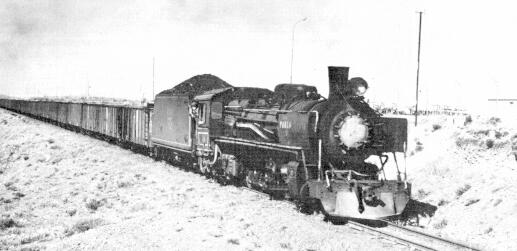
Locomotive in Service in the Early 1980's
photo by Ron Johnson
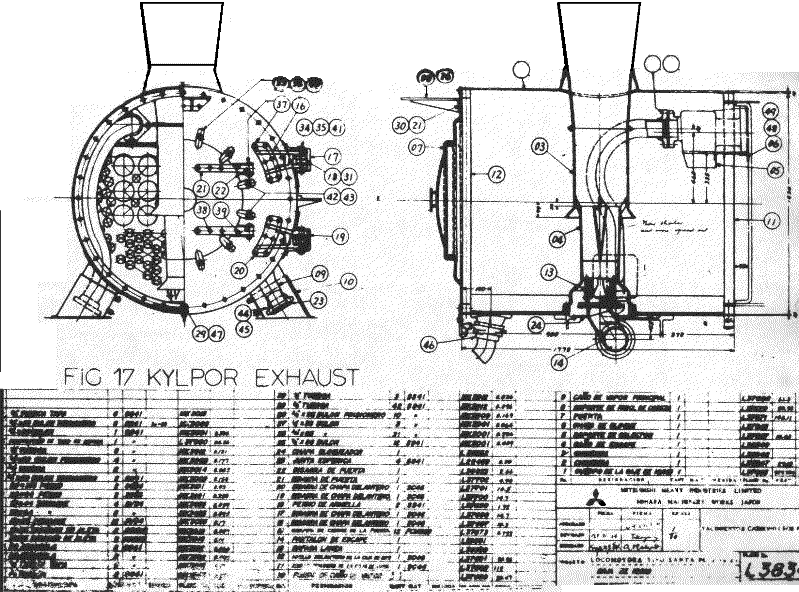
Original Construction
Drawing for 1964 Series Locomotives
Showing Smokebox Arrangement Including Kylpor
Exhaust System
Mihara Engineering Works, Mitsubishi
Heavy Indudustries
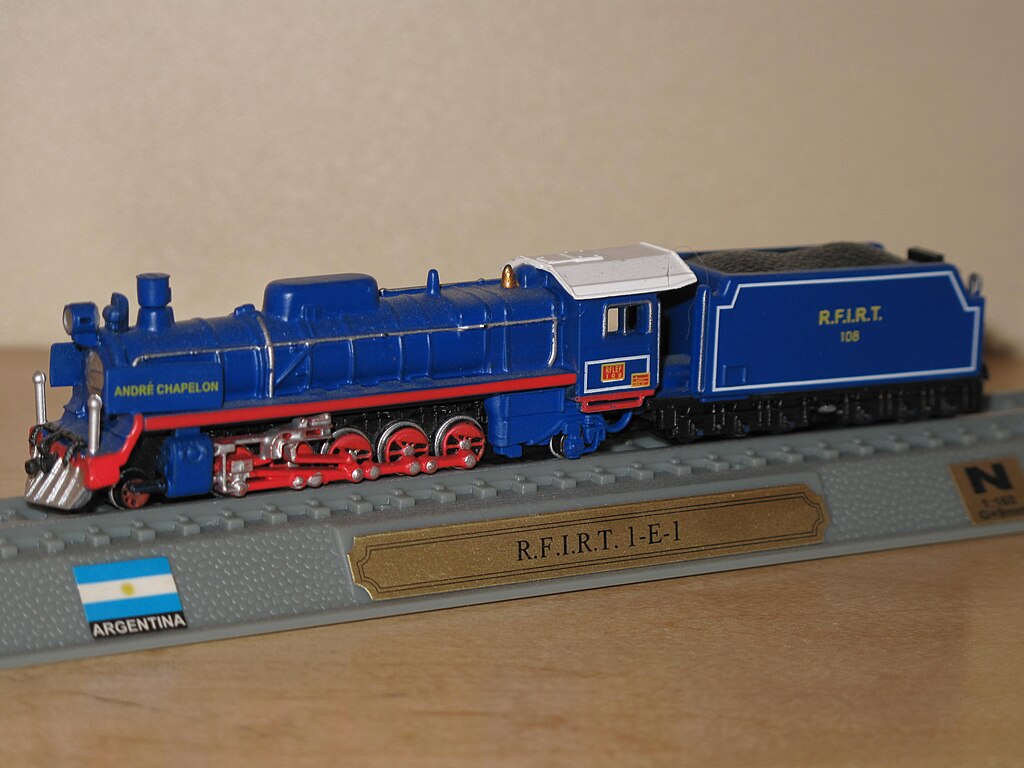
Photo of RFRT
2-10-2 Model, from Wikipedia Commons
For more information on
these engines, visit the following pages:
Rob Dickinson's International
Working Steam Locomotives includes several
relatively recent updates (2015-2018) on these
locomotives: https://www.internationalsteam.co.uk/americas.htm#Argent
Martyn Bane visited the engines in
January 2004. See his page at:
http://www.martynbane.co.uk/modernsteam/ldp/rfirt.htm
For photographs of the inoperable
engines at Rio Gallegos, go here:
2-10-2 Photos
For photographs showing details of
the Kylpor exhaust systems, go here:
Kylpor
Exhaust System Photos
For details of various railways in
Patagonia, including the RFIRT, see Martin Coombs'
pages at:
http://railwaysofthefarsouth.co.uk
The Railways of the Far South page
includes photos of these locomotives being loaded
in Japan for shipment to Argentina, which are well
worth a look: http://railwaysofthefarsouth.co.uk/09erfirtlocos.html
For more information on the railways and locomotives of Argentina, see "El Ferrocarril en Internet" written by Sergio L. Klimovsky at: http://members.tripod.com/ferrocarril/index1.htm
Also see magazine articles:
"Rail Classics" magazine, May 1982 issue, "World's Most Southerly Railroad" by Ron Johnson
"Locomotive & Railway Preservation" magazine, Issue 44, November-December 1993, "The Tiny Giants of Patagonia" by Gary A. Hunter





 Back to
Top
Back to
Top