Visit the TrainWeb.org Fan Page on Facebook!
Your Ad Here
Old Main Line Photo Tour

B&O Old Main Line
Modern day photo tour

Accompanying each photo below are:

Click a photo to see a larger view. Please send your comments and corrections to Steve.


Daniels - Brief Historical Background:

Map

Map
Mile: 17.8 Date: Nov 2006
Ease: View:
Area: IC2:
Map:

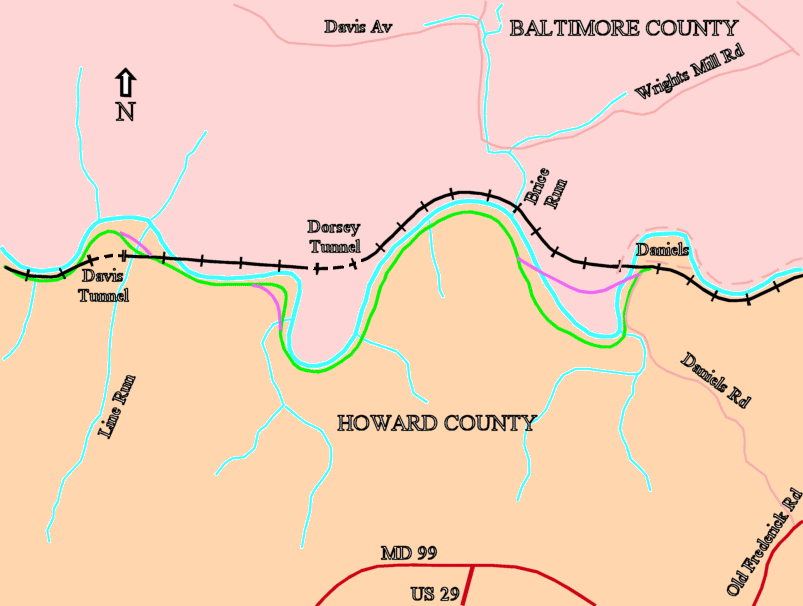
This map depicts the area from Daniels west to Davis. The Patapsco River weaves through the middle, separating Baltimore and Howard counties. Green marks the 1830 alignment, magenta 1838, and black the current.


New Signals

New Signals
Mile: 17.8 Date: Aug 2005
Ease: B View: N
Area: A IC2:
Map: Ho 12 D 1 Topographic Maps

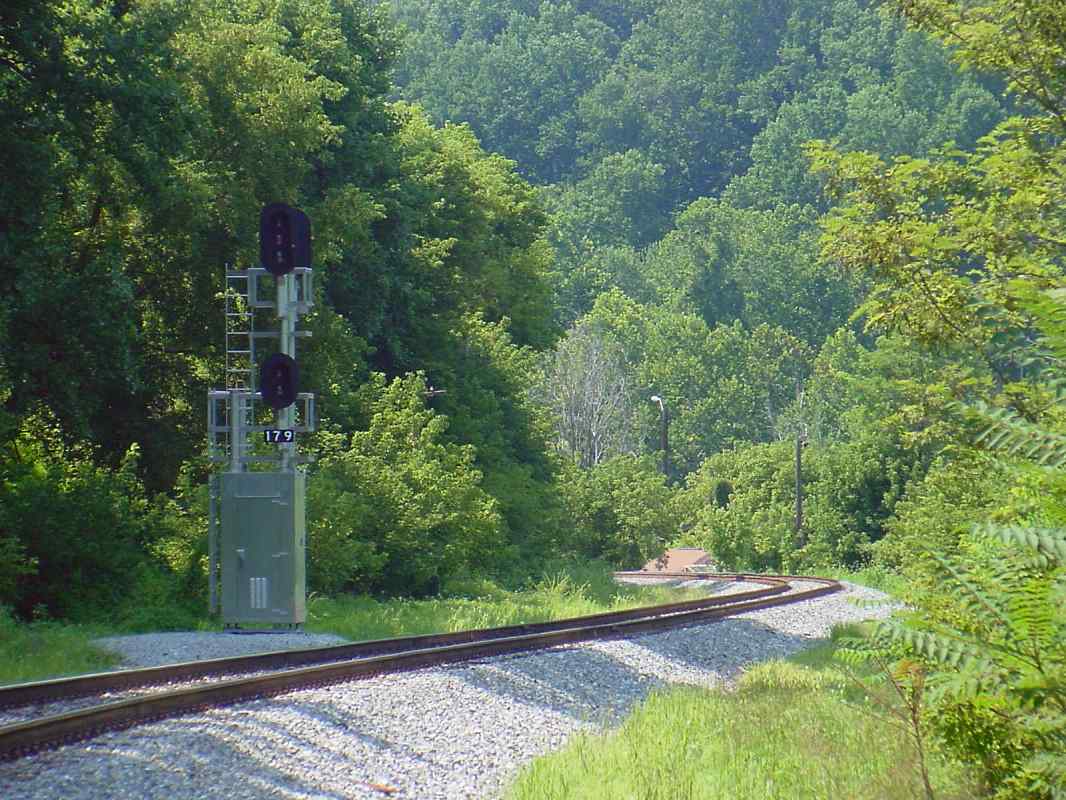
At new signals, an S-curve leads us west into the old town of Daniels. The track here still follows the original 1830 alignment.


From Hillside
Photo courtesy owner Baltimore County Public Library

From Hillside
Mile: 17.6 Date: 1880s
Ease: B View: W
Area: A IC2:
Map: Ho 12 E 1 Topographic Maps

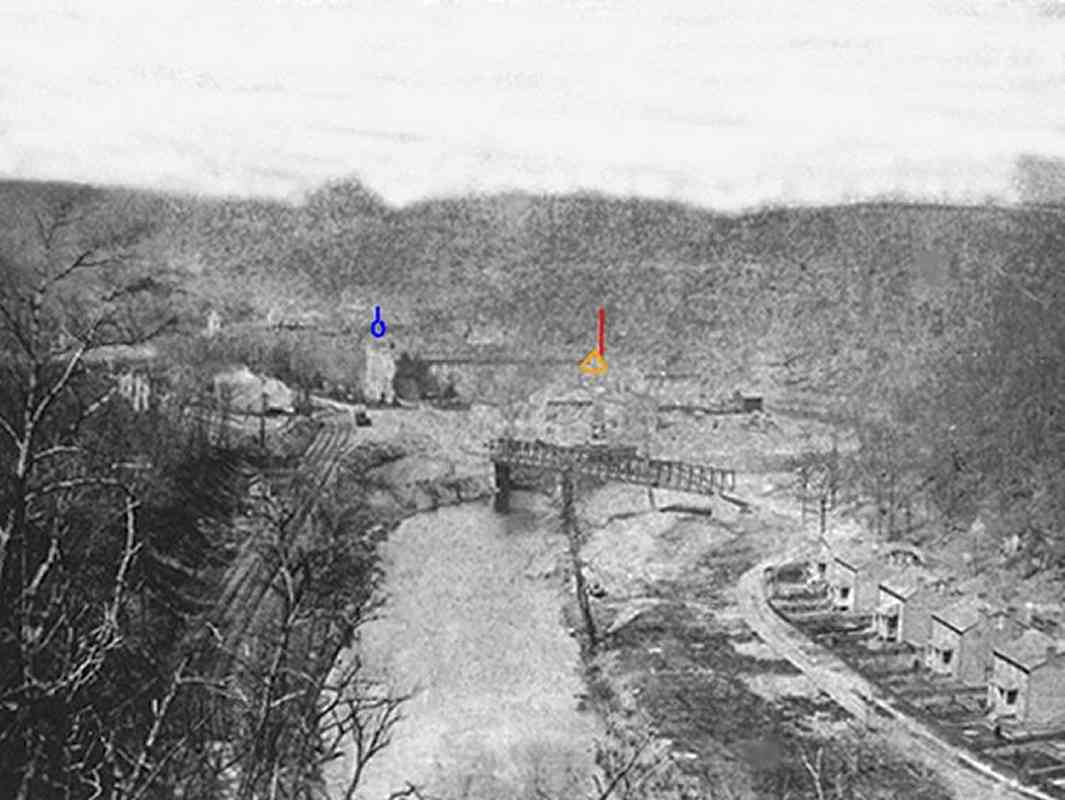
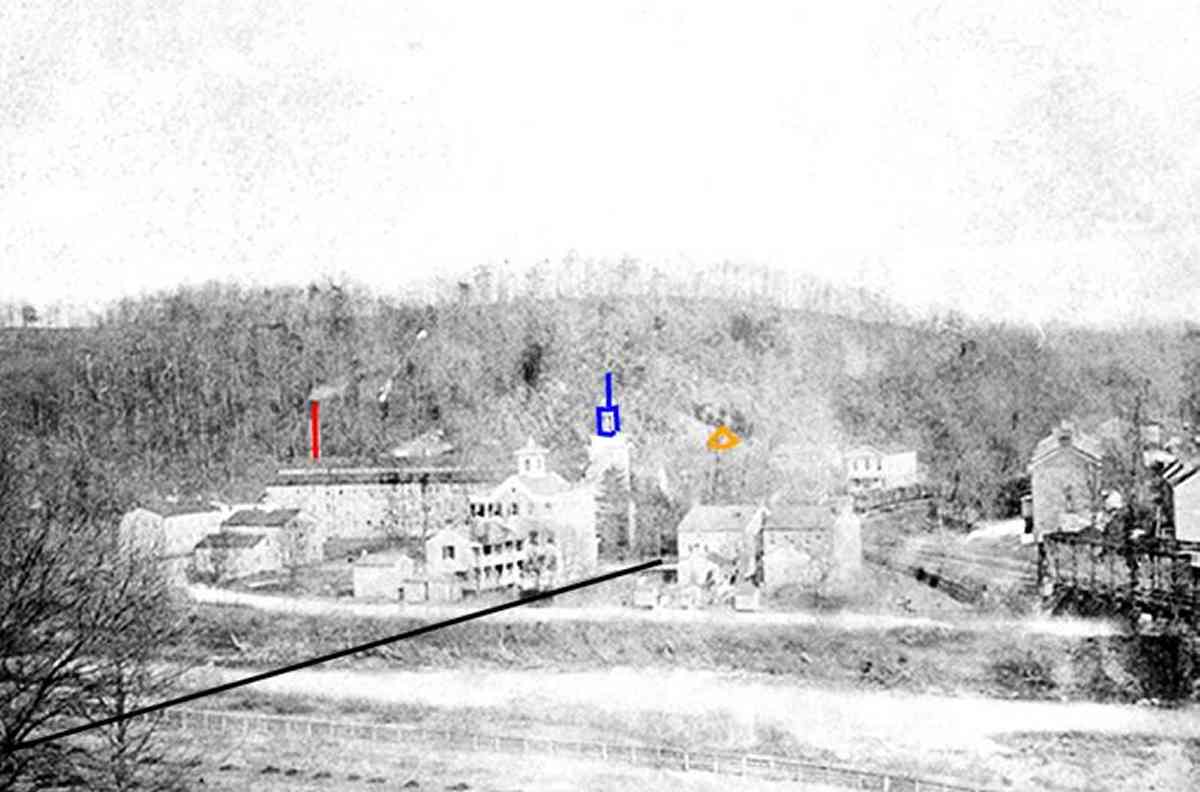
This is the same S-curve (left bank of the Patapsco River) as viewed from the hillside above during the 1880s.

From this vantage point, we can see the Alberton mill complex at center, and employee homes along the north bank of the river. For future reference, the bell tower roof of St. Albans church is marked in orange, the cupola of the mill in blue, and a smokestack in red. The unmarked cupola at the distant left belongs to the manager's house.

The bridge at center is sometimes misattributed as a railroad bridge, but it is actually a road bridge that connects Alberton Road and the mill. A later version of the bridge was washed away in the 1972 Tropical Storm Agnes flood. Debris from that flood, such as a tanker truck, can still be found downstream.

Links to older pictures: similar view in summer ~1900, reverse view 1940


St. Albans Then
Photo courtesy owner Baltimore County Public Library

St. Albans Then
Mile: 17.9 Date: early 20th century
Ease: B View: NE
Area: B+ IC2: 87
Map: Ho 12 D 0 Topographic Maps

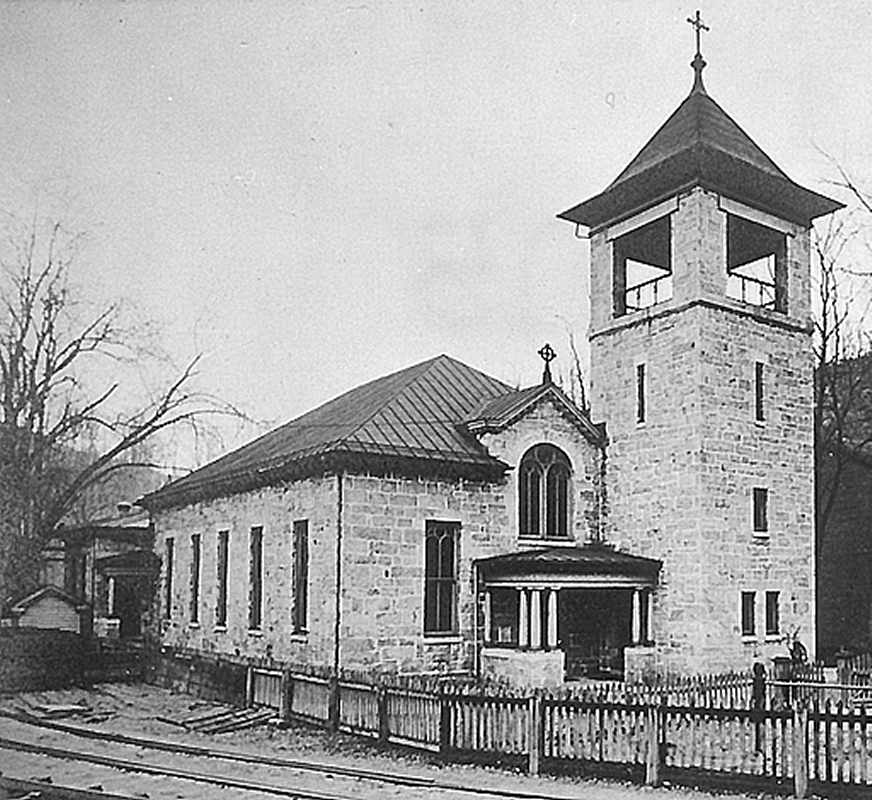
In this early 20th century photo, B&O sidings curve around St. Albans church. The main mill building was located across these sidings (left).


St. Albans Now

St. Albans Now
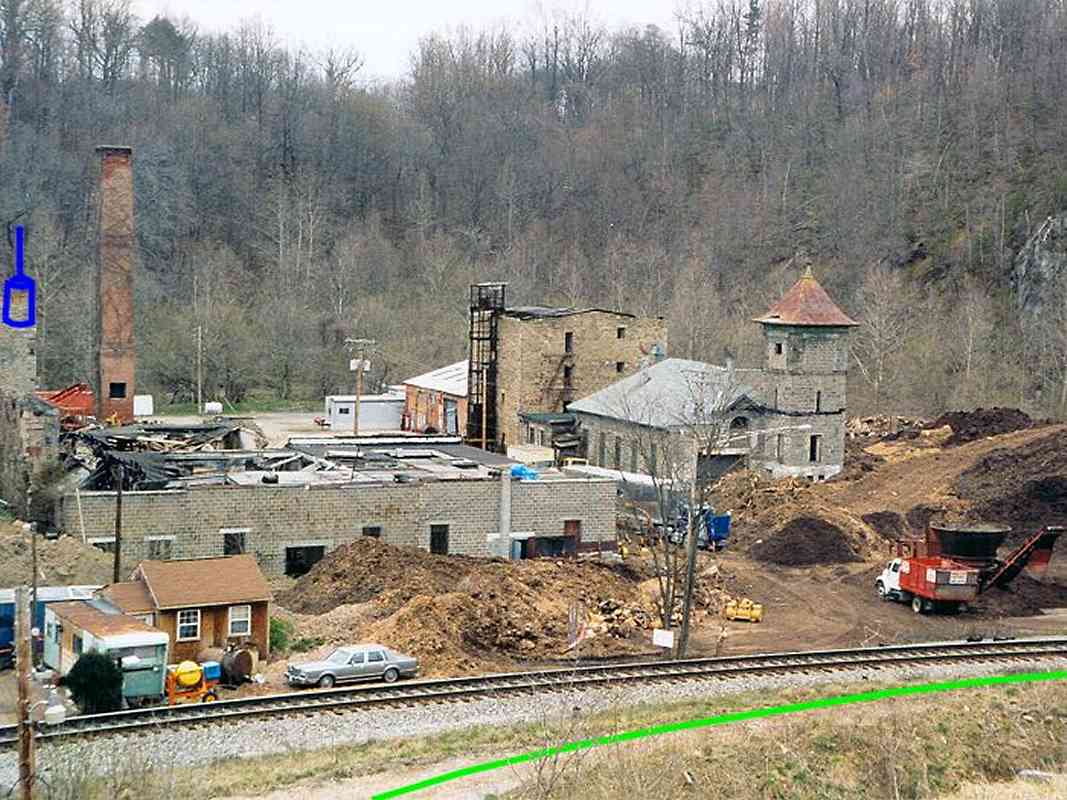
Mile: 17.9 Date: Mar 2000
Ease: B View: NE
Area: B+ IC2: 87
Map: Ho 12 D 1 Topographic Maps

The distinctive roofline of the church's bell tower survives to provide a reference point. The mill's smokestack is also readily visible. The mill building's tall cupola was reportedly airlifted while the 1972 flood was in progress, and is sketched in blue to mark its former location. Does anyone know where it is preserved?

The green line at the bottom depicts the B&O's original circa 1830 alignment in this area.

Links to older pictures: mill's tower ~1880, 1974


Curving

Curving
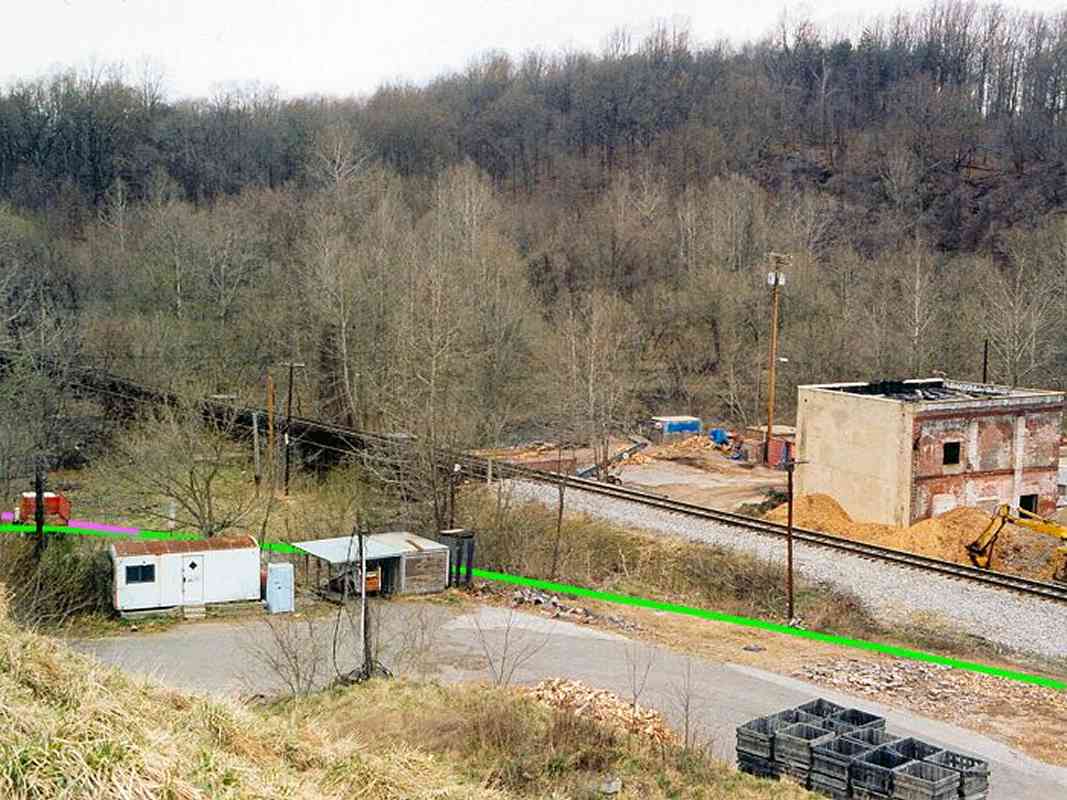
Mile: 17.9 Date: Mar 2000
Ease: B View: NW
Area: B+ IC2: 87
Map: Ho 12 D 1 Topographic Maps

Turning left and looking from the same vantage point as the prior photo, the B&O's original 1830 alignment (green) curves sharply to squeeze between Standfast Hill and the mill race. The resulting screeching of train wheels around the curves convinced the railroad that a straighter alignment was needed (magenta at left).

In the background, the railroad's still active bridge spans the Patapsco River.


First Alignment

First Alignment
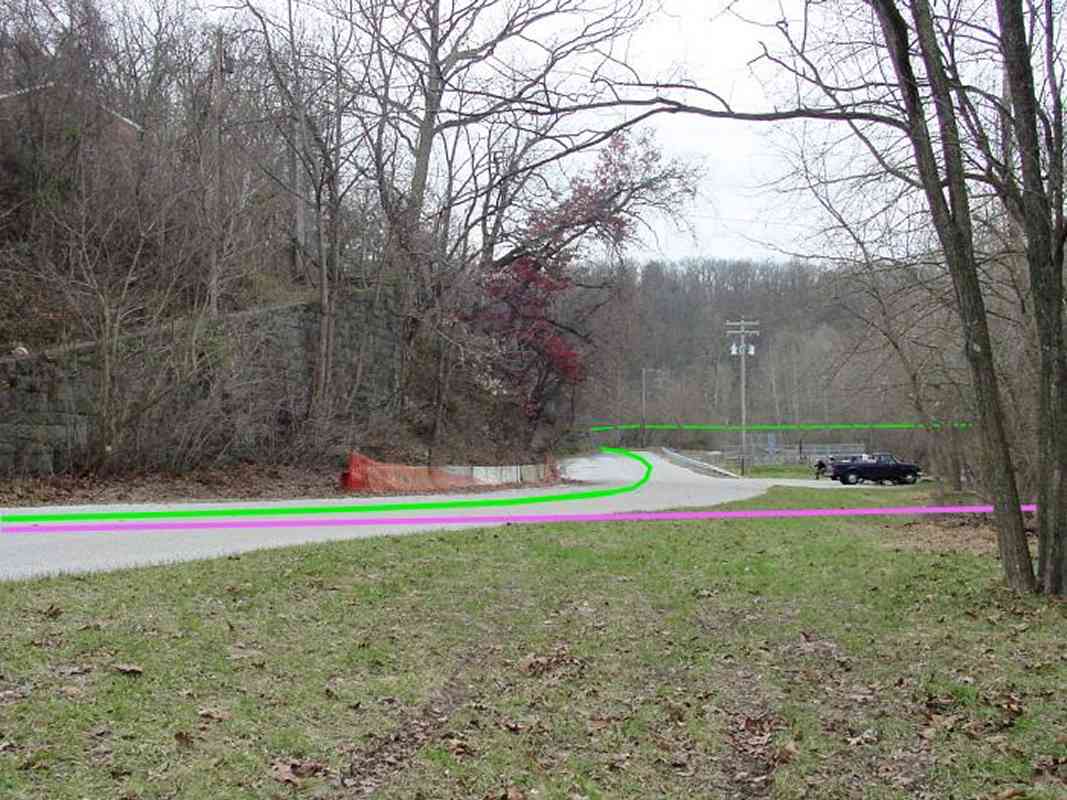
Mile: 18.0 Date: Nov 2002
Ease: A View: S
Area: A IC2:
Map: Ho 12 D 1 Topographic Maps

The original 1830 alignment is now paved over by the north end of Daniels Rd. It followed this road about as far as you can see here, and then turned sharply to the right, paralleling the river upstream.

That first alignment proved so unworkable that before the decade of the 1830s ended, the railroad gave in and constructed two bridges to span the river and reduce the 18-degree curve. The two bridges were named the Lower and Upper Elysville bridges, and spanned the river at unusual angles, allowing the tracks to cross back into Baltimore County briefly.

The magenta line marks the second alignment, and reaches the easternmost bridge pier barely visible at right. Unseen beyond the parked verhicles are a fish ladder and the mill's surviving dam.

Link to older picture: dam ~1880


Daniels Mill
Photo courtesy owner Baltimore County Public Library, photographer Lawrence McNally

Daniels Mill
Mile: 18.1 Date: 1956
Ease: View: NE
Area: A IC2:
Map: Ho 12 D 1 Topographic Maps

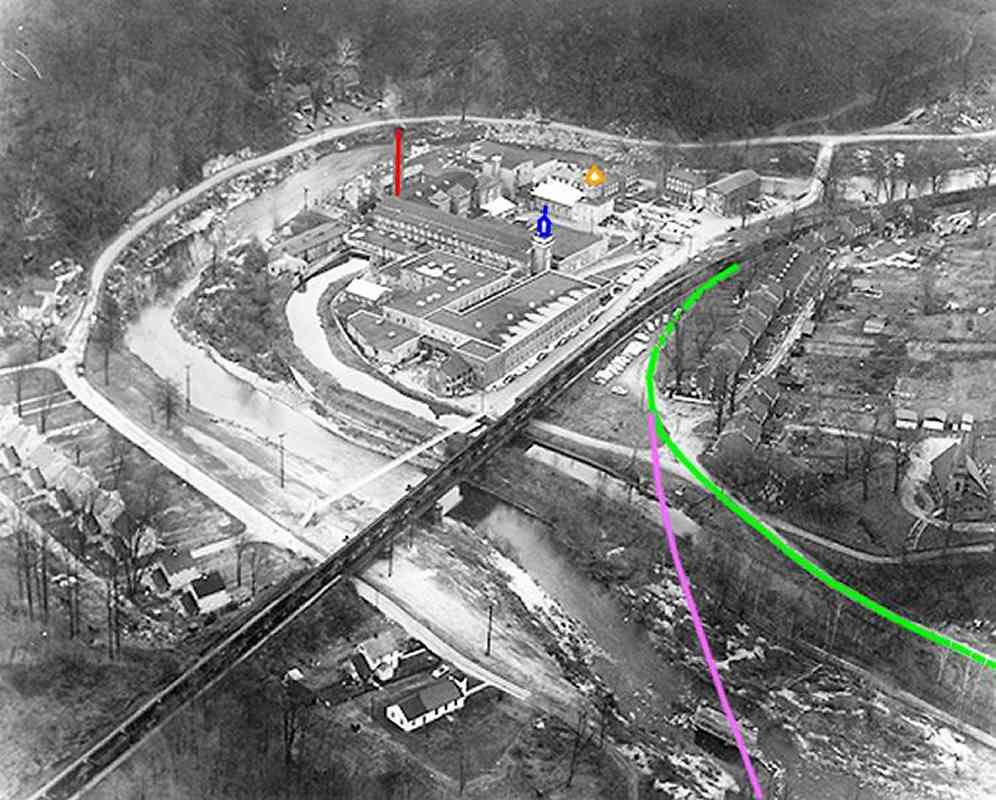
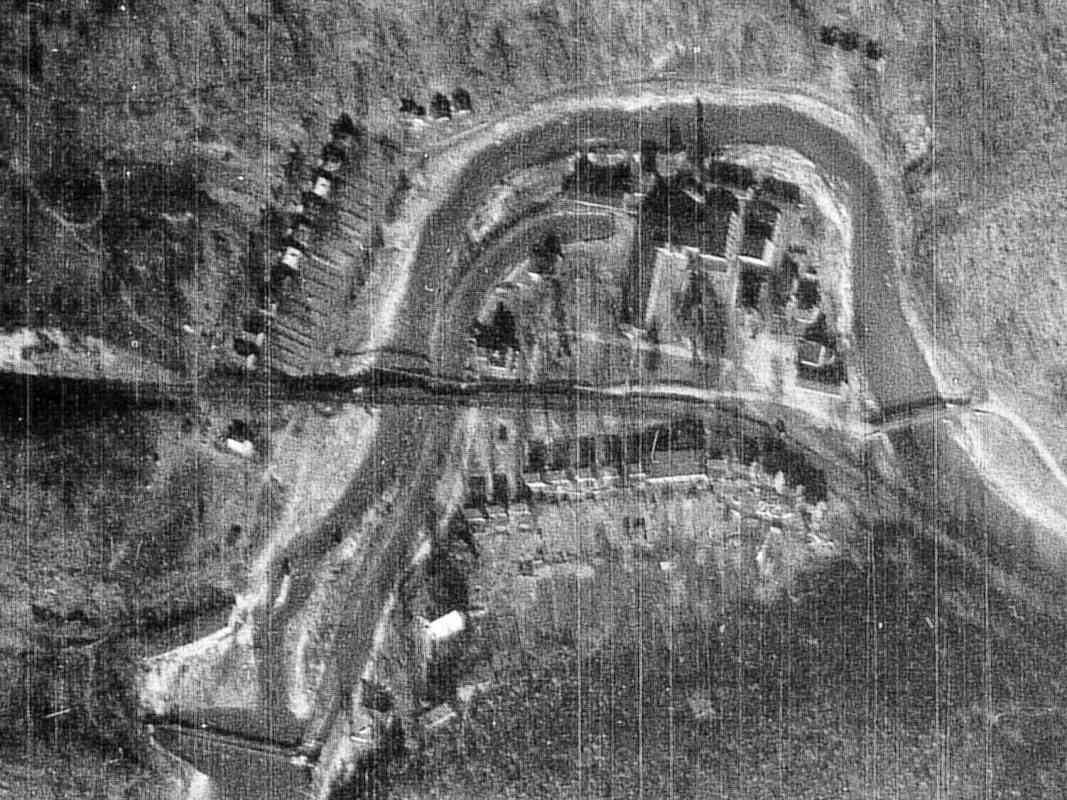
This 1956 aerial photo shows the mill at maximum expansion, about a decade before it would be shuttered. A coal train rides the third and final alignment. At the right edge, the Gary Memorial Methodist church (still active today) sits atop Standfast Hill.

The first alignment (green) curves sharply to squeeze between the hill and the mill race. The second alignment (magenta) crosses the river via the Lower Elysville bridge. A short distance upstream (unseen, below bottom edge of thie photo) the Upper Elysville bridge carried the tracks back across to rejoin the original alignment.

Links: Daniels Area of Patapsco Park, 1972 flood aerial photo, CR Daniels corp web site


Second Alignment

Second Alignment
Mile: 18.0 Date: Nov 2002
Ease: A View: W
Area: A IC2:
Map: Ho 12 D 1 Topographic Maps

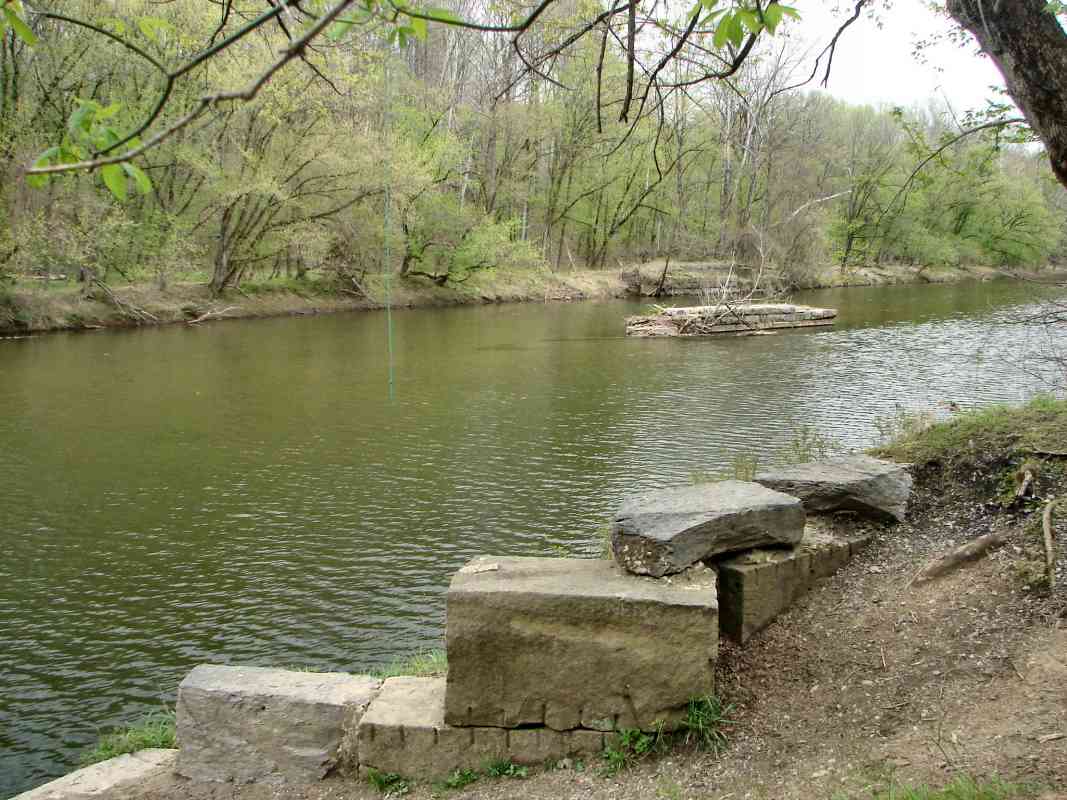
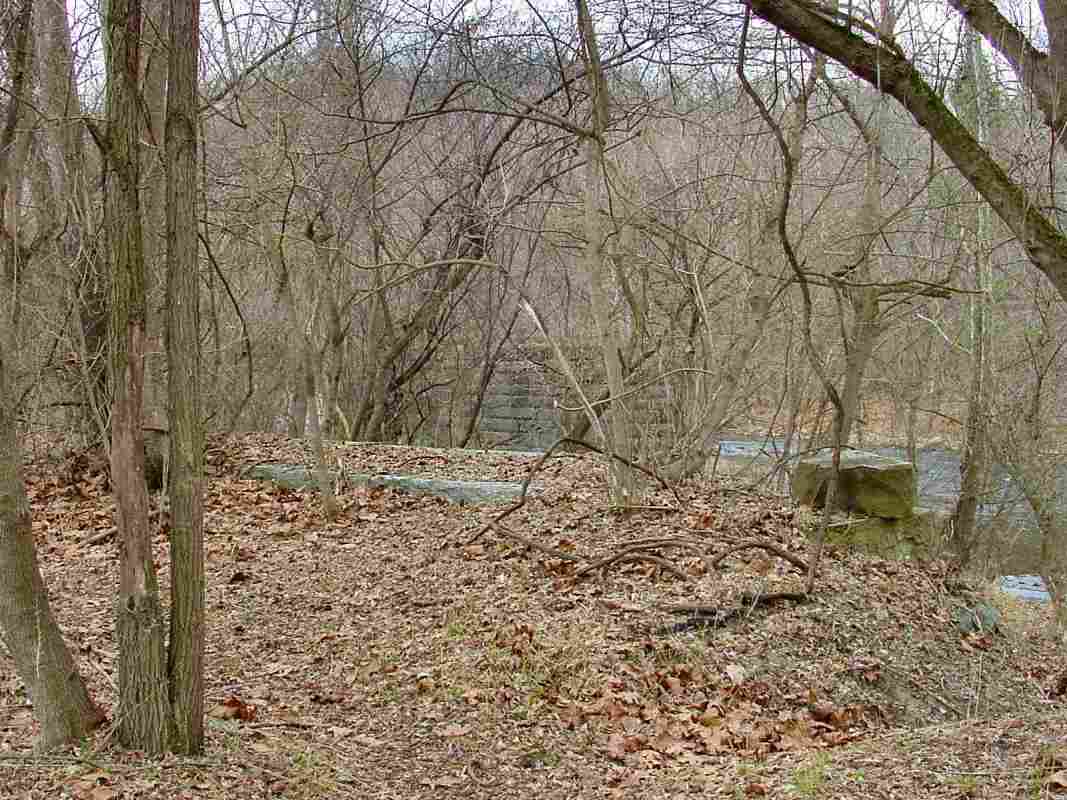
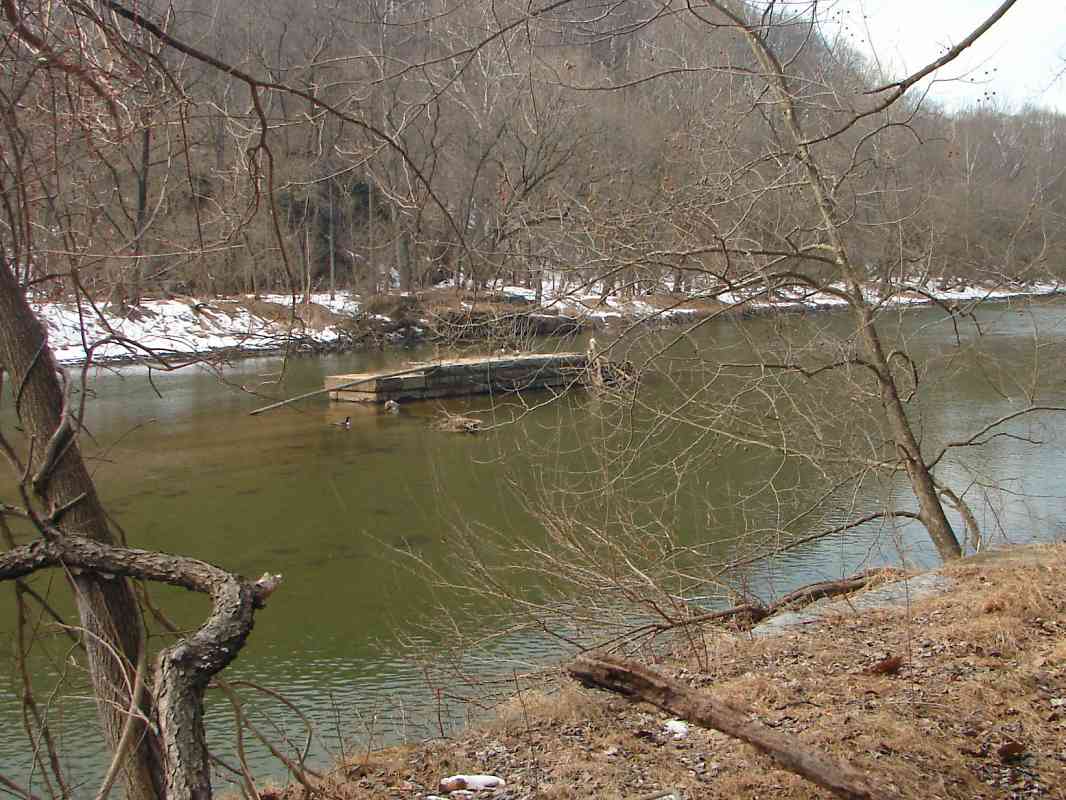
This photo shows the easternmost two of five stone supports of the downstream, or Lower, bridge as they look today from what had been trackside. The town ruins are to the right and behind.


Downstream

Downstream
Mile: 18.0 Date: Apr 1999
Ease: B+ View: N
Area: A IC2:
Map: Ho 12 D 1 Topographic Maps

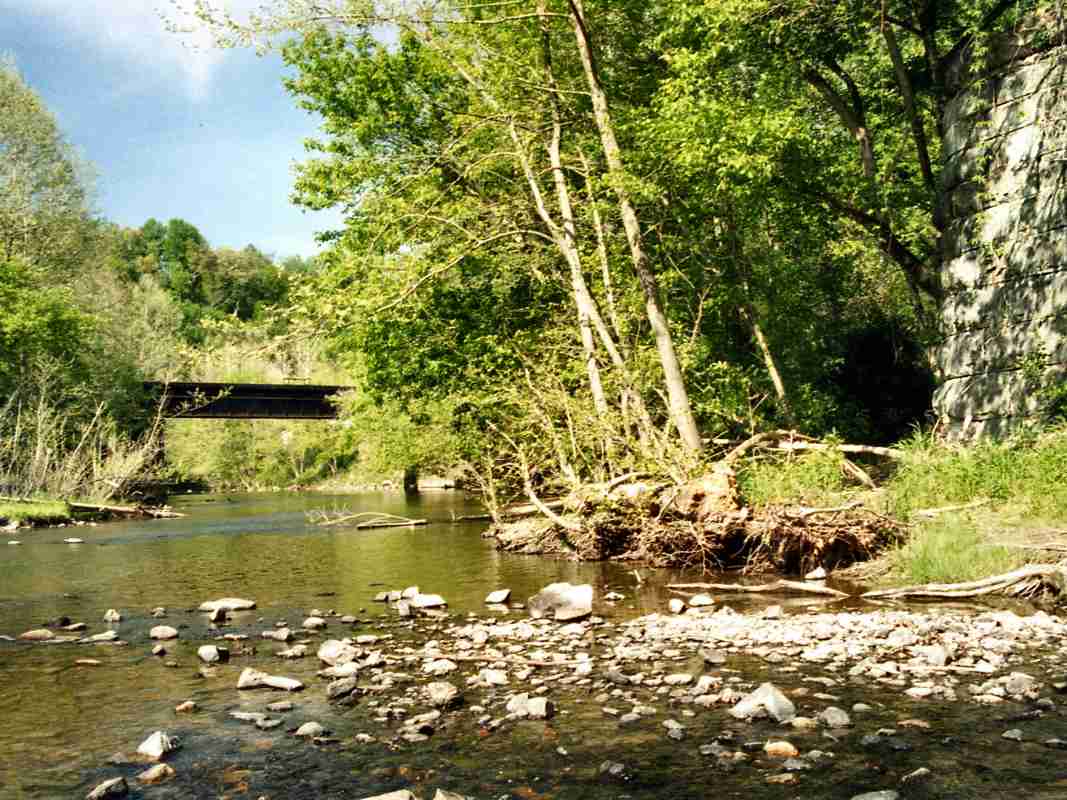
Looking downstream between a pair of Lower Elysville bridge piers gives a glimpse of the active CSX bridge opened in 1906 to further straighten the previous two alignments.

The stone for the Elysville bridges came from the railroad cut at Mt. Airy that was underway at the same time.

Link to older picture: ~1860


Lower Elysville Bridge

Lower Elysville Bridge
Mile: 18.0 Date: Jan 2000
Ease: B+ View: W
Area: A IC2:
Map: Ho 12 D 1 Topographic Maps

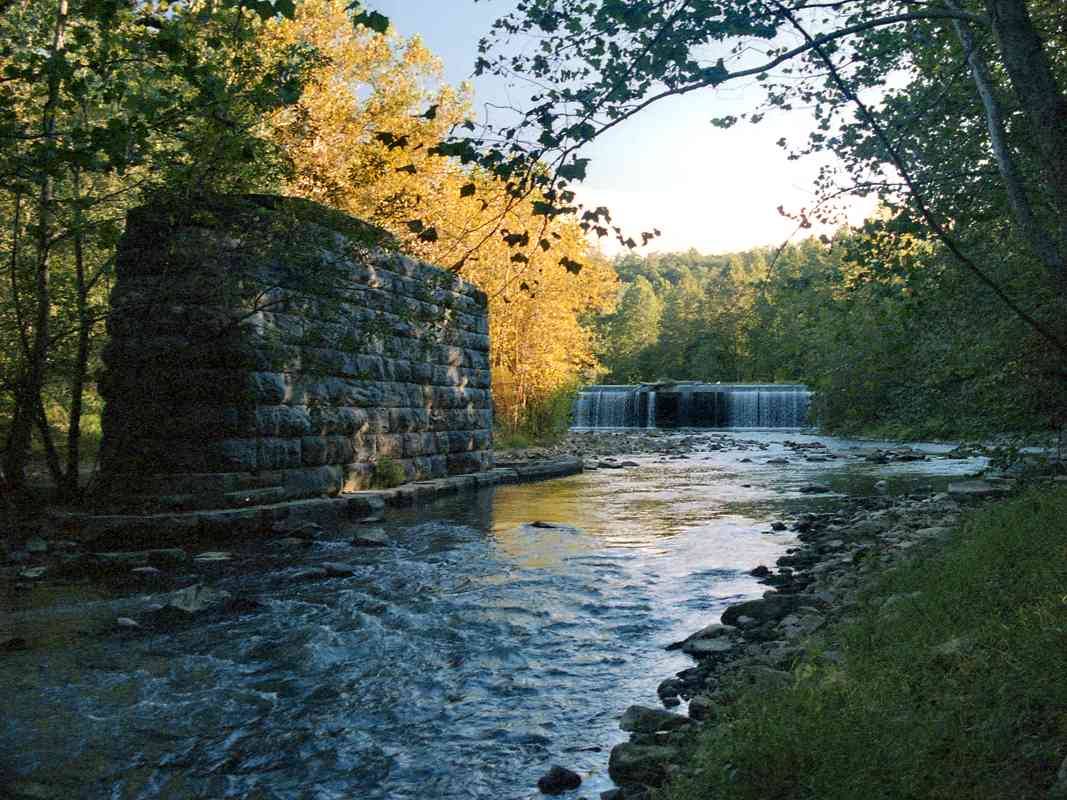
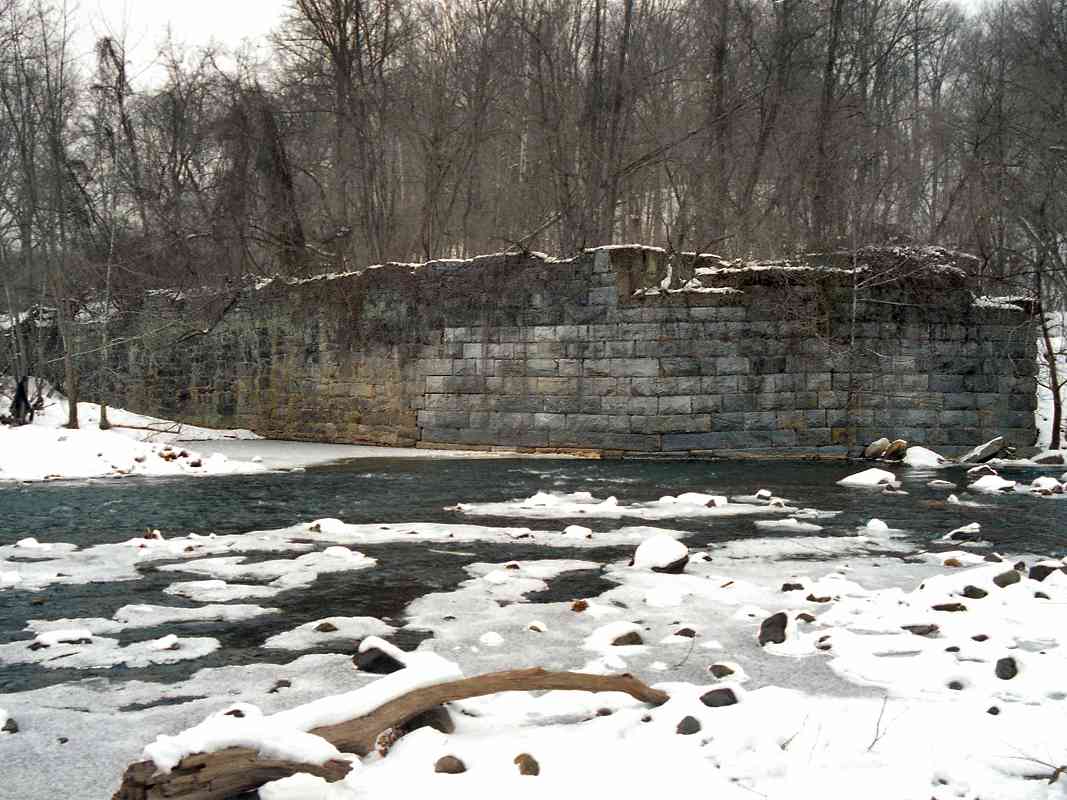
This view shows the westernmost of the five stone supports of the Lower bridge.

Both Lower and Upper bridges were over 300 feet long and designed by Benjamin Latrobe. He based his design on a bridge in Switzerland that employed an odd collection of diagonal struts. In a surprising (for the B&O) cost saving move, the structure atop these stone abutments was built of wood, and was covered.

Unfortunately, the wood proved unacceptable, and in the 1850s was replaced by Bollman truss bridges made of iron. They were the second bridges on this, the second alignment.

These Bollman truss iron bridges, of which the B&O eventually built about 100, contained many diagonal struts. It is possible that Wendell Bollman's classic design was inspired by the original wooden bridges that were here at Elysville.


Alberton Photo courtesy Baltimore County Public Library

Alberton
Mile: 18.1 Date: ~1880s
Ease: View: E
Area: A IC2: 69
Map: Ho 12 D 1 Topographic Maps

By 1870, Elysville had been renamed Alberton, and was busy recovering from the flood of 1868. This view looks back toward the mill (blue) from a western hillside. During the 1800s, the forests along the Patapsco Valley were substantially thinner than now due to logging.

The black line shows where the railroad is today. Note the mill race along the far river bank, and at right the Bollman structure crossing the Lower bridge.

Link to older picture (looking east): locomotive on bridge ~1860


Bollman at Alberton
Photo courtesy Smithsonian Institution

Bollman at Alberton
Mile: 18.0 Date: ~1870
Ease: View: NE
Area: A IC2: 69
Map: Ho 12 D 1 Topographic Maps

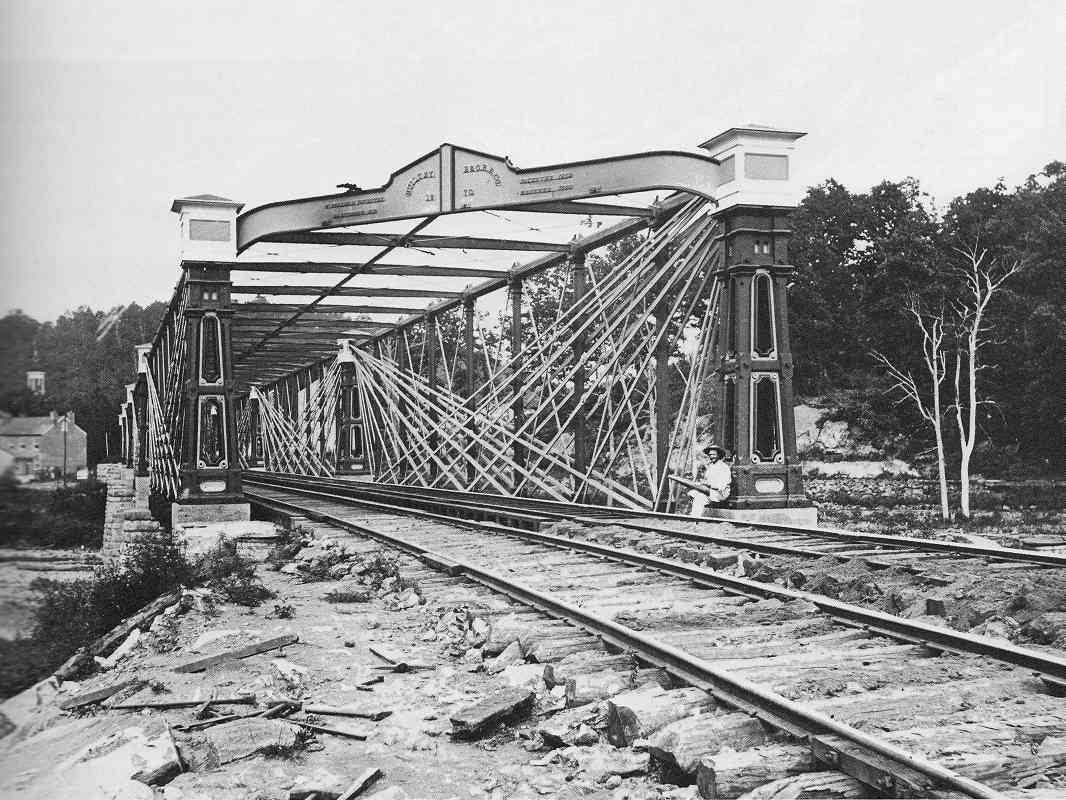
The flood of 1868 washed out the first iron Bollman bridge at this location, necessitating the replacement pictured in this excellent photo. This is the third bridge on the second alignment. Records are incomplete, but as at Ilchester and Frederick Junction, prior to 1906 there may also have been fourth bridge design employed over these piers.

This view looks back toward the town from the west abutment shown in the present day photo above. The cupola seen in the distant left is that of the mill.

Note the ties are roughly hewn, and hand tools can be seen in the foreground left. This could indicate the tracks had been recently laid over the new, replacement bridge. Meanwhile, on the right, a man with a wooden leg relaxes. Working conditions were much tougher in those days, and one can't help but wonder if he lost his leg in a railroad accident.


Upper Elysville Bridge

Upper Elysville Bridge
Mile: 18.3 Date: Mar 2000
Ease: B View: NE
Area: A IC2:
Map: Ho 12 C 1 Topographic Maps

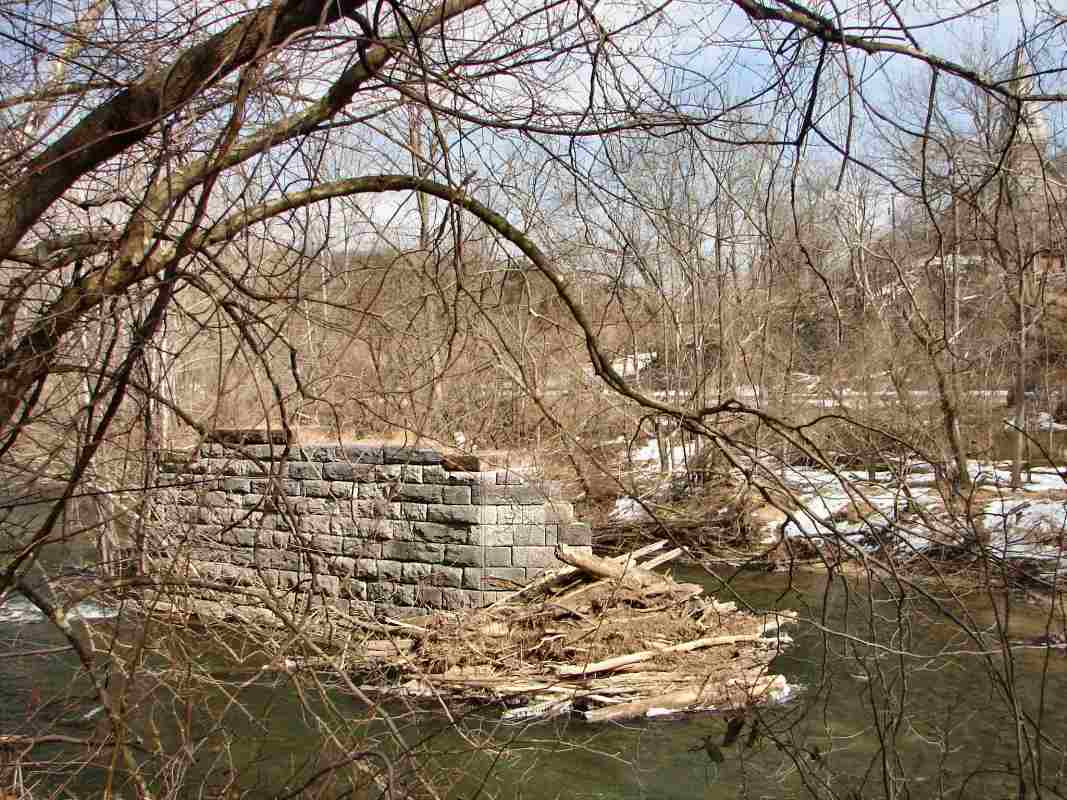
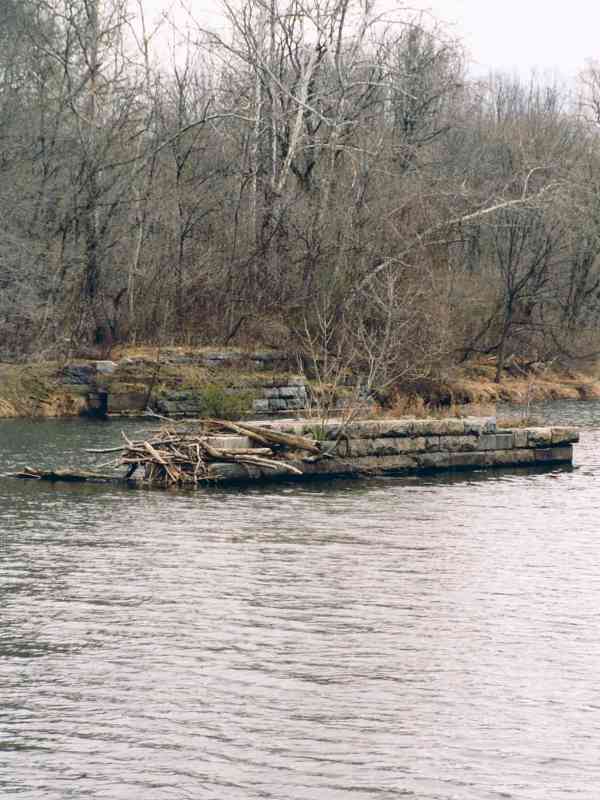
Further upstream, and looking rather the worse for wear are the upper Elysville bridge abutments, part of the second alignment. If you visit, you can find these by following the old dirt road that splits west from Daniels Road a short distance above the dam.


High Water

High Water
Mile: 18.3 Date: Mar 2000
Ease: B View: NE
Area: A IC2:
Map: Ho 12 C 1 Topographic Maps

Same view as prior picture, less zoom. The bridge piers do not extend far out of the water because the B&O knew the river would not get much higher: the mill's dam is a short distance downstream.


Stone Stringers

Stone Stringers
Mile: 18.8 Date: Mar 2000
Ease: C+ View: NW
Area: A IC2:
Map: Ho 12 B 1 Topographic Maps

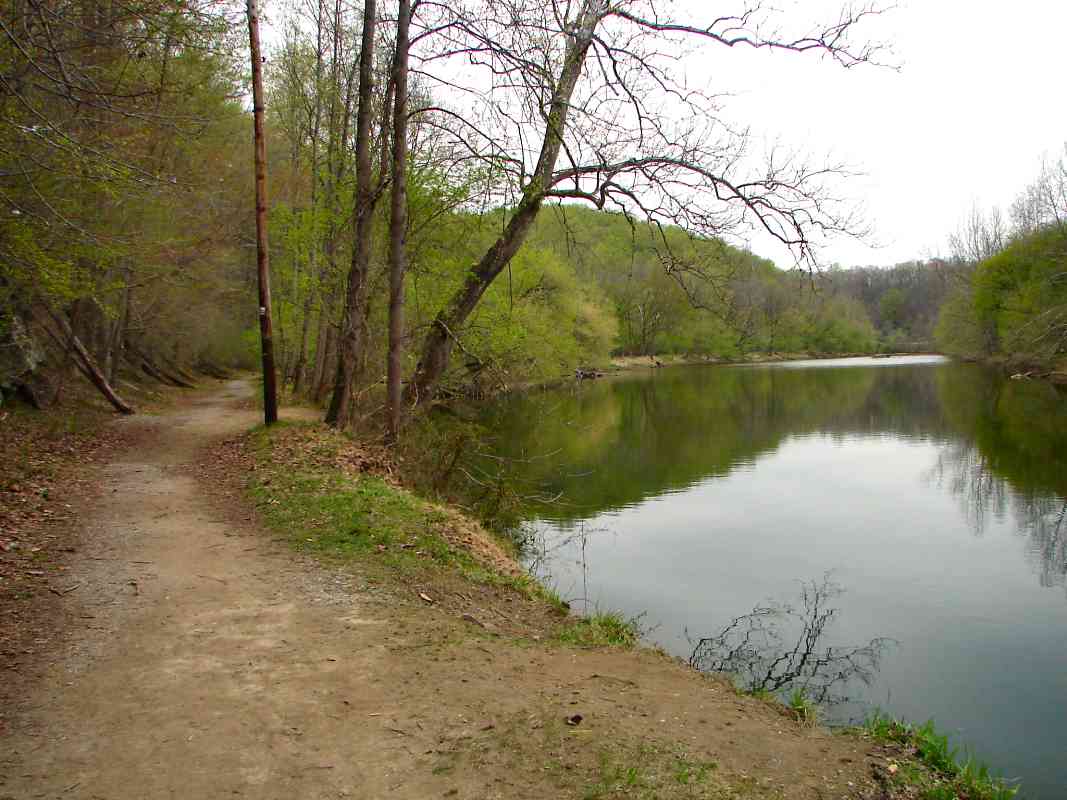
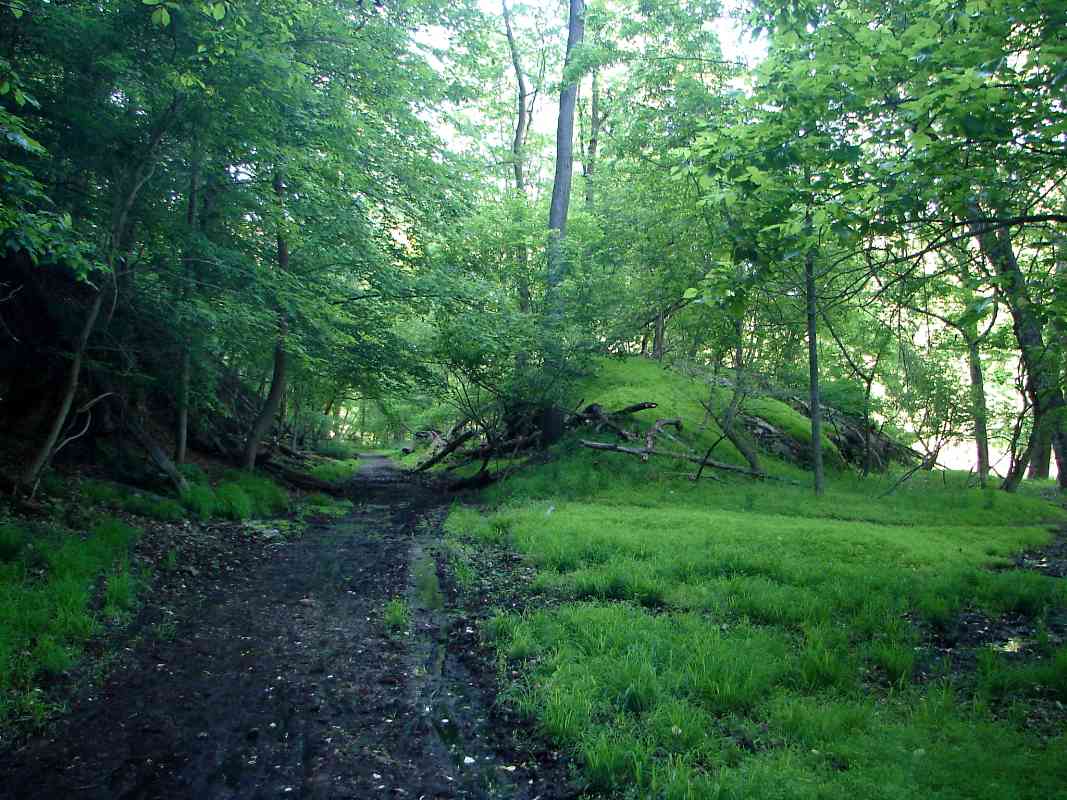
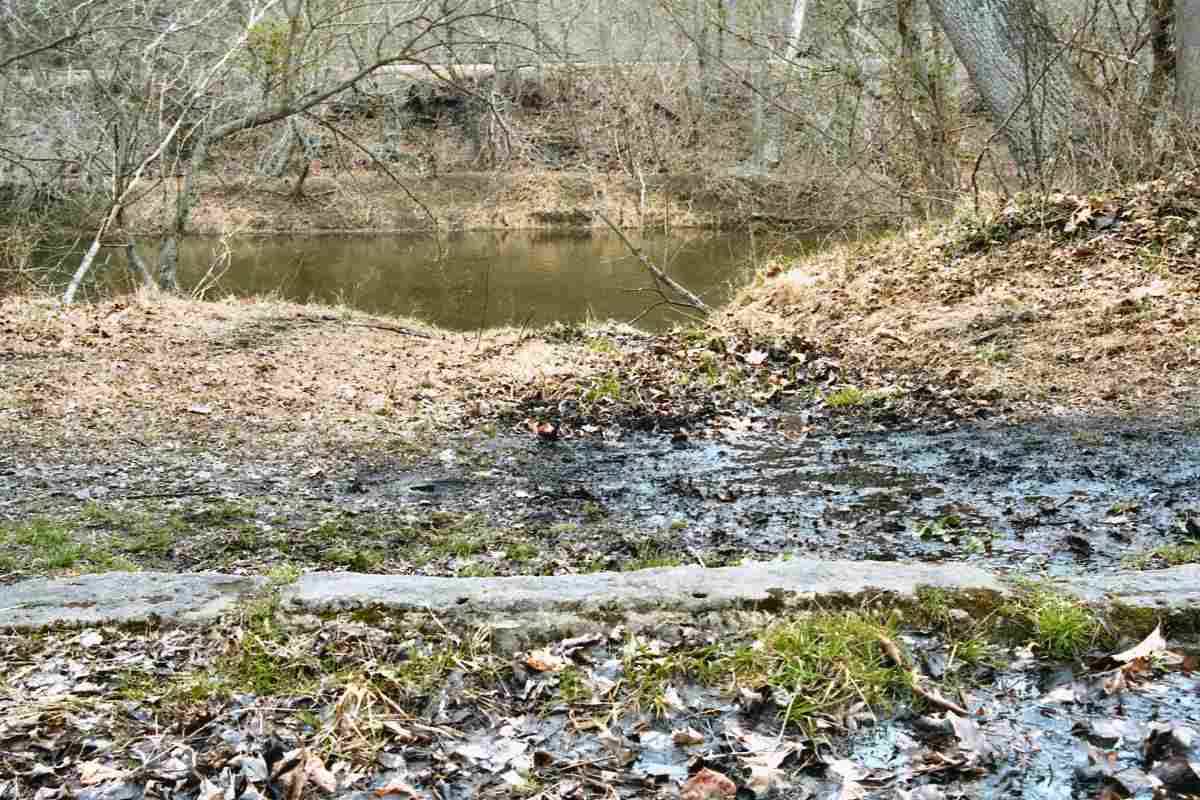
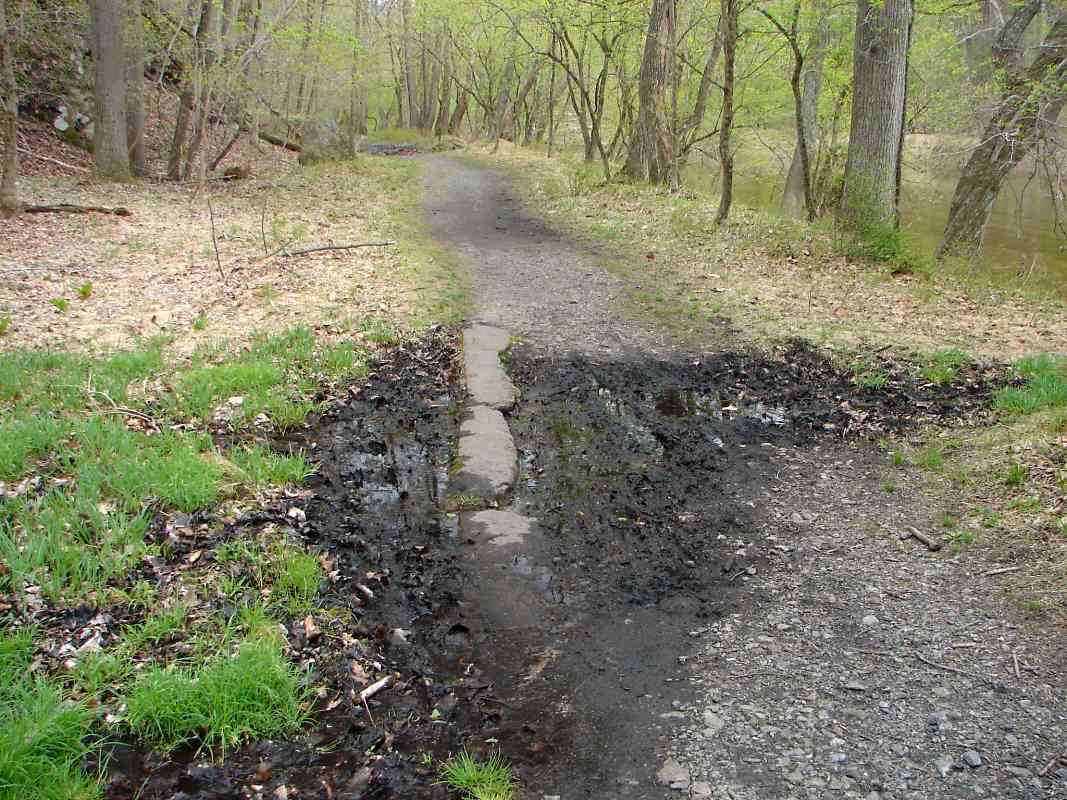
Here, west of Daniels, as at Ilchester, the original stone stringers have worked their way to the surface at several locations along the bypassed right-of-way. In this photo, they are shown in the foreground while the current route can be seen across the river. If you visit this area, be prepared for muddy spots.


Arched Bridge

Arched Bridge
Mile: 19.0 Date: Mar 2000
Ease: C View: N
Area: A IC2:
Map: Ho 12 A 1, Ba 31 K 9 Topographic Maps

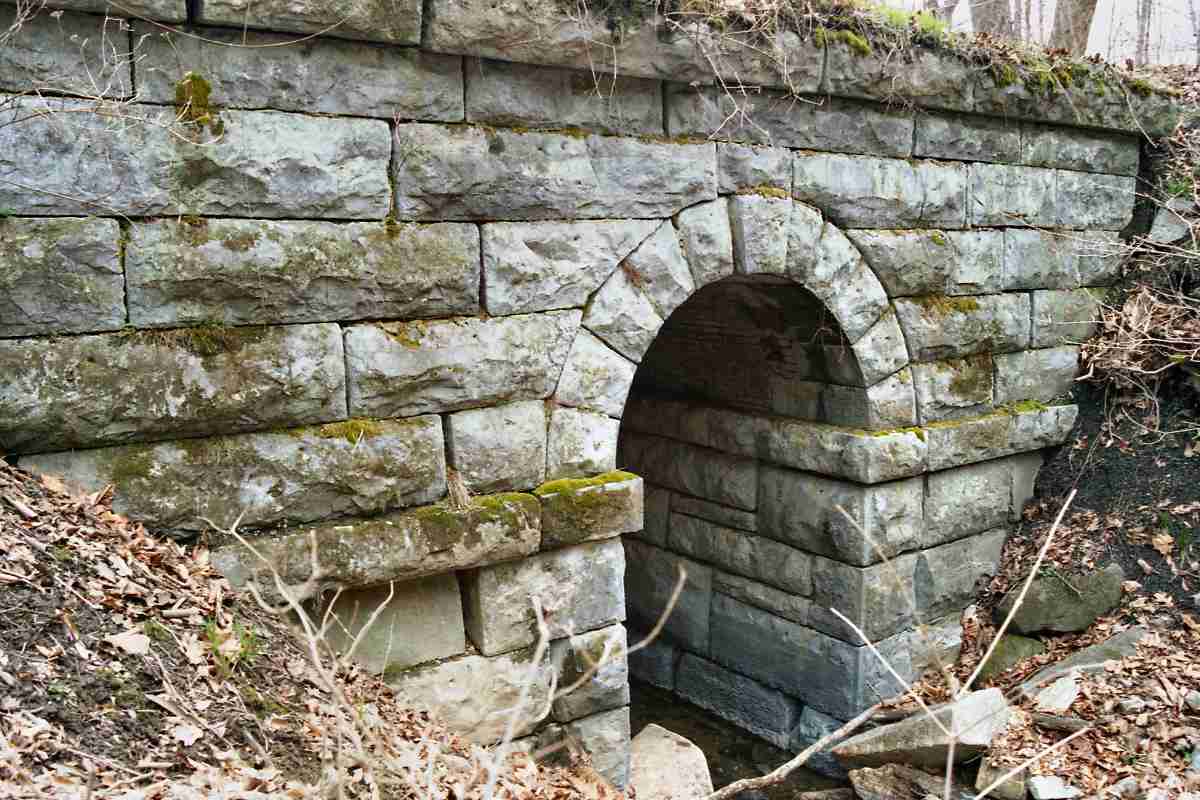
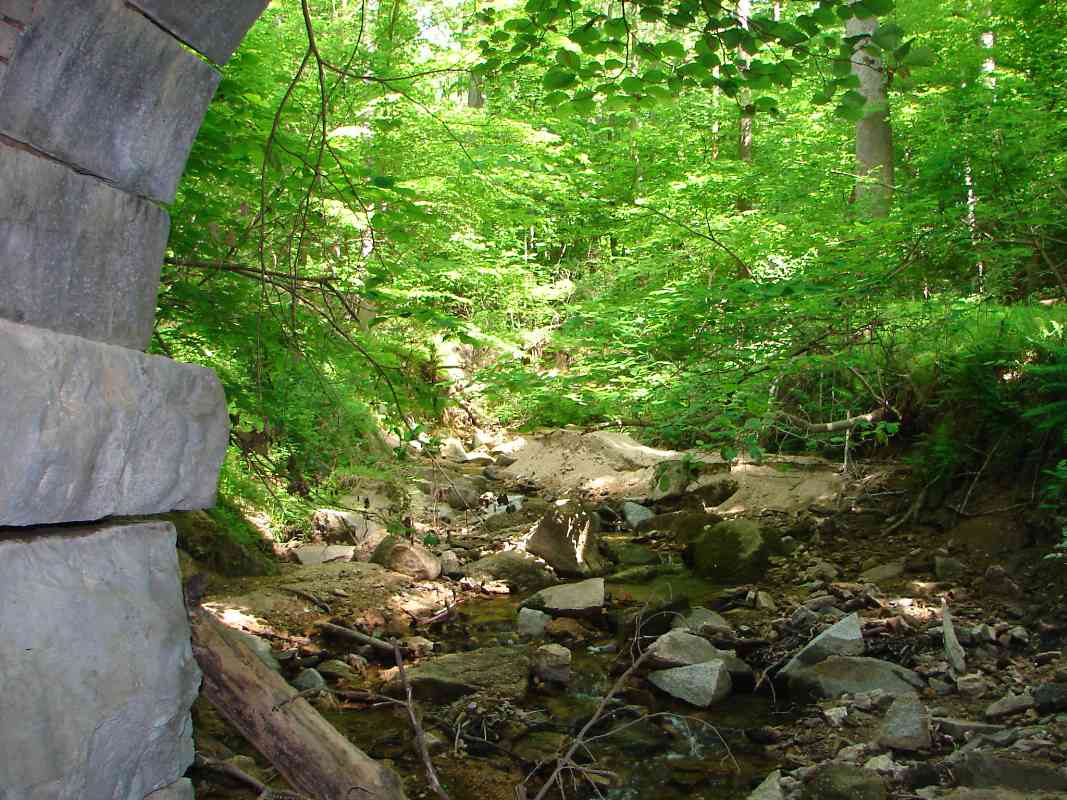
By continuing west along the abandoned right-of-way you'll find this attractive, arched granite bridge. Trains haven't been through here for about 100 years, yet this bridge looks as good as new. Note the nicely squared blocks and lack of mortar, both of which indicate this is an original bridge dating to around 1830. This is the smallest bridge along the OML to receive a stone arch.


Scenic Bridge

Scenic Bridge
Mile: 19.0 Date: Dec 1999
Ease: D View: SE
Area: A IC2:
Map: Ba 31 K 9, Ho 12 A 1 Topographic Maps

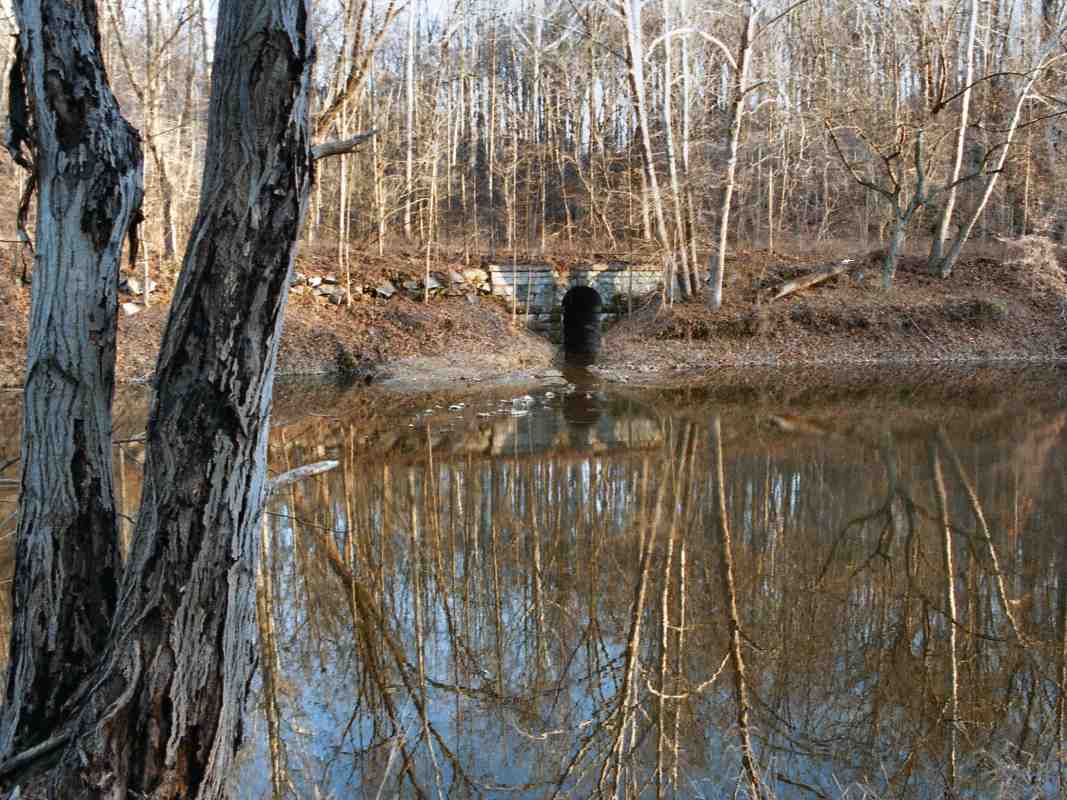
Here's the same bridge as seen from the Baltimore County (north) side. The beautiful setting makes me wish I could have also captured the reflection of a steam engine puffing away as it hauled goods upstream.


Scenic Zoom

Scenic Zoom
Mile: 19.0 Date: Dec 1999
Ease: D View: SE
Area: A IC2:
Map: Ba 31 K 9, Ho 12 A 1 Topographic Maps

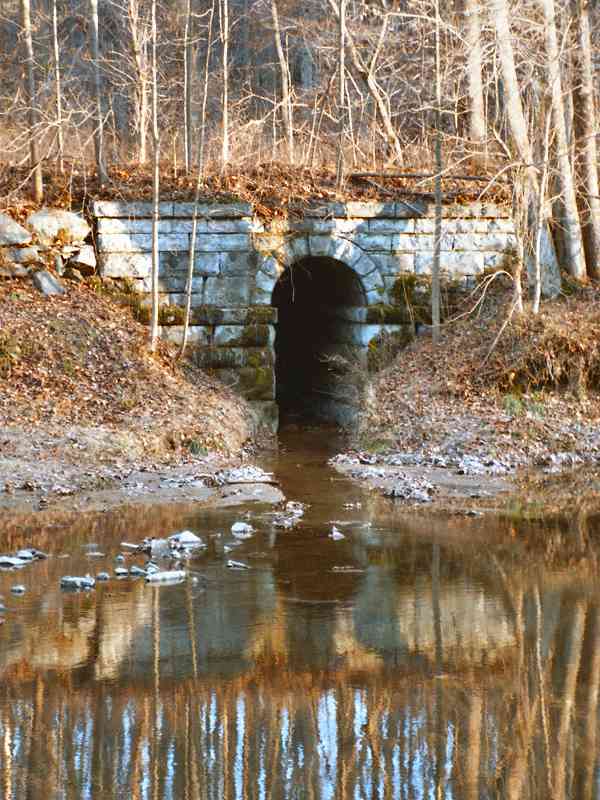
Same bridge, zoomed in close enough to see the moss clinging to its sides.


Enigma
Updated May 2010

Enigma
Mile: 19.4 Date: Nov 2003
Ease: C View: SE
Area: A IC2:
Map: Ho 12 A 1 Topographic Maps

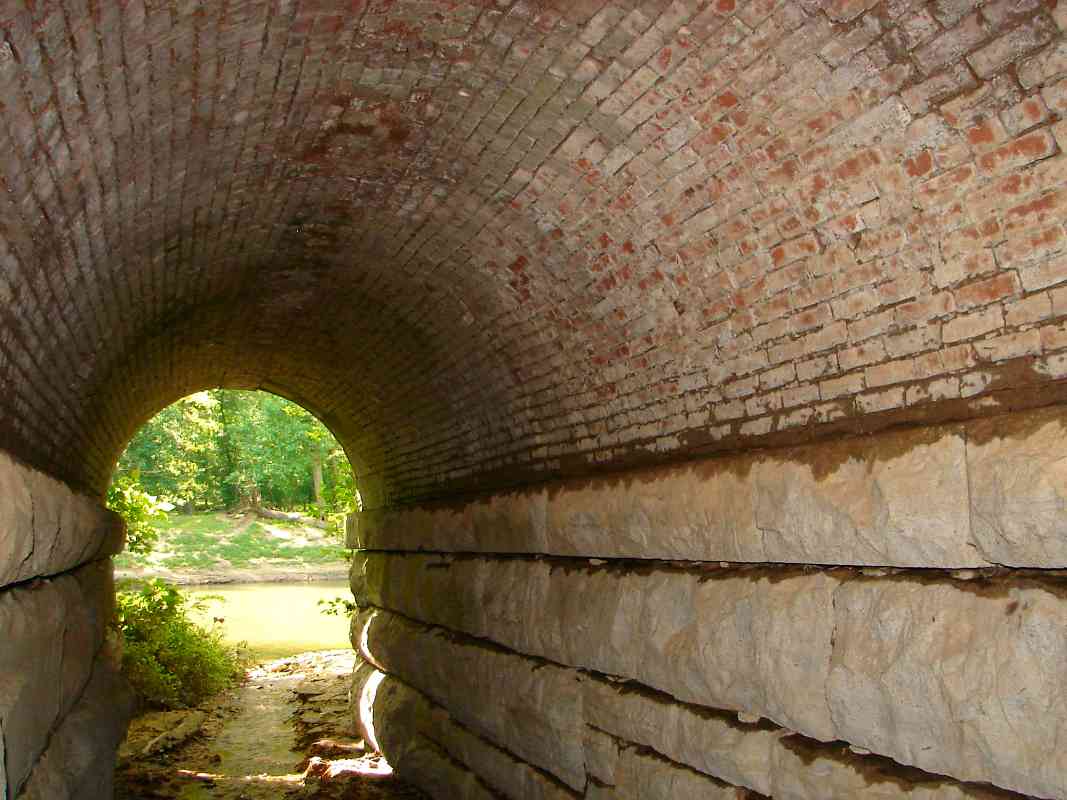
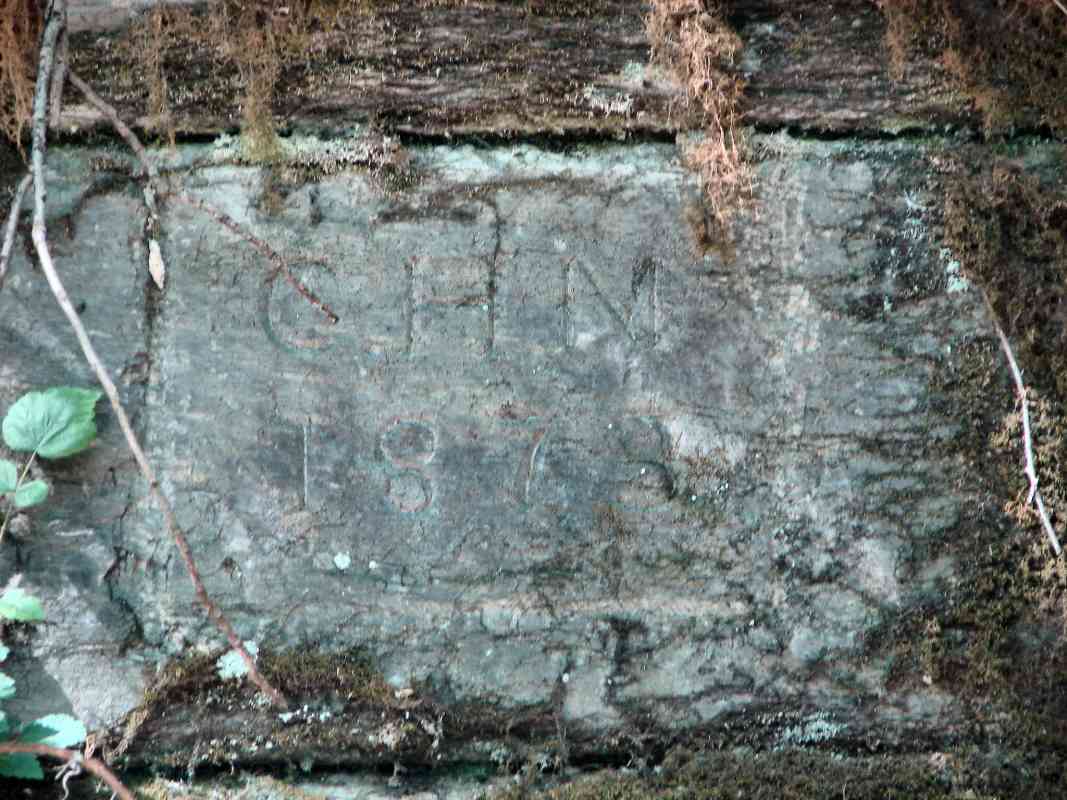
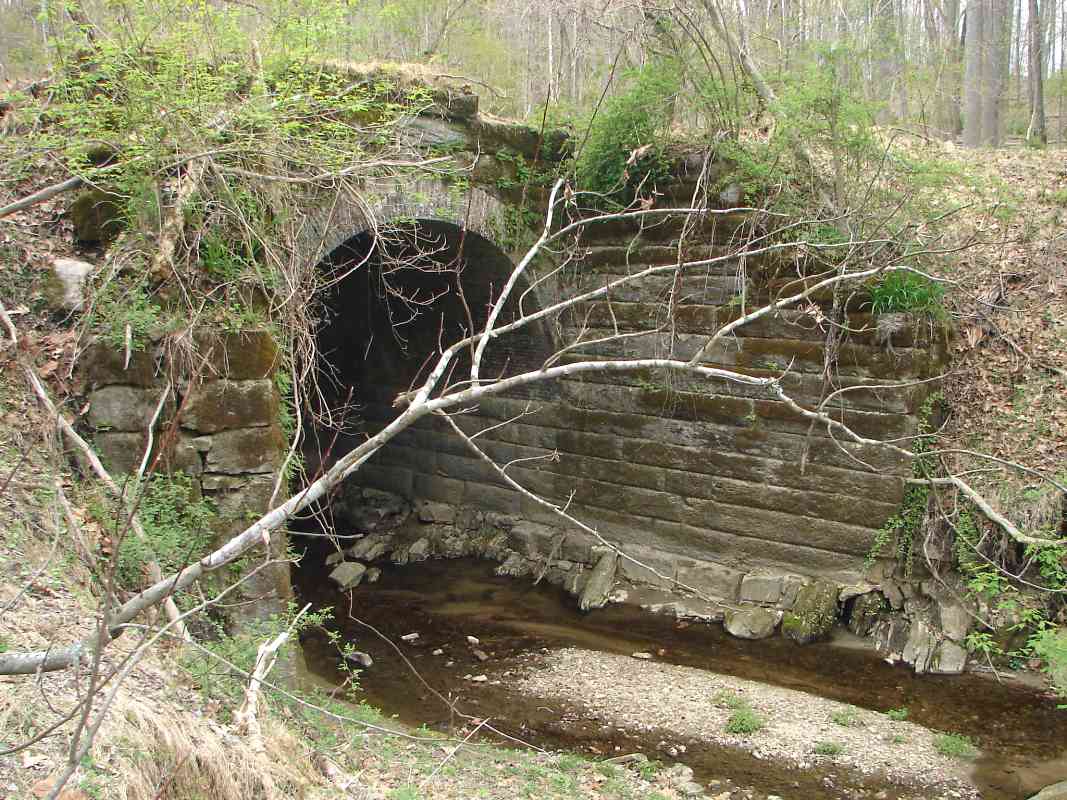
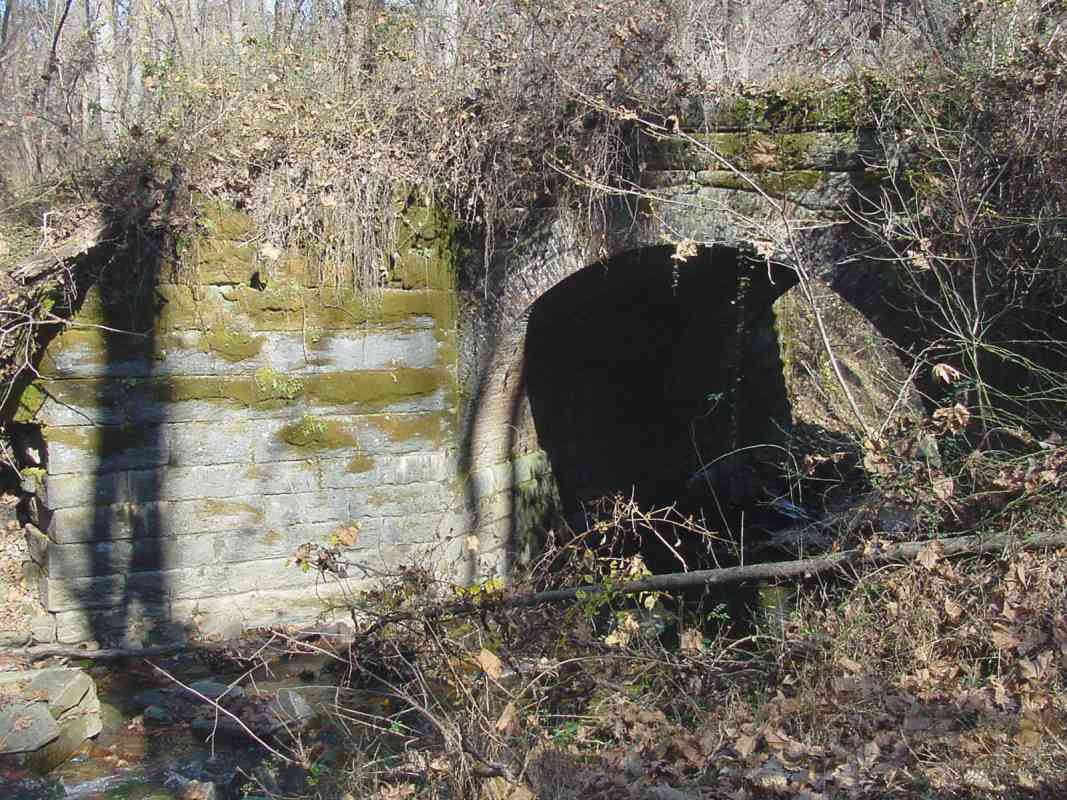
This brick arch bridge is an enigma. I do not know of any brick B&O bridges that date to the 1830s, so I suspect this one was constructed later, either as part of a subtle realignment or to replace a washed out bridge. The granite foundation appears to be dry fit (sans mortar) a style well represented by other examples that date to the 1830s. Perhaps only the arch failed and was replaced.

Perhaps a clue about the origin comes from speculation by reader Adam Litecky:

    "This brick arched bridge is indeed different from the other bridges on the OML. On the western end of the northern support wall there is an engraving that may shed some light on this oddity. Carved into the stone it reads 'C.H.M. 1873'. The reason for the repair or reconstruction is unknown to me but by the engraving, this suggests significant work was done in that year. It could possibly be part of the alignment that corresponds with the construction of the lower and upper Elysville bridges. The cut just north of this bridge I believe served a work camp for the B&O when they built the final alignment that consists of the Davis and Dorsey tunnels and the Eureka and Daniels bridges. It appears that the entire area near the cut and across the river has been extensively graded at one point to accommodate workers and equipment. I have seen a 1911 or 1912 Howard County road map that shows the alignment tracks, the OML tracks, and the loop that served the camp. The map is located at the Howard County Historical Society."


Cut

Cut
Mile: 19.4 Date: Nov 2003
Ease: C View: NW
Area: A IC2: 204
Map: Ho 12 A 1 Topographic Maps

Hillside cuts along the 1830 right-of-way are rare, but not unknown. While this one's proximity to the enigma bridge supports the idea of a later realignment, until I can find further evidence I am assuming this cut is original.

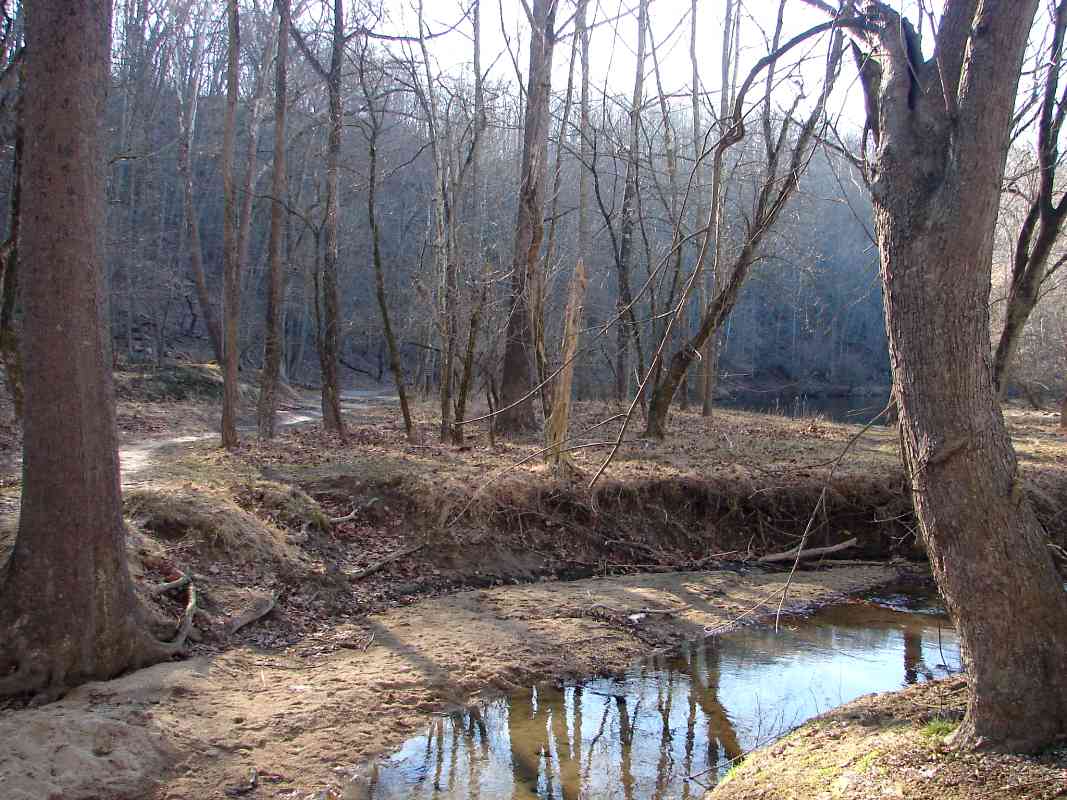
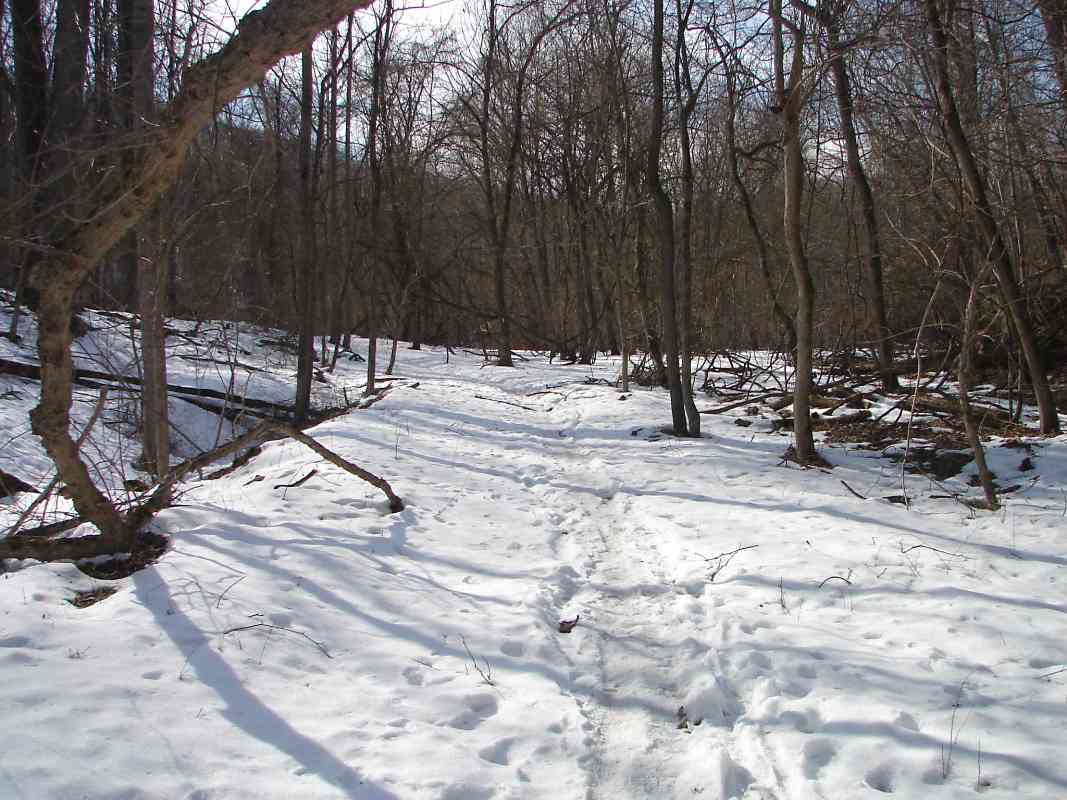
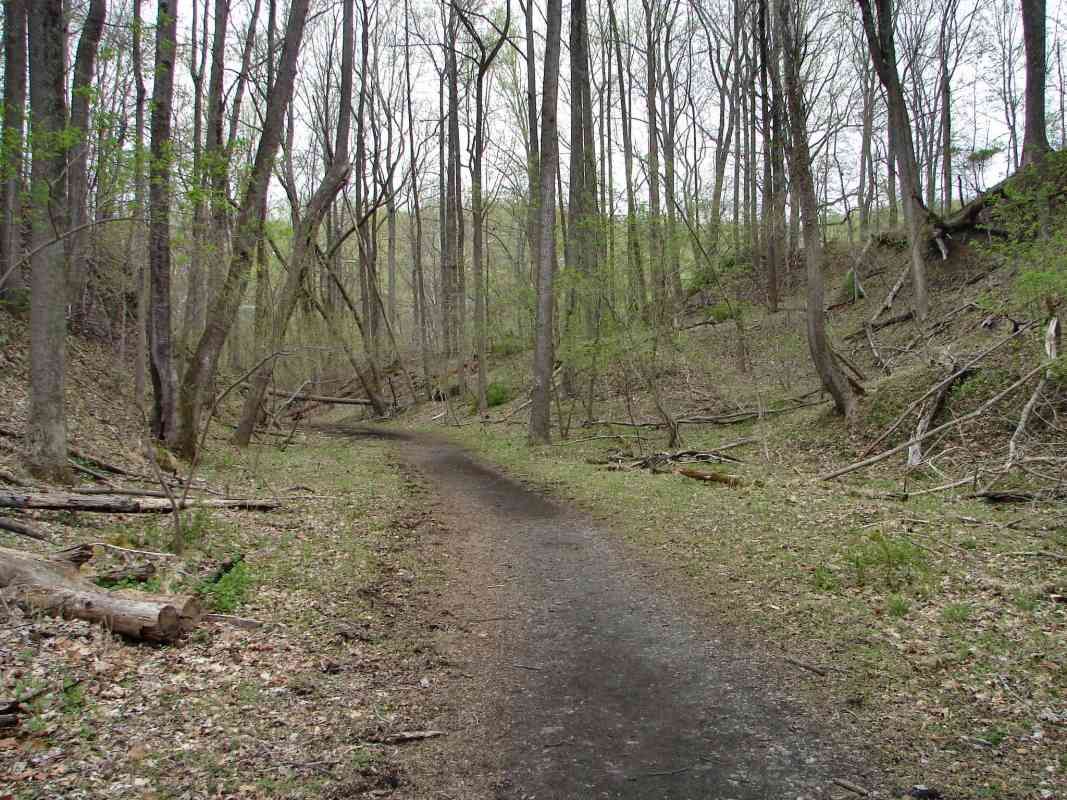
Though disused by the railroad for over a century, the original alignment lives on as a walking path through Patapsco State Park. It's muddy in spots but otherwise a recommended walk accessible from Daniels Road. You may even see some CSX train action across the river.


Eureka Bridge

Eureka Bridge
Mile: 19.7 Date: Dec 1999
Ease: C View: N
Area: A IC2:
Map: Ho 11 K 0 Topographic Maps

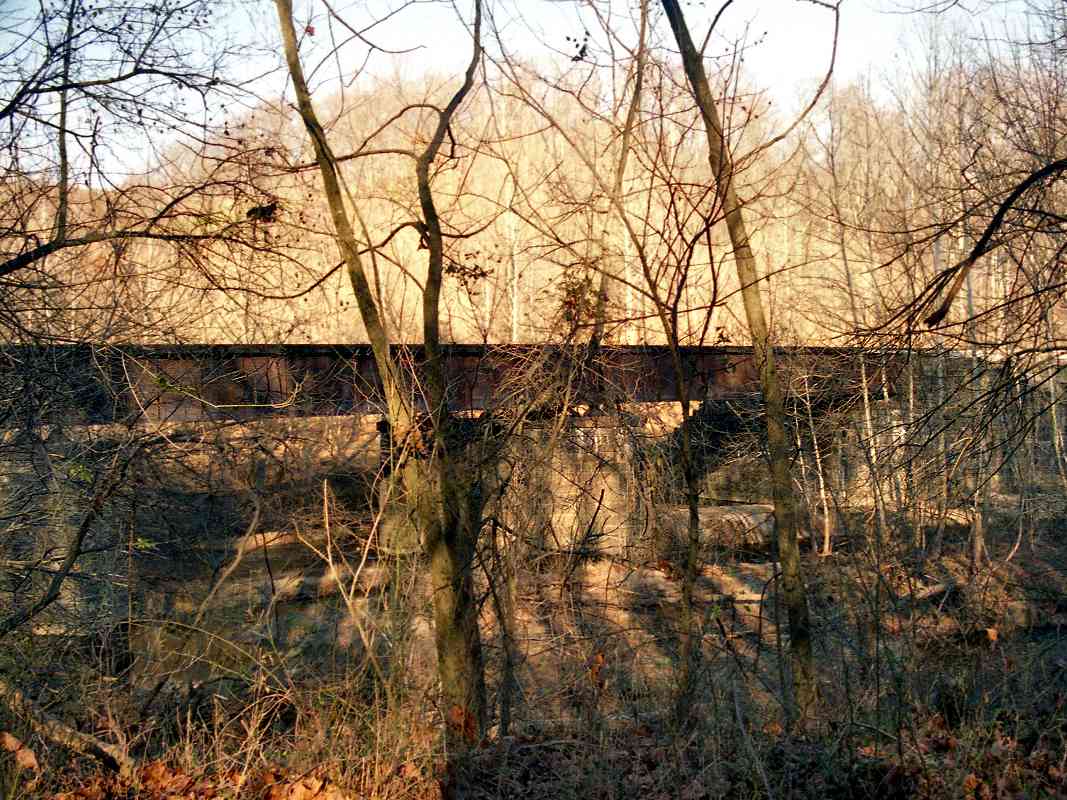
Eventually the original alignment and its 1906 successor will meet, but before doing so the latter must cross the Patapsco River via Eureka Bridge, named for the mining company that had operated here.


Meet

Meet
Mile: 19.8 Date: Dec 1999
Ease: C View: E
Area: A IC2:
Map: Ho 11 K 0 Topographic Maps

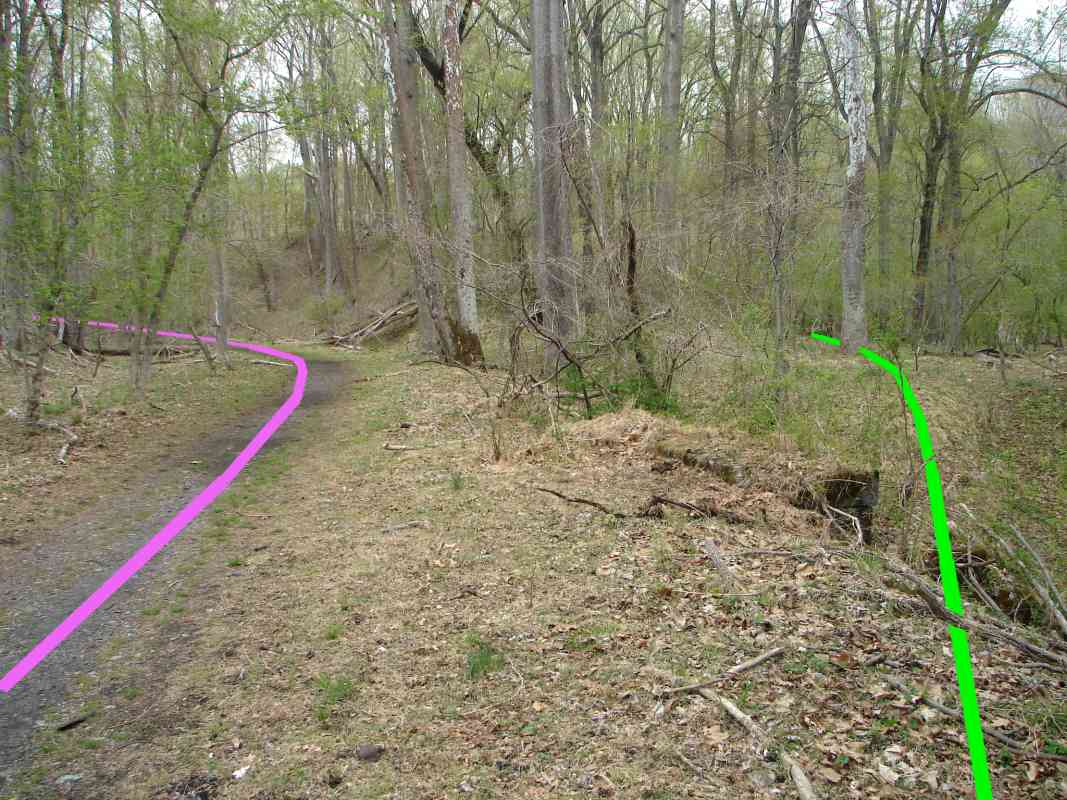
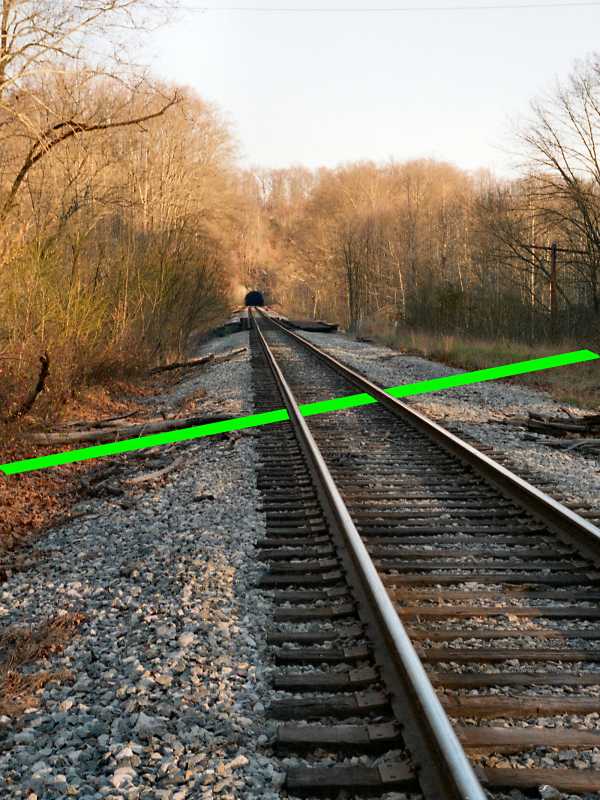
Looking back east, Dorsey Tunnel is more than half mile distant, but in the foreground the original alignment (green) and the current finally one meet again, but it is only to cross. The original winds around a hill, while the current bores right through via Davis Tunnel behind the photographer.


Continue to rejoin the OML tour

Or, return to main page


Copyright Notice
Visit the TrainWeb.org Fan Page on Facebook!
Create your own free Rail Blog or Website!

Advertise | About Us | Contact Us | Sign up for our Newsletter | TrainWeb.com
Your Ad Here
Your Ad Here