



 |
|
 |
What's New ~ Articles ~ Stories ~ Archives ~ Photographs ~ Preservation ~ Library ~ Home |
|
Canadian Northern
The CNoR entered Toronto from the north (Muskoka Sub. from Capreol) built 1906-07 via what is now the CNR’s Bala Sub. to Rosedale in the Don Valley (near Bloor Street) where a small yard and rectangular engine house was located. Its east mainline from Ottawa (Orono Sub.) built 1911-13, passed through Scarborough just north of the GTR Danforth yard, to meet with the northern line at new Todmorden, just south of Leaside and about 2 miles from Rosedale and nearly 4 miles from Union station. The CNoR had difficulty getting access to the downtown area being the last railway to enter Toronto, but did eventually manage to secure an agreement to get there over the GTR via the old Toronto Belt Line from Rosedale.
The CNoR needed bigger facilities for Toronto so it built new shops (opened 1919) at Leaside including an erecting shop for locomotives, a coach shop and a (freight) car shop. A small yard was also built. In order to get access to this property it had to build a connection from the Bala line south to Leaside. The line up the Don through Rosedale climbs a grade, crossing well below the CPR before reaching higher land near Oriole. Here a connection was built for southward to westward (or east to north) movements to Donlands (2.2 miles) where it connected with the CPR to reach Leaside another 1.3 miles and completed in June 1917. It was intended to connect the Ottawa mainline from near Scarboro Village via a four mile long new connection to Donlands and then to Leaside. It needed at 650 foot long viaduct to cross the Don Valley. Disputes over level crossings delayed work and it all ended with the failure of the Canadian Northern and its take over by the Federal Government. It was not long before most of the mainline between Toronto and Ottawa was abandoned beginning in 1923, there simply wasn’t a need for four main lines. Toronto, Niagara & Western was yet another railway that sought entry into Toronto via North Toronto. It was controlled by MacKenzie and Mann of Canadian Northern fame, the same two gentlemen who owned the Toronto Street Railway as well! This was a proposed electric interurban railway sharing the Hydro right-of-way from Niagara Falls to the Bridgman Transformer station (still in use) near Davenport Road and Dupont Street in Toronto. This was the first use in Toronto of "Hydro" electric power generated by water. Prior to this Toronto’s electricity was generated by steam including a large plant of the Toronto Street Railway located at its shops at Front & Frederick Streets in downtown Toronto. Much street and other lighting was by manufactured gas made by burning coke. Entry into Toronto would have been across the Humber River at Lambton parallel to and north of the old Toronto Belt Line to West Toronto (Keele Street just north of St.Clair Avenue West), where it would have dropped into a cut to underpass both the GTR’s Stratford line and the CPR’s Sudbury line (Mac Tier Sub.) as well as some streets. Just south of St.Clair Avenue it would have entered a 2360 foot long tunnel under the GTR’s ex Ontario Simcoe & Huron Railway (Ontario’s first railway) at Davenport and exit at Davenport Road and St.Clarens Avenue. It would then run parallel to and north of the CPR North Toronto Sub. over to North Toronto (Yonge Street). Joint Section agreement was reached October 1, 1915 permitting the CNoR use of CPR’s North Toronto station along with joint tracks and common tracks. Nothing ever came of either the TN&W being built nor CNoR trains entering North Toronto due to the financial failure of Canadian Northern. The CNR did operate over the Oriole spur to Donlands and over CPR into Leaside to reach local industries there as well as the railway shops. It also had use of common tracks from Leaside to North Toronto and over the north service track along with exclusive rights to traffic from local industries on the north side between Avenue Road and Dovercourt Road. It retained this arrangement for many years afterwards. The last CNR employee timetable to refer to these "common tracks" across North Toronto was April 1969. (It was no longer shown in the October 1969 timetable.) The last few industries on what remained of the north service track were thereafter served by the CPR. The one still remaining is the TTC Hillcrest shops, the last use of which was several years ago to ship out several old PCC streetcars to the US. CNoR mainline Toronto-Ottawa
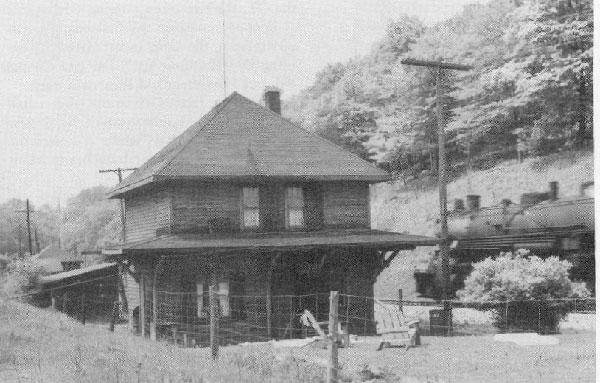
Todmorden station (Toronto)
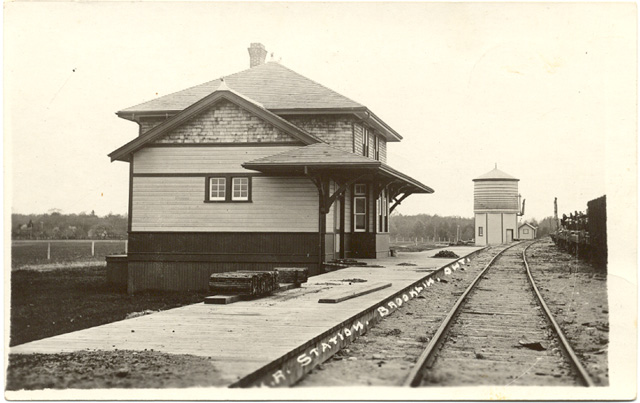
Brooklin, shown still under construction in this old postcard view. Collection of Doug Birchill
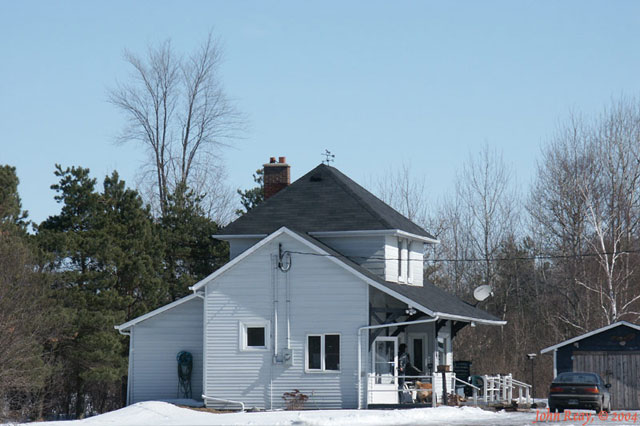
Former Solina station still in use as a residence on orginal abandoned right of way.
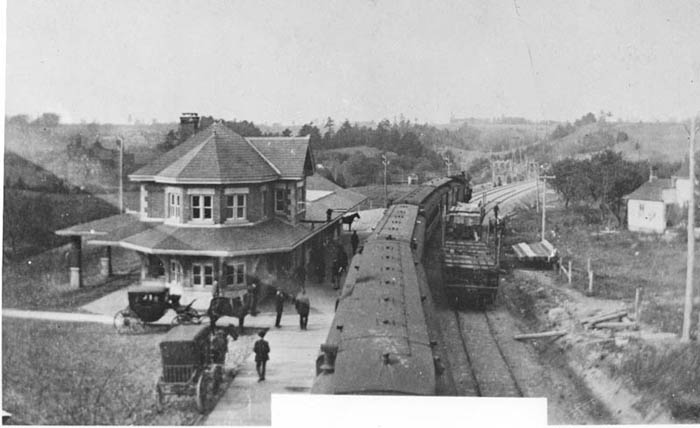
Undated early view of Port Hope station with eastbound passenger train on the Toronto-Ottawa mainline.
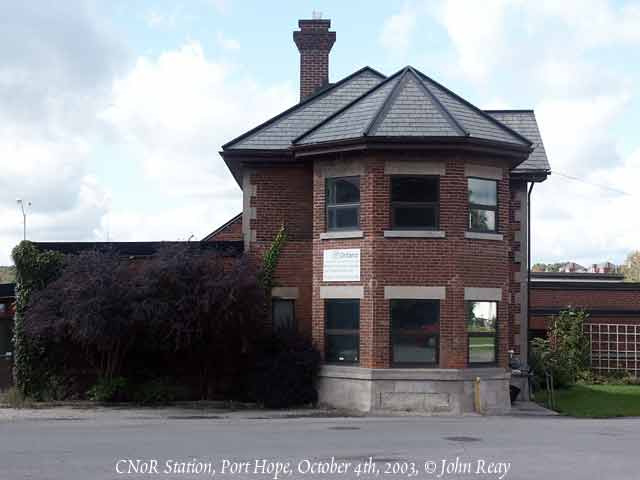
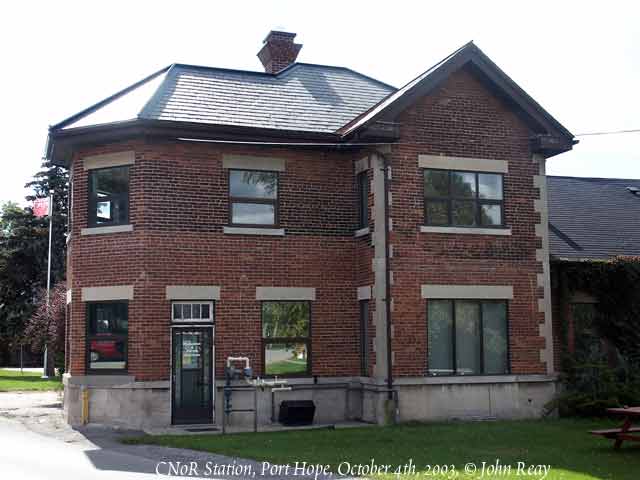
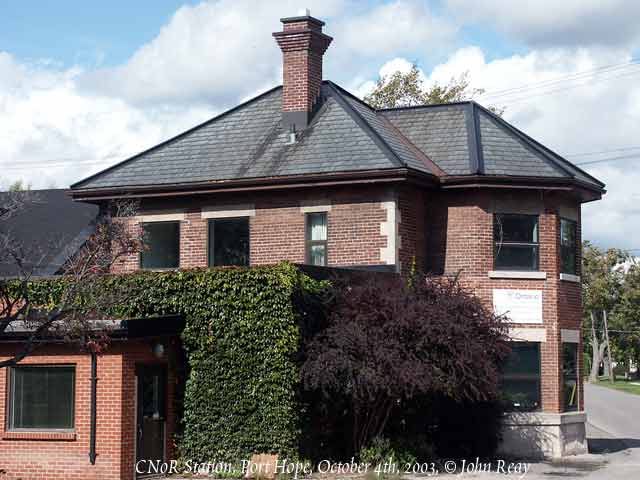
The above three photographs were taken by special request.
Canadian Northern station at Bonarlaw (Mile 24.98 Maynooth
Sub.) was situated right at the diamond with the CPR (O&Q) old mainline
(Mile 80.4 Havelock Sub.) and was used by both railways. Originally built
for the Central Ontario, it later was taken over by the Grand Trunk and
finally the GTR became part of the Canadian National Railways. The train
is Trenton-Bancroft Mixed 313 due at 9.05 a.m. on Friday August the 8th.
1958. Note the large sign leaning against the station advertising the
Canadian National Exhibition in Toronto.
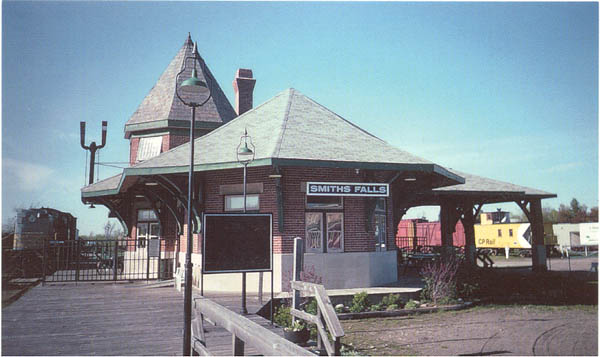
Smiths Falls station is another of the sturdy Canadian
Northern brick stations that survived.
Sudbury station shared by Algoma Eastern.
|
|
|
What's
New ~ Articles
~ Stories
~ Archives
~ Photographs
~ Preservation
~ Library
~ Home |
|