




 |
Somerset &
Dorset Joint Railway Bank Engine and Shunting Staffs |
|
||||
|
||||||
This page describes the 'Bank Engine Staffs' which were used at two locations on the former Somerset and Dorset Joint Railway (S&DJR), and also a 'Shunting Staff' used at one other S&DJR location. These notes are provided as a supplement to other RailWest pages on the history of S&DJR Block Working and details about the various methods and instruments used for single-line and double-line control.
There were two locations on the S&DJR (Bath Junction and Binegar) where it was necessary sometimes to provide 'banking engine' assistance at the rear of Down goods trains, but only to a 'summit' that was part of the way through the block section from one signal-box to the next. The use of a 'bank engine staff' in those block sections enabled the banking engine to return to the signal-box in rear while the rest of the train continued on to the next signal-box.
There were also some locations where a train might shunt at an intermediate siding within a block section, but then return to the signal-box at which it had entered that section rather than continue ahead to the next signal-box. There were various ways to facilitate this within the different methods of block working, but one method was the provision of a 'shunting staff' specifically for that purpose and an example existed at Pylle for some years.
When the 'Bath Extension' was opened in 1874 then officially the first single-line block section southwards from Bath Junction extended to Wellow. In practice it appears to have been divided into three block sections, with intermediate signal-boxes at Bath Ticket Platform and Midford. The signal-box at Bath Ticket Platform was closed in late 1876 when a new Bath Single Line Junction signal-box was opened, with a short section of double-track between it and Bath Junction. At that time normal S&DJR block working on single-line sections was by 'block telegraph' using block instruments only, with no physical 'train staff', and Bath Single Line Junction worked to Midford (if 'switched in') or else to Wellow.
Many Down goods trains were banked up the steep gradient out of Bath on the single-line section southwards from Bath Junction towards Midford, but assistance was required only as far as the summit of the section near the northern entrance to Combe Down tunnel. To avoid the need for the banking engine to go all the way through the block section it carried a special 'bank engine' staff, which gave its driver authority to return from Combe Down tunnel to Bath Single Line Junction signal-box whilst the Down train itself continued on its way towards Midford. The late CR Clinker recorded that S&DJR Signal Instruction No 1 advised that this staff would be bought into use on 22-December-1876; no original instructions for its use are known, but click here to see the later instructions in the S&DJR Working Time Table (WTT) Appendix No 7 dated 1-March-1886.
In late 1886 Electric Train Tablet (ETT) working was introduced between on the section between Bath Single Line Junction and Wellow, and Midford ceased to be a block-post. When a Down goods train was assisted by a banking engine, then the tablet for the single-line section was carried on the train engine all the way through to Wellow, whilst the banking engine carried the 'bank engine staff' and returned from the summit to Bath Single Line Junction signal-box as before. However it is clear from the revised instructions (click here) in the S&DJR WTT Appendix No 8 dated 1-October-1886 that the bank engine staff was kept in some form of lock at Bath Single Line Junction signal-box that was interlocked with the ETT instrument there. This ensured that, even if the Down train reached Wellow and the tablet was placed in the ETT instrument there, the block section could not be cleared and a new tablet issued for another train until the bank engine staff had been returned to Bath Single Line Junction.
In 1892 the line was doubled from Wellow to Midford and the latter location became a block-post again. The ETT block section from Bath Single Line Junction now extended only as far as Midford, but this change did not affect the general method of working with the bank engine staff. However by the time of the 1905 edition of the S&DJR WTT Appendix the relevant instructions (click here) had been expanded to include procedures for various 'exceptional circumstances' such as an inability to remove the staff from its lock. In 1912 the Tyer's No 1 ETT instruments in use on the Bath Single Line Junction to Midford section were replaced by the Tyer's No 6 pattern and this required a new lock mechanism for the bank engine staff. This change lead to revised instructions (click here) in the 1914 edition of the S&DJR WTT Appendix to cater for the new arrangements for securing the ETT instrument in the event that the bank engine staff could not be withdrawn from its lock. In 1924 the Bath Single Line Junction signal-box was closed (S&DJR Signal Instruction 275) and its work was taken over by a replacement Bath Junction box (which belonged to the London, Midland & Scottish Railway) which opened at the same time.The single-line section now became Bath Junction to Midford, and the ETT instrument and bank engine staff lock were transferred from Bath Single Line Junction box to Bath Junction box. Click here for the relevant instructions from the 1933 S&DJR WTT Appendix.
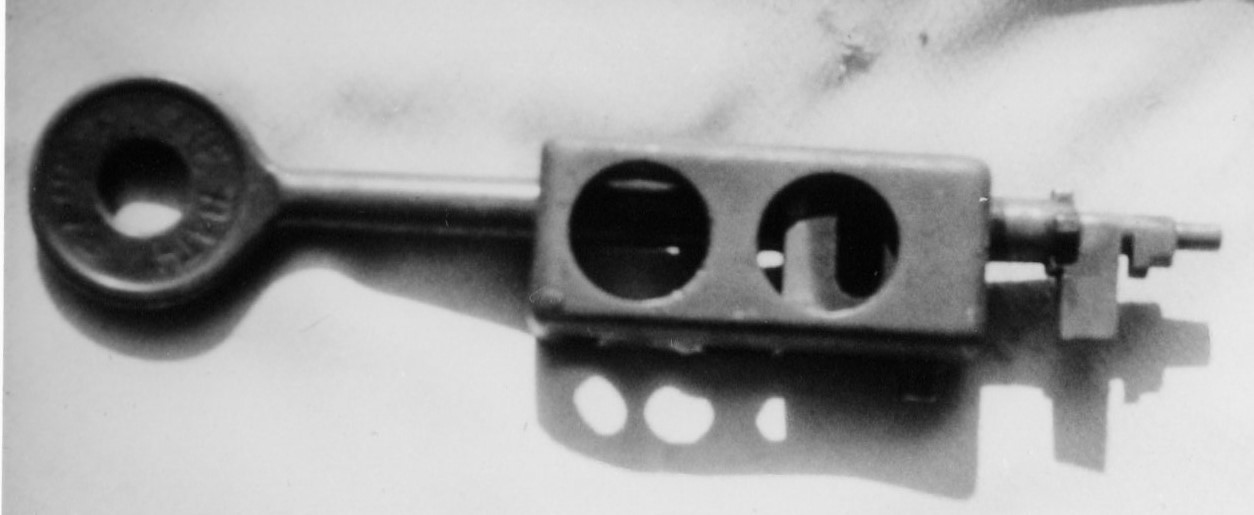
The design of the original Bath bank engine staff is unknown, but it may be been just a simple wooden 'train staff'. In British Railways days the staff took the form of a large metal key with an annular handle engraved "Bath Bank Engine" - see picture (click for larger image). The box-like section with two large holes was a loose cover which could be slid down over the key end for protection. This style of staff is identical to that which was included in a drawing circa-1912 (click here) for the lock required for the Tyer's No 6 ETT instrument, but it is a matter of conjecture as to what extent it might have resembled any earlier staff or whether it was a new staff provided at that time.
The staff lock was attached to the right-hand side of the Tyer's No 6 ETT instrument in Bath Junction signal-box - click here to see a picture showing the staff in the lock in 1965. When a Down train entered the single-line section at Bath Junction then normally the Whitaker automatic tablet exchange apparatus was used to pass the tablet to the train engine, so the bank engine staff had to be passed to the bank engine by hand and the signalman was provided with a special large pouch for that purpose. (The pouch was similar to those used for the hand transfer of tablets, but with a long rectangular leather container about 10"x3" attached to the hoop. In the photograph of the lock the white handle of the pouch can be seen hung over the lock and it is possible to make out the leather 'flap' which was buckled over the end of the container to secure the staff.) One former signalman at Bath Junction recalled the perils of standing in the 'six foot' as a Down train steamed past up the bank, holding up the pouch for the approaching bank engine while trying to avoid being hit by any loose ropes or sheets hanging off the passing wagons.
The Bath bank engine staff served a secondary purpose of unlocking the ground-frames which controlled the intermediate May's (later Victoria Brick & Tile) and Twerton Co-op (later Bath Co-op) sidings on the S&DJR line out of Bath. The use of the bank engine staff for this purpose, rather than the single-line tablet, arose probably because of the occasional practice of taking inward traffic for those sidings sandwiched between the banking engine and the rear of a Down train, to be shunted by the banking engine on its return trip (when, of course, the driver of the banking engine was not in possession of the tablet). On other occasions when the sidings were worked by a 'trip' working from, and returning to, Bath then the engine would be required to carry both the tablet (as authority to enter the single-line section) and the bank engine staff (in order to unlock the ground-frames). The connection to the Victoria Brick & Tile siding was abolished in 1950, but the Bath Co-op siding continued in use for the rest of the life of the line.
Postscript: in the 1970s the Bath bank engine staff was an exhibit in the museum of the former Somerset & Dorset Railway Circle at Radstock, but sadly it disappeared during their relocation to Washford. In 2006 a similar staff was sold at auction in the Bristol area, but a careful comparison of photographs of both staffs confirms that they were not the same item. (In the composite image available here the upper staff was the museum exhibit and the lower staff was the auction item.) It is believed therefore that, in common with the Binegar bank engine staff, a spare Bath bank engine staff had been kept in the S&DJR Superintendent's office at Bath Green Park station. It is probable that the staff formerly at Radstock was the one actually in use in 1966 and the auction item was the spare staff.
In the early days at Binegar the use of a 'bank engine staff' had similarities with the contemporary situation of the Bath Bank Engine staff at Bath Junction. When the 'Bath Extension' was opened in 1874 then officially the first single-line block section southwards from Binegar extended to Shepton Mallet, but by late 1876 intermediate signal-boxes had been opened at Masbury and Winsor Hill. At that time normal S&DJR block working on single-line sections was by 'block telegraph' using block instruments only, with no physical 'train staff', and so Binegar would have worked variously to Masbury, Winsor Hill or Shepton Mallet depending which was the first box to be 'switched in' in the Down direction. However the signal-box at Winsor Hill ceased to be a block-post with effect from 1-January-1877 (S&DR Signal Instruction No 3).
The steep gradients on the approaches to Masbury Summit meant that it was often necessary to bank Down goods train all the way from Radstock. As the summit was less than a mile north of Masbury station then it would have been possible for the banking engine simply to continue with the train to Masbury station, before being detached to return to Binegar. However if Masbury signal-box was not 'switched in' then the banking engine would have had to continue on to Winsor Hill or even Shepton Mallet in order to clear the block-section. To avoid the need for the banking engine to go any further than necessary it carried a "Binegar Bank Engine" staff, which gave its driver authority to return to Binegar signal-box once the train had passed on its way over Masbury summit. The late CR Clinker recorded that S&DJR Signal Instruction No 4 advised that this staff would be bought into use on 22-January-1877; no original instructions for its use are known, but click here to see the relevant instructions in the S&DJR Working Time Table (WTT) Appendix No 7 dated 1-March-1886.
S&DJR WTT Appendix No 7 also contained instructions stipulating that wagons for Masbury siding had to be worked from Binegar on a banked Down goods train, the wagons destined for Masbury being attached behind the bank engine with a brake-van at their rear. Once the main part of the Down train had passed over the summit and proceeded on towards Shepton Mallet, then the bank engine had to proceed slowly towards Masbury with those wagons in tow, shunt the siding, collect any outgoing wagons, and return with them and the brake-van to Binegar. It is presumed those were the only circumstances at that time when a banking engine actually passed over Masbury summit and went as far as Masbury station.
On 10-October-1886 Electric Train Tablet (ETT) working was introduced on the section between Binegar and Shepton Mallet, and Masbury ceased to be a block-post. When a Down goods train was assisted by a banking engine, then the tablet for the single-line section was carried on the train engine all the way through to Shepton Mallet, whilst the banking engine carried the 'bank engine staff' and returned from Masbury summit to Binegar signal-box as before. However it is clear from the revised instructions (click here) in S&DJR WTT Appendix No 8 dated 1-October-1886 that the bank engine staff was kept in some form of lock at Binegar signal-box that was interlocked with the ETT instrument there. This ensured that, even if the Down train reached Shepton Mallet and the tablet was placed in the ETT instrument there, the block section could not be cleared and a new tablet issued for another train until the bank engine staff had been returned to Binegar.
It is believed that use of a bank engine staff ceased with the doubling of the line from Binegar to Shepton Mallet on 20-November-1892, after which date banking engines ran as far as the new signal-box at Masbury, where they crossed to the Up line and returned to Binegar. However during the 1920s the night shift at Masbury signal-box was abolished as an economy measure, so in order to avoid the need for banking engines to go all the way to Shepton Mallet (the intervening signal-box at Winsor Hill also being closed at night) special arrangements came into force with effect from 10-October-1927.
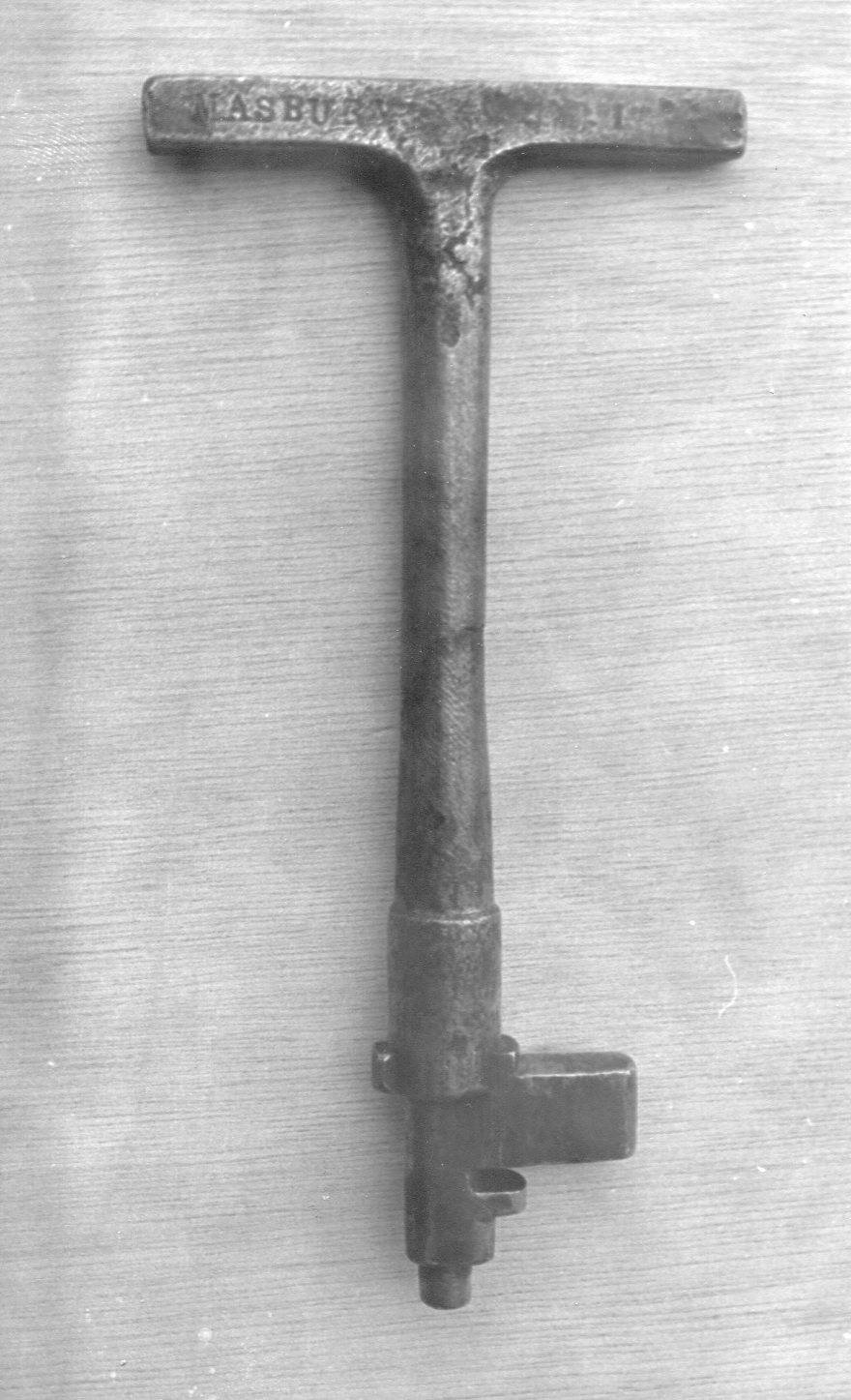 A new bank
engine staff (labelled "Masbury Summit") was
provided at Binegar, in the form of a large metal key (similar to that used at Bath
Junction, but with a T-shaped handle) shown in the picture on the left
(click for a larger image). This key was kept in the signal-box in a
floor-mounted lock attached to the lever-frame, from
which it was released by pulling lever 5. Any banked Down goods train was signalled forward
to Masbury on the relevant block instrument (as the line here was now double-track), but the
banking engine carried the staff and this permitted it, once the train had reached
Masbury summit, to return 'wrong line' to Binegar where it would cross back to the Up line.
Protection of the bank engine was afforded by the block instruments (see other RailWest
pages about S&DJR double-line equipment)
which were interlocked with the key lever 5,
rotational locking on the Down line running signals until the key lever was replaced, and
the fact that the key lever locked certain points and ground signals at Binegar which led
onto the Down line in the rear of the section signal. Click
here to read the detailed instructions in Supplement 9 to S&DJR WTT Appendix 16.
A new bank
engine staff (labelled "Masbury Summit") was
provided at Binegar, in the form of a large metal key (similar to that used at Bath
Junction, but with a T-shaped handle) shown in the picture on the left
(click for a larger image). This key was kept in the signal-box in a
floor-mounted lock attached to the lever-frame, from
which it was released by pulling lever 5. Any banked Down goods train was signalled forward
to Masbury on the relevant block instrument (as the line here was now double-track), but the
banking engine carried the staff and this permitted it, once the train had reached
Masbury summit, to return 'wrong line' to Binegar where it would cross back to the Up line.
Protection of the bank engine was afforded by the block instruments (see other RailWest
pages about S&DJR double-line equipment)
which were interlocked with the key lever 5,
rotational locking on the Down line running signals until the key lever was replaced, and
the fact that the key lever locked certain points and ground signals at Binegar which led
onto the Down line in the rear of the section signal. Click
here to read the detailed instructions in Supplement 9 to S&DJR WTT Appendix 16.
To enable the banking engine to collect the bank engine staff as the train passed through Binegar station, but without the need to slow down, an example of the Whitaker automatic tablet exchange apparatus was installed at Binegar. A special pouch was provided to hold the staff, the normal banking engines were provided with a Whitaker catcher and a 'pick-up' post was erected at Binegar at the south end of the Down platform. (A spare staff was kept for emergencies in the S&DJR Superintendent's office at Bath Green Park station.) In this new form 'bank engine staff' working resumed at Binegar in 1927 and continued until the line closed in 1966.
A 'shunting staff' was used at one time in connection with the working of Pylle Lime Siding, which was about half a mile west of Pylle station in the single-line section between Pylle and West Pennard. This siding is believed to have been brought into use in 1869 and it was accessed by a point facing to Down trains. It was worked by engines which would draw their train out from Pylle, shunt the siding, and then propel their train back to Pylle. By the 1880s the siding was controlled by an adjacent ground-frame and protected by one or more disc-and-crossbar signals, which stood normally 'off' when the ground-frame was locked.
By the time of the S&DJR WTT Appendix No 7 dated 1-March-1886 the Lime Siding ground-frame was unlocked by a key kept in the lever-frame in Pylle signal-box. The removal of this key from the lever-frame locked the Up Starting signal at Pylle and therefore prevented a second train from being signalled into the single-line section while the first train was shunting the Lime Siding. Once shunting had been completed the ground-frame would be locked, the train would return to Pylle and the key would be replaced in the lever-frame. At that time the single-line section was worked by Block Telegraph without any form of 'train staff', but later in 1886 the block working was changed to Train Staff & Ticket (TS&T) working. The key for the ground-frame remained in use with the TS&T working, the only difference being that the engine driver would now also be given the Train Staff for the Pylle - West Pennard section as his authority to enter the single-line. Click here for the relevant instructions from S&DJR WTT Appendix No 8 dated 1-October-1886.
The use of a key to unlock the ground-frame survived the introduction of Electric Train Tablet (ETT) working to the Pylle - West Pennard section in 1891 (using Tyer's No 3 ETT instruments). When a new lever-frame was installed in Pylle signal-box in 1891 (in connection with the new passing-loop at that station) the Board of Trade Inspection Report referred to an "Annett's Key" locked in the lever-frame. Revised instructions were issued by the S&DJR on 20-August-1891 (click here) to cover the need for the train to be issued with a tablet rather than the previous train staff, and it will be noted also that by that time the Lime Siding ground-frame had been upgraded to six levers, although the reason for that change is unknown.
There had been a further change in the method of working by the time of the 1905 S&DJR WTT Appendix (click here for the relevant instructions). It would appear that the 'key' had now become a 'staff', which was kept in a 'staff box' at Pylle that was interlocked with the ETT instrument. When a train had to shunt the Lime Siding the signalman at Pylle would withdraw a tablet for the section and then remove the staff from its lock, thereby disabling further use of the ETT equipment. (It is assumed that the previous practice of locking the Up Starting signal at Pylle had ceased, as that is no longer mentioned in the instructions.) The train would enter the section under authority of the tablet, the staff being used to unlock the ground-frame. It would appear also that by this time the signals at the Lime Siding had been abolished and the ground-frame merely worked the points (and presumably a Facing Point Lock). Upon completion of shunting at the siding the ground-frame would be re-locked and the train would return with the staff and tablet to Pylle. In principle this method of working using a staff interlocked with the ETT instrument was exactly the same as with the Bath Bank Engine staff.
The retention of a special key or staff during the period of ETT working is puzzling. It cannot have been retained simply to avoid drawing a tablet from the non-returnable Tyer's No 3 instrument, because both the 1891 and 1905 instructions required any train entering the section from Pylle to shunt the siding to be in possession of a tablet as well as the staff. It might have been an economy measure to avoid the cost of modifying the locking arrangements at both Pylle and the Lime Siding ground-frame, although the replacement of the Pylle lever-frame in 1891 ought to have provided a suitable opportunity. Similarly the subsequent change to the use of a 'staff box' interlocked with the ETT instrument would have incurred costs that could have been used instead to change the lock at the ground-frame. However by the time of the 1909 S&DJR WTT Appendix the use of the staff had ceased and the Lime Siding ground-frame was released instead by the tablet for the Pylle - West Pennard section. By 1912 the lime works had fallen into disuse and it was reported in the S&DJR Officers Minutes No 6540 dated 21-October-1912 that the siding had been removed.
© CJL Osment 2000-2018
Thanks to Mike Arlett, David Stirling and the late Dr Peter Cattermole for archive material.
Colour photograph links:- 'auction' Bath bank engine staff © Paul Baulch, Bath Junction staff lock ©
Doug Tritton courtesy Rev Brian Arman.
References
|
|||||||
| © West Country Railway Archives 2000 Page last updated: 01 December 2018 |
URL: http://www.railwest.org.uk E-Mail: railwest@bigfoot.com |
||||||