




 |
Somerset &
Dorset Joint Railway Block Working An Introduction and Overview |
|
|||||||
|
|||||||||
This page provides an outline history of the various methods of Block Working used on the former Somerset and Dorset Joint Railway (S&DJR). Other pages in RailWest provide more detailed information about the different methods and types of block equipment used for working S&DJR single-line and double-line sections, as well as details about the various examples of S&DJR 'shunting' and 'bank engine' staffs. There is also a Register of all S&DJR single-line sections from the 1880s onwards, with details of the various types of block equipment used and their configurations.
These pages concentrate on providing a general overview of the subject of S&DJR Block Working, with a basic chronology of the introduction of the different types of equipment. It is not intended to describe the finer details of the actual Block Regulations or the specific methods of operation of the various types of instruments. More general information about railway signalling can be found on other websites such as The Signal Box.
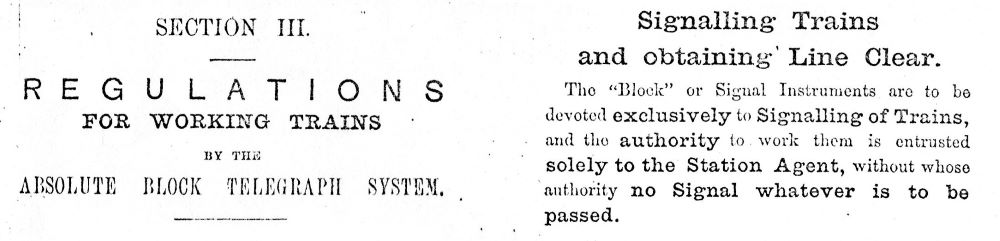
An extract from the Somerset & Dorset Railway
Rule Book 1864
Signalling information for the early years of the S&DJR and its predecessors is still very scarce and little is known to exist for the period prior to the opening of the 'Bath Extension' from Evercreech Junction to Bath in 1874. For that reason most of the content in RailWest relating to S&DJR signalling concentrates on the period from 1874 onwards, but information from the previous two decades will be included as and when it may became available.
The original single-line Somerset Central Railway (SCR) opened on 28-August-1852 from a junction with the Bristol & Exeter Railway (B&ER) at Highbridge to a terminus at Glastonbury. The National Archives (TNA) file MT6/11/91 contains a copy of B&ER "Instructions to Head Guards and all others concerned in the working of the single line between Glastonbury and Highbridge" dated 16-September-1854. The gist of these instructions was that no train was to move over the line without the guard (who was nominated specifically on a daily basis) on board, the implications being that at that time the whole branch from Highbridge to Glastonbury was worked as a single block section with a form of 'Pilot Guard' working (click here to see the full text). It is presumed that those arrangements would have been superceded once the SCR had extended westwards to Burnham in 1858 and eastwards to Wells in 1859, but no further details are available. In 1862 the SCR merged with the Dorset Central Railway (DCR) to form the Somerset and Dorset Railway (S&DR) and in 1863 the S&DR opened a continuous line to Wimborne.
Block Telegraph & Crossing Orders
In 1864 the S&DR issued a Rule Book which included a set of "Regulations for Working Trains by the Absolute Block Telegraph System" (click here to see an extract), from which it is clear that the railway was worked purely by 'block telegraph' without any form of physical 'train staff' and that the 'block telegraph' instruments were separate from the ordinary 'single needle telegraph' used for normal messaging. A system of 'crossing orders' was also in use, controlled by a 'crossing agent' located in the S&DJR offices at Glastonbury (subsequently moved to Bath), but this system existed mainly to regulate the movements of trains (eg those crossing out-of-course) and it would appear that it was not part of the actual block working system (click here to see an extract from the 1864 Rule Book).
In 1874 the S&DR opened its 'Bath Extension' from Evercreech Junction to Bath Junction and in 1875 the S&DR became the S&DJR when the line was leased jointly by the Midland Railway (MR) and London & South Western Railway (L&SWR). It would appear that the new Joint line continued to be worked throughout by 'block telegraph', still without any form of physical 'train staff', but in the absence of any known contemporary records it is not known to what extent the Block Regulations might have differed from the 1864 Rule Book. Nevertheless subsequent S&DJR Block Regulations would suggest that the indicator needles of the block instruments were still being used to convey 'dial signals' to manage the block working, rather than the later method of sending bell codes on block bells; these 'dial signals' were a form of code given by moving the needle a number of times to the left and/or right before finally keeping it 'pegged' over to denote 'Line Clear' or 'Train On Line' as appropriate.
The block instruments were located usually in the station buildings and operated by a telegraph clerk, who acted under the instruction of the Station Agent (the S&DJR term for Station Master), as did the signalman himself. Minute 3114 of the S&DJR Officers' meeting on 27-January-1885 recorded that "the new Railway Clearing House code of block signalling" would be implemented with effect from 1-March-1886, but it is clear from the subsequent revision of the Regulations that, although bell codes had been introduced, the needle of the block instrument was used still to convey 'dial signals' as well. It is believed that the instruments were maintained by JB Saunders & Co of Cardiff, who listed the S&DJR as one of the railway companies with whom they had contracts, but little specific information is available.
The 1876 disaster at Foxcote (near Radstock) made horribly obvious the danger of lax working of single-lines, but surprisingly the subsequent Accident Report by the Board of Trade (BoT) contained no strong recommendations for changes in the method of working the single-line sections. The single-lines of the S&DJR continued therefore to be worked mainly by 'block telegraph' for a further ten years, but there began to be a gradual move towards better methods of control. The first change was the introduction of 'Train Staff and Ticket' (TS&T) working, where the use of a physical 'train staff' in addition to the block instruments, rather than relying just on instruments alone, certainly provided a more secure system of working. One section (between Highbridge and Burnham) was converted to TS&T working in 1877 and another (between Glastonbury and Wells) in 1879, but those changes appear to have taken place primarily as a result of specific BoT requirements in connection with new work and the S&DJR appears to have been in no hurry to make a more widespread upgrade. Several more sections were upgraded eventually during 1886 (between Evercreech Junction and Highbridge), but this work did not have a great impact on the S&DJR in the longer term because it was soon overtaken by the change to the Electric Train Tablet system.
The most significant change for block working on the S&DJR was the introduction of the Electric Train Tablet (ETT) system in 1885-86. The first S&DJR section to be equipped with ETT was the new 'cut-off' line (officially known as the 'Poole and Bournemouth Junction Railway') which opened between Bailey Gate and the L&SWR station at Broadstone in Dorset in December 1885; the exact date of the introduction of ETT working is unknown (it may well have coincided with the opening of the new line), but certainly it was in use by the time of the S&DJR Working Timetable (WTT) Appendix No 7 dated 1-March-1886. Subsequently ETT working was installed on all the single-line sections on the S&DJR main line from Bath Junction to Wimborne Junction in October and November 1886. In later years it was extended in a rather piecemeal manner to cover almost all of the remaining single-line sections and superseded almost all the TS&T working. ETT working became a feature of the S&DJR that existed right up until the closure of the railway to passenger traffic in 1966, although during the British Railways era some ETT sections were re-equipped with the alternative Electric Key Token system. More detailed information about the various methods and changes of single-line equipment on the S&DJR is contained in the specific RailWest pages on S&DJR single-line block working and the Register of S&DJR single-line sections. No discussion about ETT working on the S&DJR would be complete without a mention of the Whitaker apparatus (described here) for the automatic exchange of tablets at speed, although that equipment was not part of the actual block working.
By the mid-1880s the S&DJR had embarked on a programme of doubling many of its single-line sections, eventually having continuous double-track working all the way from Midford to Templecombe No 2 Junction by 1894, with a further stretch from Blandford to Corfe Mullen Junction by 1905. It appears that, as various sections of the S&DJR were doubled, the existing equipment and regulations for the 'block telegraph' method of single-line working were applied to double-line use with very little alteration.
The S&DJR Block Regulations introduced in 1886 were still in use in 1889, but thereafter unfortunately there is a gap in available material until 1905. By that time the bell codes had changed to more modern versions and the 'dial signals' appear no longer to form an integral part of block working, although they were still used for some purposes - even as late as 1914 the S&DJR WTT Appendix contained the following Regulation:-
"3(f). Where Dial signals are used to indicate the direction in which a train requires to run, the direction from which a train is approaching or for any other purpose, they must, when used with the Is Line Clear? signal, be given immediately after that signal, and when used with the Train Entering Section signal, the Block Indicator, before being placed to Train On Line, must be placed in the normal position, and when the Dial signal has been given and correctly acknowledged, and the signal Signal correctly repeated (one beat of the Block Indicator to the Right) has been received, the Block Indicator must be placed to Train On Line".
More specific information about the various types of block instruments used on the S&DJR is contained in the separate RailWest page on S&DJR double-line block working.
Postscript...
This page, and the other associated RailWest pages, deals with S&DJR Block Working only until the complete closure of the S&DJR system to passenger traffic in 1966. After that date some sections of the line remained opened for freight traffic for a few more years. It is not clear whether these were worked under 'One Train Working' regulations (with or without some form of Train Staff) or simply 'under signalman's control', although the limited available evidence would suggest that the latter method was used. Additional information on any aspect or period of S&DJR block working is always welcome and should be sent to RailWest by e-mail please to the address at the end of this page.
© CJL Osment 2001-23
References
|
|||||||
|
© West Country Railway Archives 2001 Page last updated: 28 February 2023 |
URL:
E-Mail: |
||||||