



 |
Somerset &
Dorset Joint Railway Single Line Block Working Equipment and Chronology |
|
||||||||||
|
||||||||||||
This page describes the various block control systems and instruments used on single-line sections of the Somerset and Dorset Joint Railway (S&DJR) from the late 1870s onwards. There is a separate RailWest page specifically about block working on S&DJR double-line sections and also a page which provides a general Introduction to S&DJR Block Working. This page concentrates on providing a chronology of the introduction and removal of the different types of single-line equipment and does not deal with the actual methods of operation of the various instruments. Click here for a Register of all S&DJR single-line sections and their methods of working; click here for more general information in RailWest about single-line equipment and configurations.
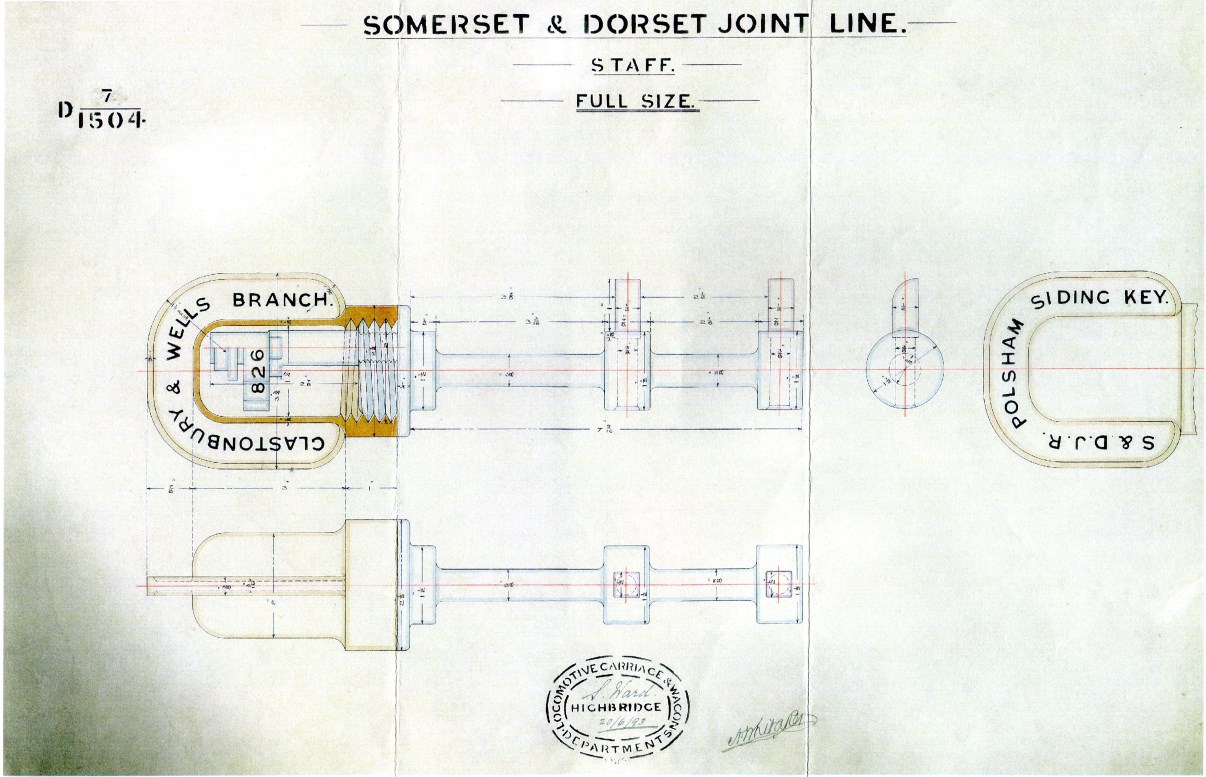
An extract from an 1893 Drawing for a new Train Staff for the Wells Branch
Until 1884 almost all of the S&DJR was a single-track line, with the exception of a few short sections of double-track working at locations such as Evercreech Junction or Templecombe Junction where there was more than one signal-box to control the layout. The RailWest 'Introduction' page on the general history of S&DJR Block Working provides details about the early arrangements for single-line block working, including the use of 'absolute block telegraph' working (without any form of physical 'train staff') by the time that the Somerset & Dorset Railway (S&DR) issued a Rule Book in 1864. This page will concentrate on the changes to single-line block working which began in the late 1870s.
Although the 1876 disaster at Foxcote (near Radstock) highlighted the problems associated with controlling single-line sections simply by block instruments alone (without any form of physical 'train staff'), there appears to have been little impetus for any immediate widespread improvement across the S&DJR. [It should be noted however that the S&DJR did introduce special 'Bank Engine' staffs at Bath Single Line Junction and Binegar in December 1876 and January 1877 respectively (click here for more details).] The late CR Clinker recorded that S&DJR Signal Instruction No 5 mentioned the introduction of 'train staff' working between Highbridge 'C' and Burnham on 15-May-1877; in the absence of a copy of that Instruction it is not known whether that was in fact Train Staff and Ticket (TS&T) initially, but certainly that section was TS&T by 1886. In 1878 the Board of Trade (BoT) specified TS&T working when they wrote to the S&DJR on 19th December sanctioning the extension of the Wells branch by a separate line into Glastonbury, and Clinker records that TS&T was introduced between Glastonbury and Wells on 1-January-1879 (S&DJR Signal Instruction 19); despite that change, the main line through Glastonbury remained worked by block telegraph only.
With TS&T working the use of block instruments would have continued, the train staff (and tickets) being provided as an additional safeguard. There is little information available about the equipment used at that time, but from photographic evidence of some block instruments circa-1890 it seems likely that the original 'block telegraph' equipment continued in use for TS&T working. Nothing is known about the actual S&DJR 'ticket boxes' (in which the blank 'tickets' were kept), but it is probable that they were similar to examples used on other railways, namely a rectangular wooden box with a hinged lid, which was unlocked by inserting the train staff into a hole at one end. In 1893 a drawing was produced at Highbridge Works for a Train Staff for the Wells Branch (shown in part above - click here for the full drawing); the two 'lugs' at the right-hand end of the main shaft were probably to operate the lock inside the relevant ticket box. Note the removable cap on the left-hand end to protect the key which unlocked the points of the siding at Polsham (opened in 1891). It is not known why this drawing was produced at that date, nor whether in fact a staff was made to that design, but it has been included here as an indication of contemporary train staff equipment.
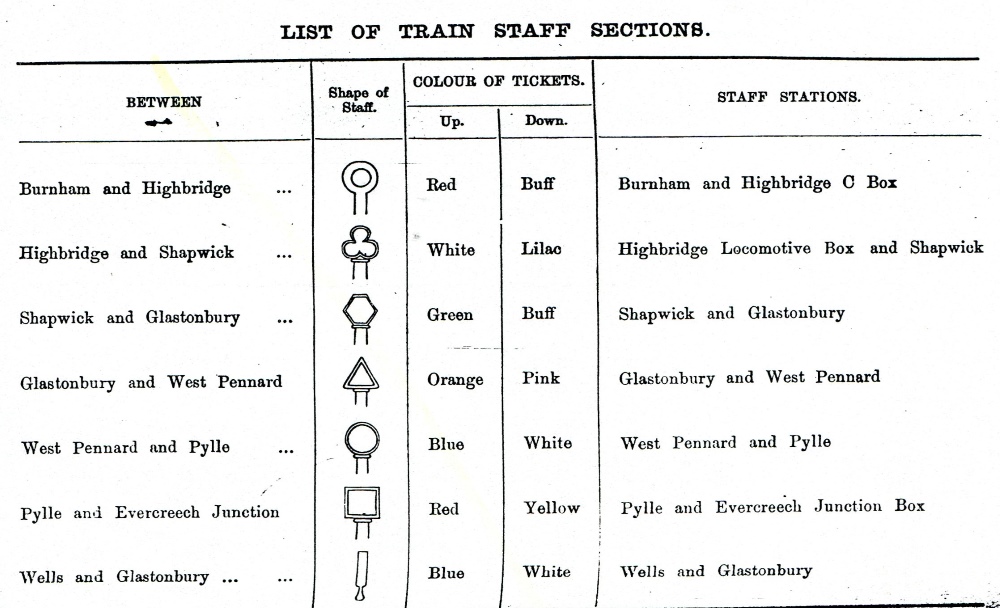
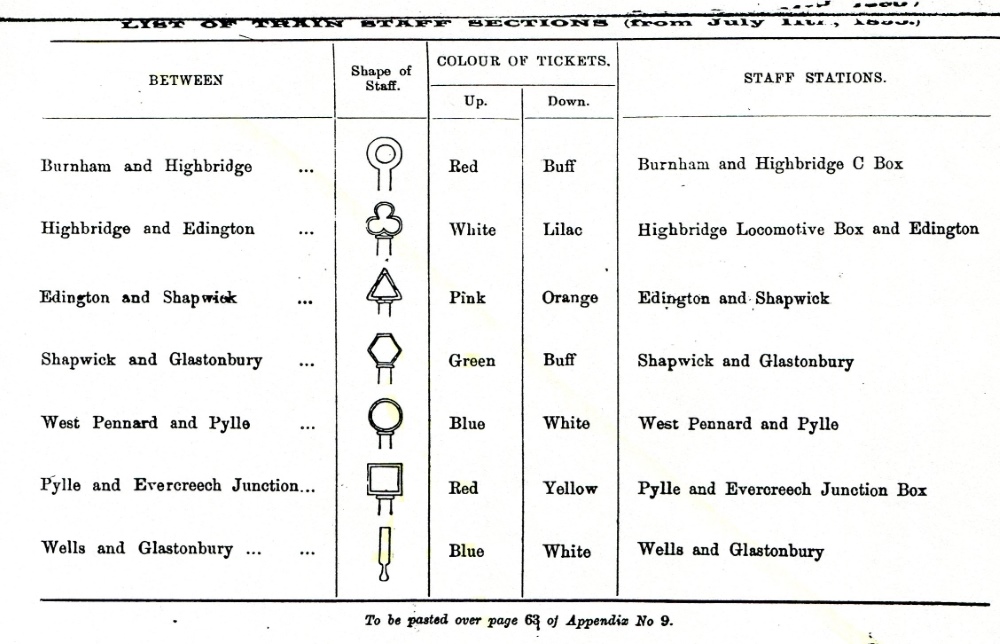
By the time therefore of S&DJR Working Time Table (WTT) Appendix 7 dated 1-March-1886 TS&T working was in force only on the GLASTONBURY - WELLS 'A' and HIGHBRIDGE 'C' - BURNHAM sections. However after an accident at Binegar on 3-February-1886 the subsequent BoT Accident Report specifically recommended the introduction of Train Staff or Electric Train Tablet (ETT) working. This seems finally to have spurred the S&DJR into action, for they gave an undertaking to the BoT on 17-September-1886 for the introduction of ETT on the main line from Bath to Wimborne and for 'staff and block telegraph' between Evercreech Junction and Burnham (in fact already completed by that date). As a result almost all of the S&DJR single-line sections were upgraded to either ETT or TS&T working within the space of a year. S&DJR Officers Minute 3390 of 23-September-1886 records that conversion to TS&T working had been completed on the rest of the branch from Evercreech Junction to Highbridge on 13-September-1886 and the left-hand table shown below is extracted from WTT Appendix 8 dated 1-October-1886. A further section of TS&T working was introduced in July 1890, when the opening of a new signal-box at Edington Junction resulted in the splitting of the existing SHAPWICK - HIGHBRIDGE LOCO section into two new sections SHAPWICK - EDINGTON JUNCTION - HIGHBRIDGE LOCO, as shown in the right-hand table below.
 |
 |
|
| Details of Train Staff & Ticket sections in October 1886 | Details of Train Staff & Ticket sections in July 1890 |
However by 1890 the S&DJR was already using the Electric Train Tablet (ETT) system to displace some existing TS&T equipment and the GLASTONBURY - WEST PENNARD section had been changed previously from TS&T to ETT working (at noon on 23-April-1888). Then in 1891 all the remaining TS&T sections between Evercreech Junction North and Edington Junction were converted to ETT working. The sections EVERCREECH JUNCTION NORTH - PYLLE - WEST PENNARD were converted on 20-August-1891 between the passing of the No 6B Down (9.00am ex-Highbridge) and No 8B Up (10.25am ex-Evercreech Junction) trains, and then the sections GLASTONBURY - SHAPWICK - EDINGTON JUNCTION were converted on 8-September-1891 between the No 8B Up and No 11B Down (11.50am ex-Burnham) trains (S&DJR Officers Minute 4008 of 27-October-1891 and Traffic Superintendent's Circulars W/527 and W/531). At an Officers meeting on 27-October-1892 (Minute 4138) the S&DJR decided to install ETT working on the EDINGTON JUNCTION - HIGHBRIDGE LOCO section and an undertaking for this was given to the BoT on 28-January-1893, but the actual date of introduction is unknown. The S&DJR Officers Minute 4423 of 23-April-1895 records a decision that TS&T working on the GLASTONBURY - WELLS 'A' section would be superseded by ETT working and this is believed to have taken place shortly thereafter.
 These changes
meant that by the end of 1895 TS&T working remained only
on the HIGHBRIDGE 'C' - BURNHAM section and this
method continued to be used there until after nationalisation of the railway in 1948. Regular passenger
traffic ceased west of Highbridge station on 29-October-1951, although there was occasional excursion
traffic until 8-September-1962, but goods traffic continued to
Burnham until 20-May-1963. It is
known that TS&T working was retained to Burnham for at least part of this later period
(a used ticket survives from 1954) and it is probable (but not proven) that it
remained in use until final closure in 1963. The 'train staff' itself was in fact a large steel key
with a T-shaped handle and is illustrated here (click the picture for a larger image);
it will be noted that the handle shape differs from that shown in both TS&T tables
above, so it may be the case that the original staff was repaired or replaced at
some unknown date. It has been claimed that (certainly in the later years) no block instruments
were used in conjunction with the staff on this section (working being by bell
only) and this appears to be confirmed by other records.
These changes
meant that by the end of 1895 TS&T working remained only
on the HIGHBRIDGE 'C' - BURNHAM section and this
method continued to be used there until after nationalisation of the railway in 1948. Regular passenger
traffic ceased west of Highbridge station on 29-October-1951, although there was occasional excursion
traffic until 8-September-1962, but goods traffic continued to
Burnham until 20-May-1963. It is
known that TS&T working was retained to Burnham for at least part of this later period
(a used ticket survives from 1954) and it is probable (but not proven) that it
remained in use until final closure in 1963. The 'train staff' itself was in fact a large steel key
with a T-shaped handle and is illustrated here (click the picture for a larger image);
it will be noted that the handle shape differs from that shown in both TS&T tables
above, so it may be the case that the original staff was repaired or replaced at
some unknown date. It has been claimed that (certainly in the later years) no block instruments
were used in conjunction with the staff on this section (working being by bell
only) and this appears to be confirmed by other records.
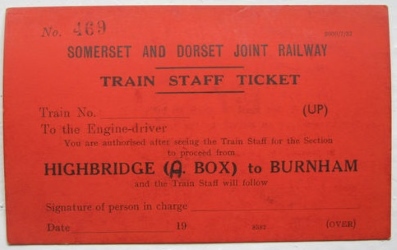
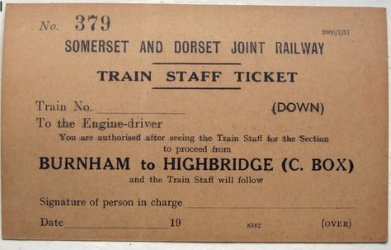
A few of the train staff tickets from the Burnham branch have survived and these illustrate the practice of having differently-coloured tickets for the 'Up' and 'Down' directions (see both TS&T tables above). Unused examples of both types are illustrated below. Although clearly from old S&DJR printed stock, it is known from other used examples that they continued to be used in British Railway (BR) days. Highbridge 'C' signal-box was renamed Highbridge East 'A' in 1949 and it will be seen that the 'Up' ticket has been amended accordingly (though only partially).
 |
 |
After the introduction of a limited amount of TS&T working (as described above), the next significant change to S&DJR single-line block working came with the introduction of the Electric Train Tablet (ETT) system. The first S&DJR single-line section to be equipped with ETT was BAILEY GATE - BROADSTONE on the new 'cut-off' line in Dorset (officially known as the 'Poole and Bournemouth Junction Railway'), which opened to goods traffic on 14-December-1885 (Minute 3298 of the S&DJR Officers' meeting on 29-December-1885). The exact date of the introduction of ETT working on that line is unknown, but certainly it was listed in S&DJR WTT Appendix dated 1-March-1886; there is more discussion on this matter here in the RailWest page on Bailey Gate. Minute 3417 of the S&DJR Officers' meeting on 30-December-1886 records that ETT working had been introduced between Bath and Radstock on 3rd October that year, between Binegar and Evercreech on 10th October and between Evercreech and Wimborne on 4th November. By the end of 1886 therefore all single-line sections on the entire S&DJR main line from Bath Single Line Junction to Wimborne S&D Junction and Broadstone were controlled by ETT, whilst the branches from Evercreech Junction to Burnham and from Glastonbury to Wells still used the Train Staff & Ticket system.
Instruments. Research into ETT working on the S&DJR has shown that at least four types of tablet instruments were used on the line at various times during its history, namely:-
The initial S&DJR ETT installations would have used the Tyer's No 1 instrument, as that was the only version which existed at that time. Not surprisingly, there was much similarity between the various ETT installations on the S&DJR and those on the London & South Western Railway (L&SWR). However the initial installation of Tyer's No 1 equipment on the S&DJR was more extensive than anywhere on the L&SWR, and some of it survived long after it had been superseded elsewhere on the L&SWR. Unfortunately with certain exceptions it is only in records from British Railways days that the various types of ETT equipment are identified specifically. However on the basis of available information (eg date of introduction, operating instructions etc) it has been possible to make certain assumptions about the type of equipment in use on any particular section and the information in these notes (and elsewhere in RailWest) should be read with that fact in mind. A full Register of all known S&DJR ETT sections and their tablet configurations can be found here.
[Note: the known use of Tyer's No 1 instruments by the L&SWR appears to have been confined to the Salisbury & Dorset Junction Railway between Alderbury Junction and West Moors, where it was introduced in March 1885. Thereafter the L&SWR appears to have installed no more ETT on its own lines until 1892, by which time it was using the later Tyer's No 3 instruments.]
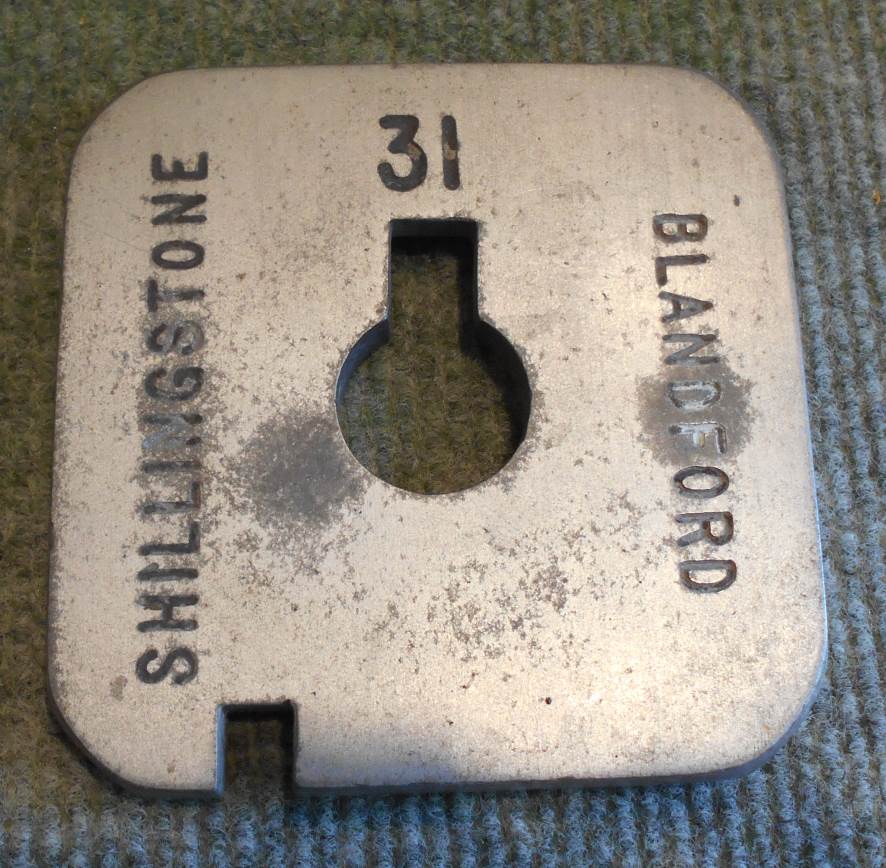
Tablets. It is unlikely that any tablets have survived from the original ETT installations of the 1880s and 1890s, but comparison with L&SWR examples would suggest that the tablets were made of steel with a brass plate inset in one face and engraved with the necessary information. Minute 5622 of the S&DJR Officers' meeting of 25-April-1904 records that:-
"The Locomotive Superintendent suggested the desirability of replacing the heavy train tablets now in use on the single sections of the Joint Line with fibre tablets, which are much lighter. The estimated cost of the alteration is £65, and as the withdrawal of the heavy tablets will considerably reduce the cost of maintenance of the pouches, &c., it was agreed to recommend that the expenditure be authorised."
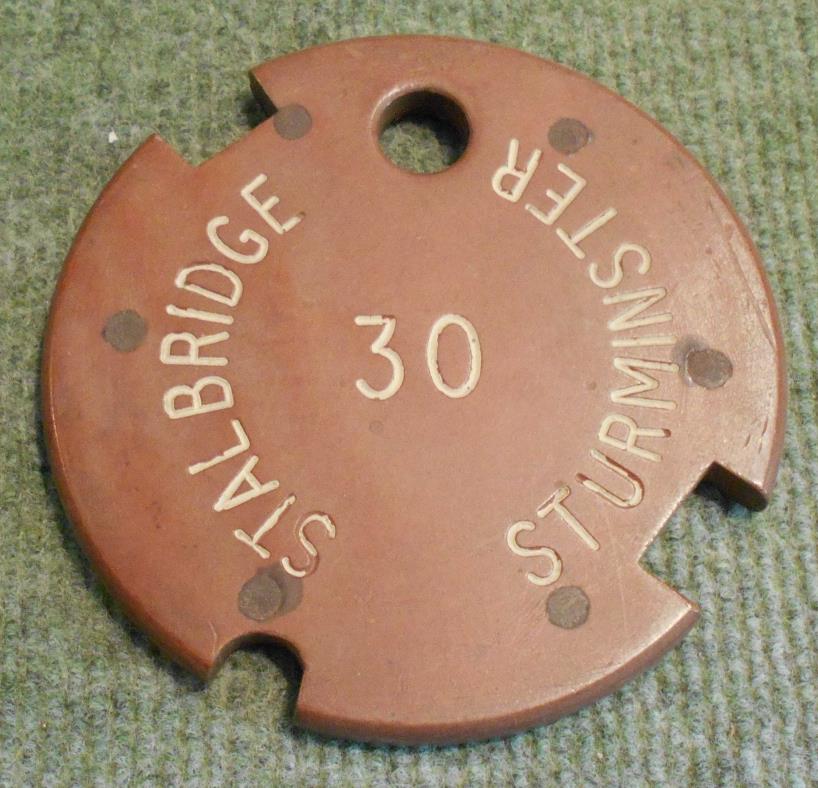
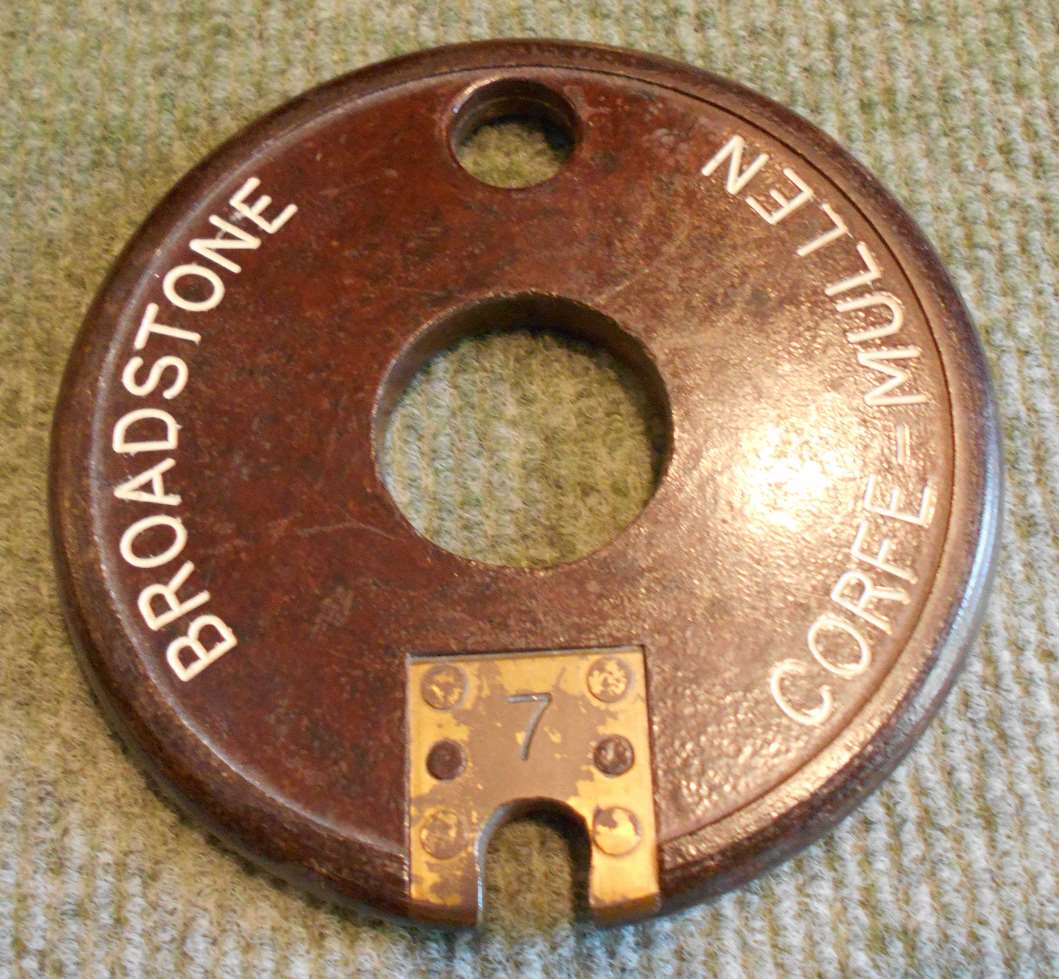
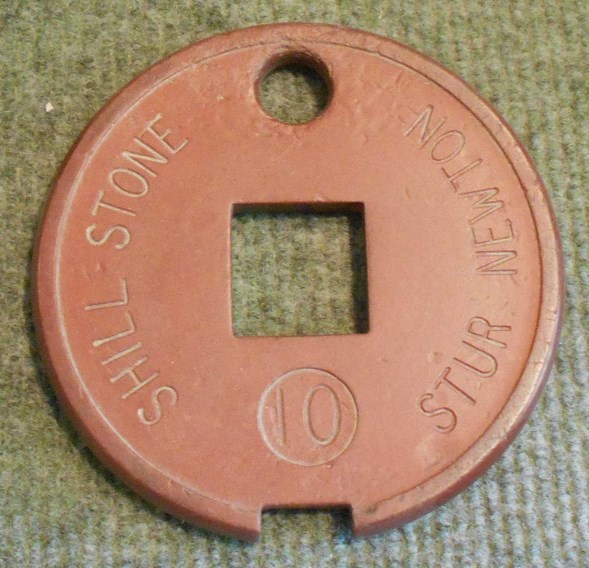
Although it is not known for certain if that change did take place, evidence would suggest that at least fibre tablets were used for a lot of future work, as most surviving examples are made from that material. There was an exception with the square tablets for the McKenzie & Holland instruments, of which all known surviving examples are made from alloy. An alloy Tyer's No 6 example exists from the BATH JUNCTION - MIDFORD section, but that may simply be an isolated example of a later replacement for a lost or damaged tablet as other known examples from that section are fibre. Sadly no survivors are known from any of the sections which used No 3 tablets. In the case of No 1 instruments it should be noted that the weight of the tablets was a critical factor in their correct operation when a tablet was inserted into the top of the machine, so any fibre examples had a fibre faceplate riveted to a steel backplate (see example on the left below).
[Note: the operating instructions for Tyer's No 1 instruments required tablets to be inserted into the instrument with the engraved face downwards, to ensure that the tablet was orientated correctly to check its configuration. This constraint did not apply to the Tyer's No 3 and No 6 instruments. It is not known what practice applied to the MacKenzie & Holland instruments.]
| Some examples of S&DJR Electric Train Tablets | ||||||
 |
 |
 |
 |
|||
| Tyer's No 1 tablet | Tyer's No 6 tablet | Tyer's No 6 tablet | McK&H square tablet | |||
| Tyer's No 3 and No 6 tablets were identical in size and style | ||||||
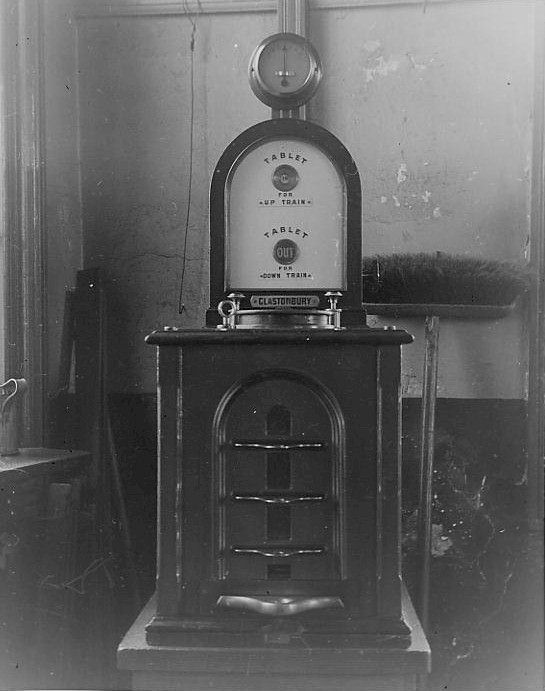 The
initial S&DJR ETT installations would have used the
Tyer's No 1 instrument, as that was the only version which existed at that
time, so by the end of 1886 therefore all single-line sections on the S&DJR main
line from Bath Single Line Junction to
Wimborne S&D Junction and
Broadstone would have been controlled by Tyer's No 1
instruments. After that initial phase of ETT installation it is considered unlikely that the S&DJR purchased
any further sets of Tyer's No 1 instruments for new work; subsequent ETT work involved the purchase of
equipment of later designs, or the re-allocation of existing instruments displaced as a
result of the piecemeal doubling of sections of the main line during the next two decades.
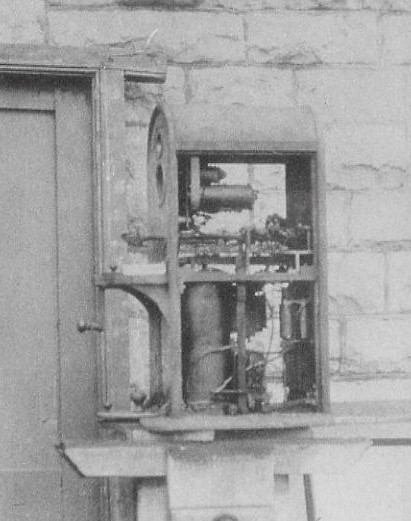
One example of that practice was the installation of ETT on the Wells Branch in
1895 and the photograph (click for larger image)
shows the Tyer's No 1 instrument in WELLS 'A' signal-box
in 1936.
The
initial S&DJR ETT installations would have used the
Tyer's No 1 instrument, as that was the only version which existed at that
time, so by the end of 1886 therefore all single-line sections on the S&DJR main
line from Bath Single Line Junction to
Wimborne S&D Junction and
Broadstone would have been controlled by Tyer's No 1
instruments. After that initial phase of ETT installation it is considered unlikely that the S&DJR purchased
any further sets of Tyer's No 1 instruments for new work; subsequent ETT work involved the purchase of
equipment of later designs, or the re-allocation of existing instruments displaced as a
result of the piecemeal doubling of sections of the main line during the next two decades.
One example of that practice was the installation of ETT on the Wells Branch in
1895 and the photograph (click for larger image)
shows the Tyer's No 1 instrument in WELLS 'A' signal-box
in 1936.
The next ETT installation after 1886 was Tyer's No 1 instruments on the GLASTONBURY - WEST PENNARD section, which were brought into use at noon on 23-April-1888; it is probable that these were the instruments recovered from the doubling of the SHEPTON MALLET - EVERCREECH NEW section on 5-February-1888. In 1892 the S&DJR decided (Officers' Minute 4138 of 27-October-1892) to transfer the Tyer's No 1 instruments from the BINEGAR - SHEPTON MALLET section (doubled 28-November-1892) to the EDINGTON JUNCTION - HIGHBRIDGE LOCO section and an undertaking for this was given to the BoT on 28-January-1893, but the actual date of introduction is unknown. It is unclear on what basis the S&DJR chose those two particular TS&T sections for their next conversions, but it may have been influenced by operating and/or traffic requirements.
S&DJR Officers' Minute 4423 dated 23-April-1895 records a decision that TS&T working on the Wells Branch would be superseded by ETT working by using the two instruments recovered from the 'Midford - Wellow widening', but a proposal dated 6-May-1895 in MT6/703/5 refers to the Radstock - Wellow doubling. The MIDFORD - WELLOW section had been doubled three years earlier on 27-August-1892 and it would seem a reasonable assumption that, at that time, the instrument in Wellow signal-box for the BATH SINGLE LINE JUNCTION - WELLOW section was transferred to the new signal-box at Midford. Therefore it is probable that the Tyer's No 1 instruments actually transferred to the Wells Branch were those released by the doubling of the WELLOW - RADSTOCK section on 29-June-1894.
The Tyer's No 1 instrument became a rare pattern on the railways of Great Britain during the early part of the 20th Century and the S&DJR was the last railway to retain them in their original, unconverted form. There were several subsequent changes to S&DJR ETT sections and equipment, but by 1948 Tyer's No 1 instruments were still in use on five S&DJR sections - three on the main line south of Templecombe Junction and two at Glastonbury. It has been said that the last S&DJR section to use Tyer's No 1 equipment was STURMINSTER NEWTON - SHILLINGSTONE (replaced by Tyer's No 6 in January 1951), and indeed an instrument from that section was transferred at a later date for display at the Science Museum in London (see Note below), but in fact that claim is relevant only to the main line. There is no known evidence to prove that Tyer's No 1 ETT did not remain on the Wells Branch until it closed in October 1951, whilst the GLASTONBURY - WEST PENNARD section retained Tyer's No 1 instruments until the introduction of Electric Key Token working in 1952.
[Note: the Tyer's No 1 ETT instrument sent to the Science Museum came from Sturminster Newton and is now at the National Railway Museum and catalogued as item 1964-330/1. A photograph of it can be seen in the Science & Society Picture Library as image number 10289084. It would appear that at some stage the side panel infills were replaced by glass so that the instrument's internal workings were visible.]
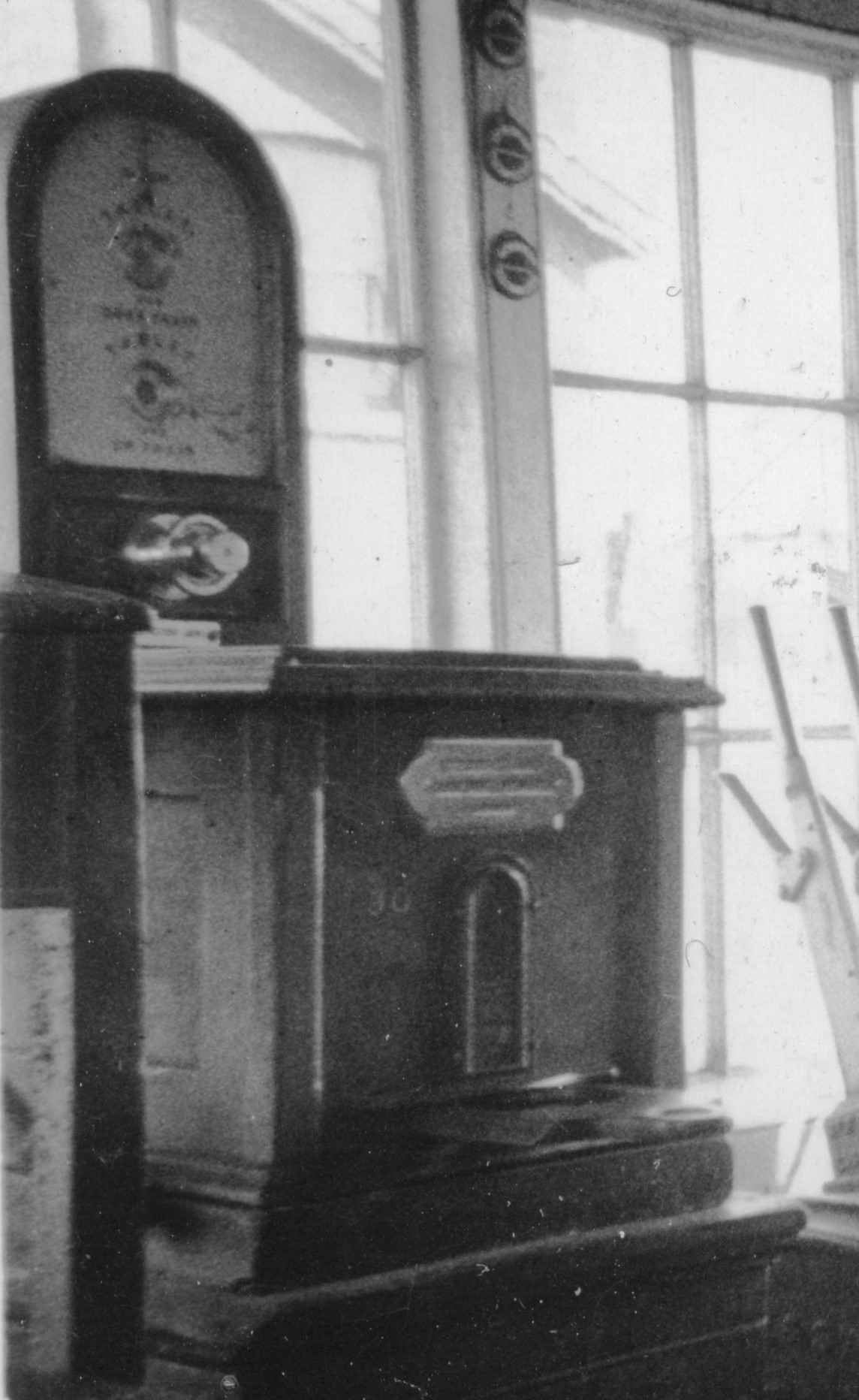 The first S&DJR installation to use the newer Tyer's No 3 pattern
of ETT instrument was the branch from Edington Junction to Bridgwater.
This photograph (click for larger image) is a partial view of the No 3
instrument in Bridgwater North signal-box in BR
days and sadly it is the only known illustration of a S&DJR No 3 instrument.
[Externally the No 3 instruments were identical in appearance to the later Tyer's No 6
pattern.] The line to Bridgwater was built by the independent Bridgwater Railway and opened on
21-July-1890, being worked from the outset as a single block section EDINGTON
JUNCTION - BRIDGWATER. The opening of the new signal-box at Edington Junction
resulted also in the splitting of the existing SHAPWICK -
HIGHBRIDGE LOCO section into two new sections, SHAPWICK
- EDINGTON JUNCTION and EDINGTON JUNCTION - HIGHBRIDGE
LOCO, and initially both these sections were worked by the Train
Staff & Ticket method.
The first S&DJR installation to use the newer Tyer's No 3 pattern
of ETT instrument was the branch from Edington Junction to Bridgwater.
This photograph (click for larger image) is a partial view of the No 3
instrument in Bridgwater North signal-box in BR
days and sadly it is the only known illustration of a S&DJR No 3 instrument.
[Externally the No 3 instruments were identical in appearance to the later Tyer's No 6
pattern.] The line to Bridgwater was built by the independent Bridgwater Railway and opened on
21-July-1890, being worked from the outset as a single block section EDINGTON
JUNCTION - BRIDGWATER. The opening of the new signal-box at Edington Junction
resulted also in the splitting of the existing SHAPWICK -
HIGHBRIDGE LOCO section into two new sections, SHAPWICK
- EDINGTON JUNCTION and EDINGTON JUNCTION - HIGHBRIDGE
LOCO, and initially both these sections were worked by the Train
Staff & Ticket method.
However in the following year the remaining TS&T sections between Evercreech Junction North and Edington Junction were converted to ETT working using Tyer's No 3 instruments. The sections EVERCREECH JUNCTION NORTH - PYLLE - WEST PENNARD were converted on 20-August-1891 between the passing of the No 6B Down (9.00am ex-Highbridge) and No 8B Up (10.25am ex-Evercreech Junction) trains. The sections GLASTONBURY - SHAPWICK - EDINGTON JUNCTION were converted on 8-September-1891 between the passing of the No 8B Up and No 11B Down (11.50 ex-Burnham) trains (S&DJR Officers' Minute 4008 dated 27-October-1891 and Traffic Superintendent's Circulars W/527 and W/531). Thereafter no further new sets of Tyer's No 3 instruments appear to have been introduced, as the S&DJR then moved to using the later Tyer's No 6 pattern.
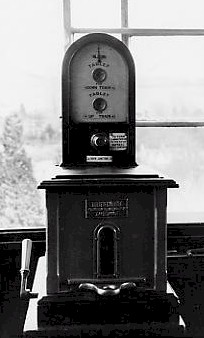 A further two types of
ETT instrument were introduced to the S&DJR in 1905, when a new passing-loop and signal-box were opened at
Stourpaine, splitting the existing single-line section between Shillingstone
and Blandford into two new sections. The Tyer's No 1 instruments on the original SHILLINGSTONE
- BLANDFORD section were removed (to be kept as spares?) and the Tyer's No 6 pattern was installed on the two new SHILLINGSTONE -
STOURPAINE - BLANDFORD sections. Externally the No 6 instruments looked the same
as the No 3 pattern, but they had the advantage of being 'returnable'.
[The No 6 instruments also used the same style and size of tablets as the No 3 pattern, so it was possible to upgrade a section from No 3 to No 6 without
having to replace the tablets.] The No 6 pattern
became increasingly common on the S&DJR in later years, because it was used during later changes as a replacement for existing No 1 and No 3
equipment. This photograph (click for larger image) shows one such
replacement No 6 instrument in Midford signal-box in 1966, where it was used for
controlling the section to Bath Junction.
A further two types of
ETT instrument were introduced to the S&DJR in 1905, when a new passing-loop and signal-box were opened at
Stourpaine, splitting the existing single-line section between Shillingstone
and Blandford into two new sections. The Tyer's No 1 instruments on the original SHILLINGSTONE
- BLANDFORD section were removed (to be kept as spares?) and the Tyer's No 6 pattern was installed on the two new SHILLINGSTONE -
STOURPAINE - BLANDFORD sections. Externally the No 6 instruments looked the same
as the No 3 pattern, but they had the advantage of being 'returnable'.
[The No 6 instruments also used the same style and size of tablets as the No 3 pattern, so it was possible to upgrade a section from No 3 to No 6 without
having to replace the tablets.] The No 6 pattern
became increasingly common on the S&DJR in later years, because it was used during later changes as a replacement for existing No 1 and No 3
equipment. This photograph (click for larger image) shows one such
replacement No 6 instrument in Midford signal-box in 1966, where it was used for
controlling the section to Bath Junction.
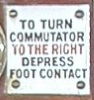 When a tablet was removed from a No 6 instrument the commutator was
locked in its left-hand position until that tablet had been returned to one
of the two instruments for that single-line section. It would appear that
many (if not all) of the S&DJR instruments incorporated a L&SWR feature
that, once the lever for the signal which controlled
entry into the single-line section had been reversed, it
had to be replaced to normal before the commutator could be turned back to
its right-hand position. This interlocking required a special additional
electro-magnetic lock within the ETT instrument, which was controlled by a
small plunger switch set into the floor adjacent to the ETT instrument and operated
by the signalman's foot (as he needed both hands when resetting the
instrument). A small enamel notice about this 'foot contact' was fixed on
the front of the ETT instrument, to the right of the commutator, as can be
seen in the photograph.
When a tablet was removed from a No 6 instrument the commutator was
locked in its left-hand position until that tablet had been returned to one
of the two instruments for that single-line section. It would appear that
many (if not all) of the S&DJR instruments incorporated a L&SWR feature
that, once the lever for the signal which controlled
entry into the single-line section had been reversed, it
had to be replaced to normal before the commutator could be turned back to
its right-hand position. This interlocking required a special additional
electro-magnetic lock within the ETT instrument, which was controlled by a
small plunger switch set into the floor adjacent to the ETT instrument and operated
by the signalman's foot (as he needed both hands when resetting the
instrument). A small enamel notice about this 'foot contact' was fixed on
the front of the ETT instrument, to the right of the commutator, as can be
seen in the photograph.
|
Stourpaine signal-box was equipped for 'switching-out' and the resulting SHILLINGSTONE - BLANDFORD 'long section' was worked by a pair of McKenzie & Holland (McK&H) 'square tablet' instruments installed in those two signal-boxes. These McK&H instruments were designed specifically for 'long section' working and they used square tablets to distinguish from the normal round tablets of the 'short' sections. This pattern of instrument was very rare in Great Britain and, apart from this solitary S&DJR section, only a few other sets on the Cambrian Railways are known. After all of the latter had been taken out of use then the S&DJR instruments remained as the only survivors until the abolition of Stourpaine signal-box and the S&DJR's only example of 'long section' ETT working in 1951. Photographic coverage of McK&H tablet instruments is very elusive and the only known picture of the S&DJR equipment shows the instrument at Blandford after it had been damaged by fire when the signal-box there was struck by lightning in 1906 (click picture for larger image). More details about the actual McK&H 'switching-out' process and its associated equipment can be found here in the RailWest page about Stourpaine box. |
Further ETT Comments.
Photographic coverage of actual S&DJR ETT instruments is very limited and colour images in particular are extremely rare; many instruments appear simply as incidental items in the background of a signal-box interior view. Consequently it can be very difficult to specific about some features, but the following should be noted:-
1. On some railways the 'face plate' surrounding the two circular indicators in the upper portion of Tyer's instruments was painted in a pale green colour. On some S&DJR instruments (in common with some ex-L&SWR instruments seen elsewhere) the face-plate appears to have been painted white, but it is not known if this colour scheme applied to all S&DJR examples.
2. Some S&DJR No 3 and No 6 instruments had a 2-digit number painted on the front of the lower casing in large white numerals. This was not a serial number (as mistakingly suggested by some commentators) but a record of the total number of tablets provided for that particular section (obviously split between the instruments at each end). All examples identified so far had 30 tablets per section. It is not known if the practice was applied to any of the No 1 or McK&H instruments.
3. There is circumstantial evidence to suggest that occasionally an ETT instrument may have been removed from a signal-box (for repair or refurbishment) and replaced by another example of the same type. It is possible, especially in later years as such instruments became scarce, that the replacement item may not have been identical in all respects to older S&DJR examples.
Prior to 1905 the available evidence suggests that only Tyer's No 1 and No 3 instruments were in use on the S&DJR. However the S&DJR WTT Appendix for 1905 contains 'Instructions for No 1 instruments' and 'Instructions for Nos 2 & 3 instruments', and the latter heading is puzzling because the method of operation of the Tyer's No 2 pattern was totally different from the No 3 type. It has been suggested that the S&DJR had slight variations in their No 3 instruments and allocated their own type numbers to them, but although it is possible that there were variations (ETT instruments were subject to various design modifications by Tyer) this theory is not supported by the evidence of later Appendices.
The new works of 1905 completed the introduction of the four different types of tablet instrument known to have been used on the S&DJR and also marked the fullest extent of ETT working on the line. Thereafter changes (other than the simple renewal of equipment by the same pattern) took place only as a result of the closure of sections or the replacement of equipment by a different pattern. The BLANDFORD - BAILEY GATE section had been doubled on 26-April-1901 and this would have released a pair of No 1 instruments for which there was no obvious destination, so probably they went into store as spares. The new Corfe Mullen Junction signal-box was opened on 16-April-1905 and the line from there to Bailey Gate was converted to normal double-track working, the existing single-line sections to Wimborne S&D Junction and Broadstone now starting at Corfe Mullen Junction; these sections continued to be worked by No 1 ETT and one may assume that the original instruments at Bailey Gate were transferred to the new box at Corfe Mullen Junction.
The next change probably was the replacement of the Tyer's No 1 instruments on the BATH SINGLE LINE JUNCTION - MIDFORD section, when it was agreed at an S&DJR Officers meeting on 23-January-1912 (Minute 6464) that "the original pattern introduced over 25 years ago" should be replaced at an estimated cost of £220, although the actual date of change is unknown. It is not known for certain that the replacement instruments were Tyer's No 6 pattern, but that type definitely was in use on this section in British Railways days. (Note: there is a reference to Tyer's No 3 ETT in L&SWR records of 1923, but that may be an error, as it seems unlikely that the S&DJR would have purchased any more non-returnable Tyer's No 3 instruments as late as 1912.) Subsequently Bath Single Line Junction box was closed on 13-April-1924, being taken over by a new Bath Junction box, and it is assumed that the existing ETT instrument was transferred there.
On 8-February-1929 the box at Pylle was reduced to ground-frame status, the block section then becoming EVERCREECH JUNCTION NORTH - WEST PENNARD using Tyer's No 3 instruments. The separate S&DJR signal-box at Wimborne Junction was closed on 1-April-1928 and the tablet instrument transferred to the Southern Railway Wimborne Junction box, but eventually on 17-June-1933 the CORFE MULLEN - WIMBORNE JUNCTION section was closed to all traffic and ETT working abolished. After 1933 there were no further changes to actual tablet sections prior to nationalisation of the railway in 1948, although equipment replacement continued. Tyer's No 1 ETT was still in use on the TEMPLECOMBE No 2 JUNCTION - STALBRIDGE section in 1932, but by 1939 it had been replaced by the Tyer's No 6 pattern. By 1938 the Tyer's No 1 instruments on the EDINGTON JUNCTION - HIGHBRIDGE LOCO section had been replaced also by the Tyer's No 6 pattern, perhaps as a result of the increase in facilities at the milk depot at Bason Bridge and/or the need for trains to be able to 'trip' from Highbridge and return.
After nationalisation British Railways (Southern Region) replaced the remaining sets of Tyer's No 1 instruments on the main line by the Tyer's No 6 type, the STURMINSTER NEWTON - SHILLINGSTONE section being the last to change on 14-January-1951 (see also Note below). The Wells Branch closed completely on 29-October-1951 and research suggests that it had retained Tyers No 1 ETT until that date. In the absence of any evidence to the contrary, it is believed that the very last pair of Tyer's No 1 instruments on the whole S&DJR were on the WEST PENNARD - GLASTONBURY section, which was converted to the new Electric Key Token system on 6-April-1952. On 18-December-1951 Stourpaine box and passing-loop were closed and the line from Shillingstone to Blandford reverted to being a single block section; this new section was worked by Tyer's No 6 ETT and the McKenzie & Holland instruments were removed. The Bridgwater Branch closed to passengers on 1-December-1952, but it retained Tyer's No 3 ETT until final closure to goods on 4-October-1954, a fact which gave that branch the unique distinction of having been both the first and the last S&DJR Tyer's No 3 ETT section.
[Note: in 1905 Shillingstone was one of the first S&DJR SBs (along with Stourpaine and Blandford) to be equipped with Tyer's No 6 ETT. When the section to Sturminster Newton was changed to No 6 ETT in 1951 it became also (along with Sturminster Newton) one of the last S&DJR SBs to be equipped with No 6 ETT.]
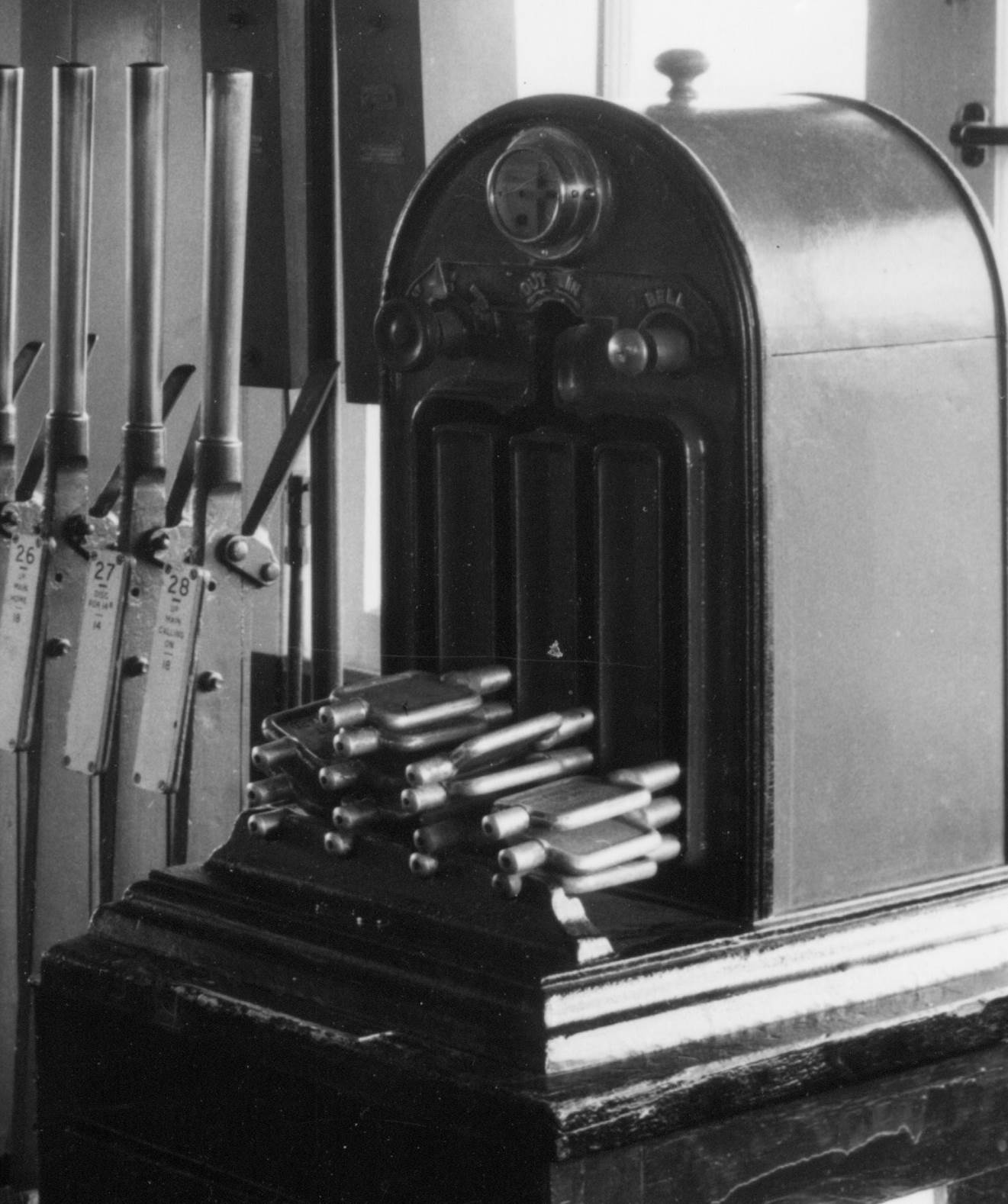 In 1950 the entire S&DJR network north of Cole came under the control of British
Railways (Western Region) (BR(WR)), who introduced yet another type of
single-line equipment to the line in the form of Electric Key Token (EKT)
instruments. However the EKT installations, which used instruments of BR(WR) pattern, were confined
to the branch from Evercreech Junction to
Highbridge. The EVERCREECH
JUNCTION NORTH - WEST PENNARD - GLASTONBURY sections were converted to EKT
working on 6-April-1952. At about the same time, although the exact date is unknown, further
conversions to EKT working took place on the various sections from
Glastonbury through to Highbridge East 'C' (the re-named 'Highbridge Loco' box). The photograph (click for larger image)
shows the EKT instrument at Glastonbury for the section to West Pennard.
In 1950 the entire S&DJR network north of Cole came under the control of British
Railways (Western Region) (BR(WR)), who introduced yet another type of
single-line equipment to the line in the form of Electric Key Token (EKT)
instruments. However the EKT installations, which used instruments of BR(WR) pattern, were confined
to the branch from Evercreech Junction to
Highbridge. The EVERCREECH
JUNCTION NORTH - WEST PENNARD - GLASTONBURY sections were converted to EKT
working on 6-April-1952. At about the same time, although the exact date is unknown, further
conversions to EKT working took place on the various sections from
Glastonbury through to Highbridge East 'C' (the re-named 'Highbridge Loco' box). The photograph (click for larger image)
shows the EKT instrument at Glastonbury for the section to West Pennard.
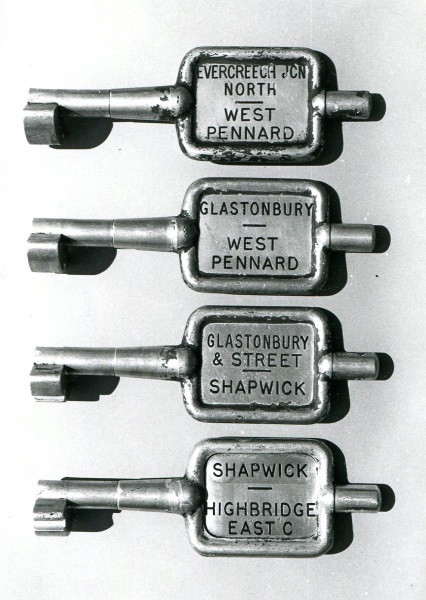
The closure of Edington Junction signal-box on 4-February-1956 meant the loss of one block section and thereafter the EKT sections were equipped with the following key configurations:-
| Examples of S&DJR Electric Key Tokens from the Highbridge Branch | ||||||||||
|
EVERCREECH JUNCTION NORTH - WEST PENNARD |
A |
 |
|
C | GLASTONBURY - SHAPWICK | |||||
| WEST PENNARD - GLASTONBURY | B | D | SHAPWICK - HIGHBRIDGE EAST 'C' | |||||||
| Click either photograph to see a larger image of all four tokens | ||||||||||
Note: in the absence of a known date for the introduction of EKT working west of Glastonbury, it has been assumed - based on circumstantial evidence from surviving records - that this took place before the abolition of Edington Junction signal-box. It is a matter for conjecture therefore as to which configuration was used for the Edington Junction - Highbridge East 'C' key tokens, although one may speculate that perhaps they were 'A' configuration. Although the use of 'D' configuration key tokens for the new Shapwick - Highbridge East 'C' section might imply the re-use of those from the previous Shapwick - Edington Junction section, it is curious that none of the surviving tokens from the new section show any trace of such a previous use, being either completely new tokens or else old tokens 'ground down' and completely re-engraved. Furthermore, if the tokens used for the new section were not the same configuration as those for the previous Edington Junction - Highbridge East 'C' section, then it would have been necessary to change the configuration of the lock on the intervening ground-frame at Bason Bridge Sidings. Therefore there remains some uncertainty regarding the precise arrangements during the 1952-56 period until such time as more definitive information may come to light.
By mid-1956 therefore ETT working remained only on the S&DJR main line, with all the sections there now using the Tyer's No 6 pattern. The Western Region considered converting the BATH JUNCTION - MIDFORD section to EKT and, at the same time, dispensing with the Whitaker automatic exchange apparatus on that section, or replacing it with either a modified version (as used on the Minehead and Barnstaple branches of the former Great Western Railway) or Manson equipment. However these ideas were dropped eventually in view of the expense that would be incurred by the need to replace also all the exchange apparatus on the ETT sections south of Templecombe Junction (which were controlled still by the Southern Region at that time) or the increased running times caused by the speed reductions if exchanging tablets by hand.
On 14-August-1964 the signal-box at West Pennard was closed and the EKT section became EVERCREECH JUNCTION NORTH - GLASTONBURY ('B' configuration). This was the last change of single-line sections to take place before the closure of the S&DJR to all passenger traffic in 1966, apart from the 1965 abolition of the Goods line at Highbridge described below.
There were a few S&DJR single-line sections which were worked by a method described variously as 'no-staff block' or 'GWR bell block'. The influence of the Great Western Railway (GWR) derives probably from the fact that these sections were involved with the various physical connections between the GWR and S&DJR. There are few known details about this system, but it seems to have been merely the use of GWR Spagnoletti 'disc' block instruments and bells (without any form of physical train staff). The reliance on instruments only is similar to the early 'block telegraph' method of single-line working and the use of this system may have been because all the block sections concerned were extremely short and in most cases the signal-boxes at each end were within sight of each other.
The sections controlled by 'no staff' working were:-
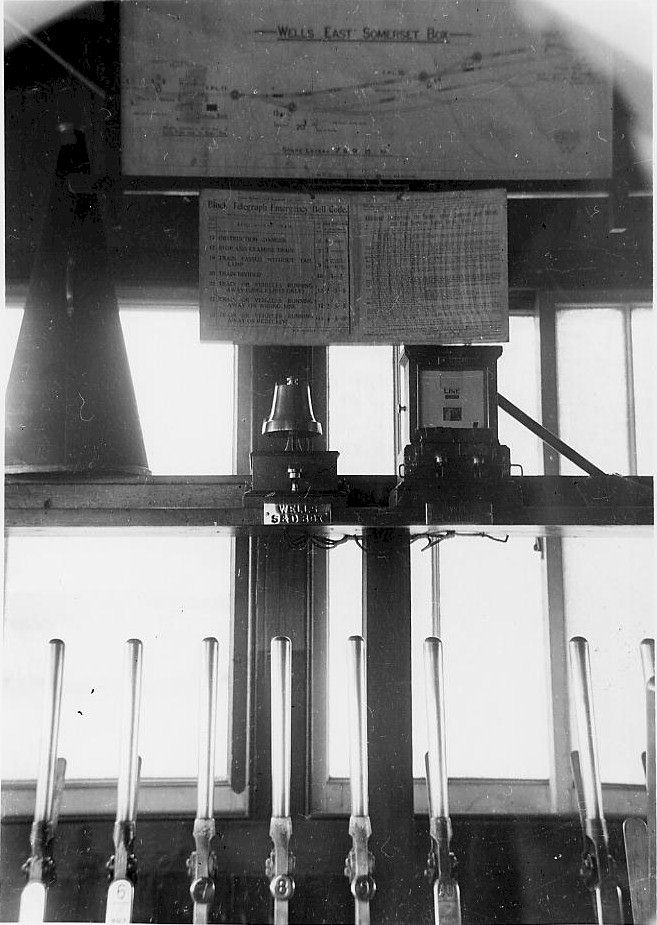
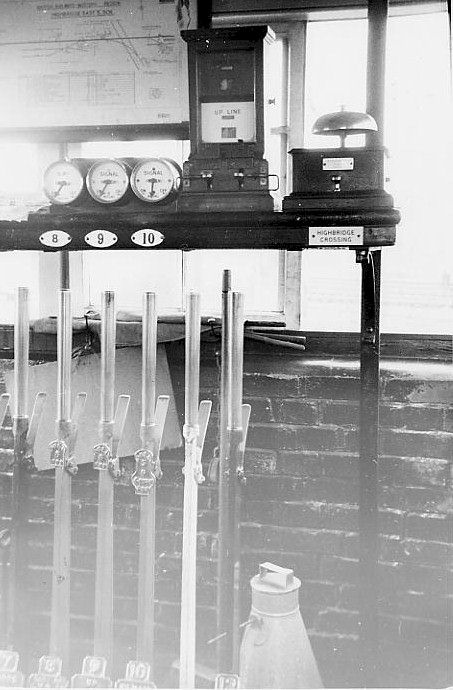
After the 'A' box at Highbridge was closed in 1914 the 'B' box worked to the GWR Highbridge West box (renamed Highbridge Crossing circa-1951). The upper photograph on the right was taken inside Wells East Somerset box in 1935 and shows a Spagnoletti block instrument of the pattern with a single indicator. The lower photograph is a later 1962 view inside Highbridge East 'B' of a double-indicator Spagnoletti block instrument for the section to Highbridge Crossing. Click either image for a larger complete photograph. [Note: the precise arrangements for block working between Highbridge 'A', 'B' and 'West' boxes prior to 1914 are unclear, but research is continuing and it is hoped to be able to add additional information to the RailWest page on Highbridge in due course.] An ex-Highbridge signalman has stated that the section between the 'B' and 'C' boxes at Highbridge was worked by bell only (without any block instruments) and this appears to be confirmed by other records, but further information would be welcomed. S&DJR records appear to suggest that the separate Goods line between those two signal-boxes also had bell-only block working. After the closure of the line to Burnham in 1963 it is believed that the 'main' single line between the Highbridge East 'B' and East 'A' boxes was closed also, but the Goods line remained in use (apparently still with 'bell block' working) until May 1965, when the remaining former S&DJR lines west of the ex-GWR lines were closed completely. |
|
|||||||||||||
|
© CJL Osment 2001-23
Tyer's No1 and Spagnoletti block instrument photographs © Ian Scrimgeour courtesy Signalling Record Society, Tyer's
No3 instrument photograph ©
Dennis Ashill courtesy David Bown, McKenzie & Holland instrument photograph courtesy Mike Christensen and Signalling Record Society,
EKT instrument photograph © David Milton, tablet colour photographs courtesy David McGhie,
Burnham train staff photograph courtesy the late Peter McGhie, Wells Branch train staff drawing courtesy the late Paul Fry.
References
|
|||||||
|
© West Country Railway Archives 2004 Page last updated: 02 March 2023 |
URL:
E-Mail: |
||||||