




 |
Somerset &
Dorset Joint Railway Yellow Ground Signals |
|
||||
|
||||||
This page deals specifically with the use of 'yellow' Ground Signals on the Somerset & Dorset Joint Railway (S&DJR). General information about the style and use of Ground Signals on the S&DJR can be found in a separate RailWest page on S&DJR Signals.
In older S&DJR signalling practice a ground signal would control only one route. For example, in the case of a ground signal at the exit from a set of sidings, where the 'trap point' led to a headshunt, the interlocking in the signal-box lever-frame would permit the signal to be cleared only when the points were reversed for exit onto the main line. This meant that any train shunting into the headshunt had to pass the ground signal in the 'on' position and one must assume that this was normal practice, as it is unlikely that signalmen were required to give hand signals for every such shunting move. After the 1923 Grouping of the railways in Great Britain there were general discussions amongst the various Railway Companies about the undesirability of movements passing red signals on a regular basis and these talks gave rise to the change to yellow arms for distant signals as well as the idea of 'yellow ground signals'.
Exactly when 'yellow ground signals' were introduced is unknown, but probably it was circa-1925/26. In a 'yellow' ground signal that part of the arm or disc normally coloured red is coloured yellow instead and there is a yellow light instead of red in the 'on' position. The yellow colour indicates to the driver that the signal may be passed in the 'on' position if the route for which it applies is not set. A typical use of such a signal would be in the example previously quoted above; if the siding points are normal, then a train may pass the ground signal in the 'on' position in order to shunt into the headshunt, but if the points are reversed then the signal must be obeyed. The use of the colour yellow is not to be confused with its use for the arms of distant signals, although it was the case that one S&DJR 'yellow' ground signal was used simply as a repeater for another 'red' ground signal further ahead.
 For all the original S&DJR installations of yellow ground signals the relevant
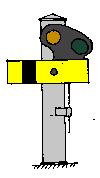
S&DJR Signal Instructions state that the signals were of the 'miniature semaphore arm' type,
with the face of the arm painted yellow with a vertical black band. This type of signal continued to be used
specifically for this purpose long after the Southern Railway had introduced the
'half disc' ground signal and 'yellow' versions of the 'half discs' (with a
horizontal yellow band on a black background for better contrast) were not introduced by British Railways (Southern Region) until about the early 1960s.
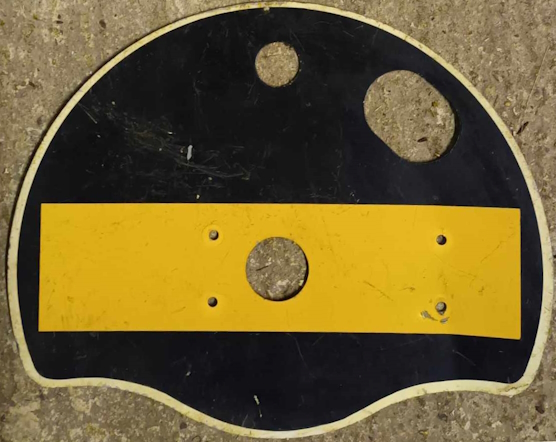
An example of a yellow/black 'half disc' was recovered from Blandford in 1969, but with limited photographic evidence it is not
known whether any more of the S&DJR's yellow ground signals were renewed with that pattern. There are no known examples
of a S&DJR Stevens 'drop-flap' ground signal being repainted with a yellow face.
For all the original S&DJR installations of yellow ground signals the relevant
S&DJR Signal Instructions state that the signals were of the 'miniature semaphore arm' type,
with the face of the arm painted yellow with a vertical black band. This type of signal continued to be used
specifically for this purpose long after the Southern Railway had introduced the
'half disc' ground signal and 'yellow' versions of the 'half discs' (with a
horizontal yellow band on a black background for better contrast) were not introduced by British Railways (Southern Region) until about the early 1960s.
An example of a yellow/black 'half disc' was recovered from Blandford in 1969, but with limited photographic evidence it is not
known whether any more of the S&DJR's yellow ground signals were renewed with that pattern. There are no known examples
of a S&DJR Stevens 'drop-flap' ground signal being repainted with a yellow face.
[Note: there were a few instances where 'drop flap' ground signals, because of poor sighting, had 'repeater' ground signals located some distance in rear. In the absence of any photographic or documentary evidence it is unclear whether the 'repeaters' were distinguished in any way from the 'main' signal, but all such examples pre-dated the introduction of 'yellow' ground signals.]
 A total of 14 yellow ground signals are known to have existed at seven S&DJR
locations prior to the formation of British Railways in 1948 and at least one
more installed thereafter. (See the
Register below for specific details of
all the installations.) The earliest example was installed at
Masbury on
6-November-1928, a further twelve were installed elsewhere in the following two years,
and the final example was installed at Corfe Mullen Junction
on 18-June-1933. Most,
but not all, of the installations coincided with layout alterations at the
relevant locations. There were other S&DJR locations where such signals could have been appropriate, but were
not installed, so perhaps existing practices were retained rather than incur additional
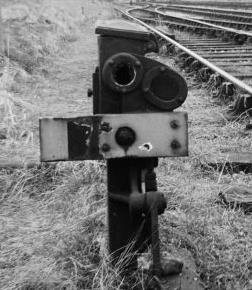
expenditure. Sadly there is limited photographic record of these ground signals, but two
examples at Glastonbury appear in
pictures from the 1960s and one of those (No 8PULL) is illustrated on the
right here.
A total of 14 yellow ground signals are known to have existed at seven S&DJR
locations prior to the formation of British Railways in 1948 and at least one
more installed thereafter. (See the
Register below for specific details of
all the installations.) The earliest example was installed at
Masbury on
6-November-1928, a further twelve were installed elsewhere in the following two years,
and the final example was installed at Corfe Mullen Junction
on 18-June-1933. Most,
but not all, of the installations coincided with layout alterations at the
relevant locations. There were other S&DJR locations where such signals could have been appropriate, but were
not installed, so perhaps existing practices were retained rather than incur additional
expenditure. Sadly there is limited photographic record of these ground signals, but two
examples at Glastonbury appear in
pictures from the 1960s and one of those (No 8PULL) is illustrated on the
right here.
The signal installed at Corfe Mullen Junction was different in that it was provided simply as a repeater signal for another (red) ground signal further ahead because of sighting difficulties. Another variation occurred at Henstridge in 1929 where there was a replacement, not just of the disc (8) which controlled movements out of the siding, but also of the disc (3) which controlled movements from the main line into the siding. It is probable (but can not be proven) that the latter change was done to eliminate a situation whereby Up trains passing through the station under authority of the main running signals had to pass a 'red' ground signal in the 'on' position and it may have been a quicker and cheaper solution than altering the interlocking to make signal 3 a 'running shunt'. No other comparable situation is known on the S&DJR.
It is a little unclear as to what further changes may have taken place during British Railways days, particular after much of the northern part of the line was taken over by BR(Western Region). A signal diagram for Glastonbury in the 1960s shows that ground signal 27 there had been converted to 'yellow' form at an unknown date (probably after closure of the Wells Branch in 1951). There is a reference also to yellow ground signals at Evercreech Junction South in a diagram for the 1960s, but photographic evidence (albeit black-and-white) does not seem to confirm this. Signal 17PULL at Blandford appears in the background of Plate 66 in Middleton Press's "Bournemouth to Evercreech Junction" book; that photograph is dated 13-August-1965 and the signal was still of the 'miniature semaphore' type at that time. However it should be noted that a yellow/black 'half-disc' face-plate was recovered privately from Blandford in 1969 (as seen here), although its precise origin is unknown.
The known examples of S&DJR yellow ground signals are listed in the Register below in line order. The lever number of the signal is given, together with the number of the relevant Signal Instruction which described the introduction of the signal and the date of that work (where known). Details of any other examples would be most welcomed.
| Register of S&DJR Yellow Ground Signals | |||
|---|---|---|---|
| Location | Signal Number | SI No | Date of Work |
| MASBURY | 10 | 289 | 6-Nov-1928 |
| HENSTRIDGE | 3, 8 | 291 | 7-Mar-1929 |
| STURMINSTER NEWTON | 5PUSH | 299 | 19/22-Dec-1929 |
| BLANDFORD | 17PULL | 304 | 10-Aug-1930 |
| 11PULL, 13PUSH, 19PUSH | 17-Aug-1930 | ||
| CORFE MULLEN JUNCTION | 13R | 338 | 18-Jun-1933 |
| WEST PENNARD | 5, 18 | 295 | 24-Nov-1929 |
| GLASTONBURY | 6PUSH, 6PULL, 8PULL | 300 | 28-Dec-1929 |
| 27 | - | 1950s? Note | |
Note. It is probable that this change did not occur until sometime after the closure of the Wells Branch in October 1951 and the conversion of the branch platform line at Glastonbury to a goods line (click here for more details).
© CJL Osment 2000-24
Miniature-arm signal graphic courtesy of John Hinson, yellow/black half-disc
face-plate photograph © Nigel McBay, Glastonbury signal photograph WCRA collection.
|
|||||||
|
© West Country Railway Archives 2000 Page last updated: 15 April 2024 |
URL:
E-Mail: |
||||||