



|
McCloud Rails
Equipment Roster Cabooses |
|
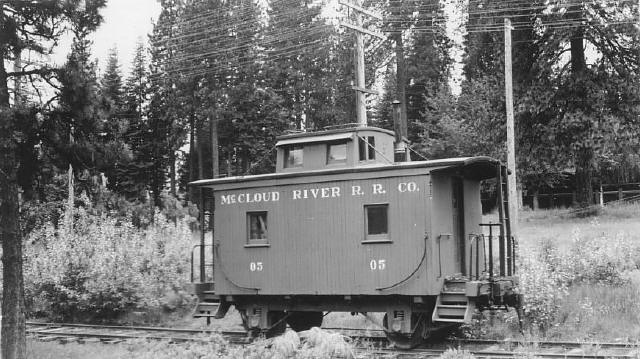
Caboose #05, from the George Landrock collection
|
|
Underlined numbers are clickable links to a photo page of that car. 2: 4-wheel caboose, known from a circa 1901 photograph. Retired prior to 1906; may have become #05. 03: Built in 1912 by the McCloud car shop as an arch roof combine. Converted to a caboose January 1939; Retired and scrapped 7/1945. 05: 4-wheel caboose, built in the McCloud car shop prior to 1906 (1900 according to 1917 ICC Valuation). Retired December 1942, with body incorporated into a rebuild of caboose #025 (see below). 07: 8-wheel caboose, built circa 1905 in the McCloud car shop. Car was built with rounded sliding doors in the sides to allow for the loading and unloading of freight. Was also the only caboose to carry a name, the Shasta. Retired January 1917, with the body was removed from the trucks and placed on the ground at Bartle, where it served as a wood shed until burned in 1937. 09: 4-wheel caboose, built in the McCloud car shop either in 1901 (according to 1917 ICC Valuation) or August 1908 (according to company records). Retired January 1939. 011: 4-wheel caboose, built in the McCloud car shop in November 1909. Retired January 1939. 015: 8-wheel caboose built in McCloud car shop in November 1914 to early Southern Pacific standard caboose plans. Car was equipped with side door to allow for loading and unloading of freight. Cupola had indicators as found on SP cabooses, and cabinet arrangement under the cupola was identical to SP cabooses. The railroad built the car specifically to display along with the #18 and a train at the Pan-Pacific Exposition in San Francisco through 1915, after which the car returned to McCloud and entered service. Retired November 1946, with body placed on the ground at Bartle and converted into a bath house for the section gang stationed there. Body burned in the early 1970's. 017: 8-wheel caboose, built in May 1919 in the McCloud car shop. Car was equipped with sliding side doors and a cupola, but the roof did not extend out over the platforms, leaving both open. Car was used primarily as a work caboose, mostly by the steel gang (track laying and removal crews) in the woods. Saw only limited use as a road caboose. Caboose was involved in a derailment at Young's Spur (between Hambone and Car A) on. July 14, 1945. Car was pushed out of the way and burned. 019: An early Union Pacific CA-class caboose built by or for U.P. around 1910. Purchased by McCloud River on December 31, 1929. Had sliding side doors cut into the carbody. The caboose was used primarily by the lumber company logging crews at White Horse. Car rode on the standard U.P. equalized caboose trucks of the era and gave a very comfortable ride. Was also equipped with indicators on the cupola. Retired February 1949 and scrapped at McCloud. 021: Built in the McCloud car shop in July 1937. Was identical to the #015 above, but did not have indicators on the cupola. Car was bad ordered in 1955 at Milpost GN 21.5, at the foot of Lava Hill and retired. Car sold to the owner of Hawkey Trucking Company, Anderson, CA, and moved to their yard. Car became derelict over the years and was donated circa 2004 to the Shasta-Cascade Railroad Preservation Association, who is deciding what to do with it. 023: The first of the ex-Great Northern 25-foot wood cabooses on the property. Was ex-GN #X344, purchased December 1939. Carbody as originally built, with a steel centersill and archbar trucks. Cupola side windows enlarged at McCloud. Cupola sat 5 or 6 inches higher than the rest of the following ex-GN cabooses. Car was bad ordered in 1955 at Milepost 31.5 (just west of Hambone). Car was initially sold to a group of railfans in the Bay Area, and eventually became property of the Western Railway Museum at Rio Vista Junction, CA, where it remains on display today. 025: ex-GN 25-foot wooden caboose, formerly GN #X-378. Acquired by McCloud River December 1939. After a few years of service a sliding door was cut into the sides of the car. A year or two later the body was badly damaged in a rear-end collision at Car A. The body from 4-wheel caboose #05 (see above) was then mounted on the frame, and the resulting car was used for several years by lumber company railroad crews working out of Pondosa until the old body from the #05 was found to be unsafe for futher use. A new half-body was then constructed in the McCloud car shops and mounted on the frame, with a large toolbox installed on the half open end of the car. Retired circa 1964 and sold to Yreka Western Railroad, who eventually renumbered it their #001 and named the car City of Yreka. Car transferred to Wallowa-Union Railroad, Elgin, Oregon, in June 2012 for use on that road. 027: ex-GN 25-foot wood caboose, formerly GN #X-579, purchased from GN in October 1940. One source indicates this car scrapped at McCloud circa 1962, while another source lists this car as sold to A&K Railroad Ties and used as an office in their Emeryville, CA, yard well into the 1970's. 029: ex-GN 25-foot wood caboose, was ex-GN #X433, purchased from GN July 31, 1944. First of the ex-GN cars to be re-built by that road before coming to McCloud, but was still riding on the old archbar trucks with outside hung brake beams and a wooden peaked roof. One source indicates the company purchased the car for president Phil Myer's exclusive use as an inspection car, but surviving correspondence between McCloud and the Great Northern indicated the railroad needed the car so that a caboose could be provided to a lumber company railroad crew that did not have one at that time. Car damaged circa 1957 in a wreck near Obie and retired. Car was then placed near the end of the remnant of Chippy Spur, where it saw use for several years as a hunting lodge, primarily by railroad employees. When vandalism started to affect the car it was sold to Bob Ferraris, the railroad's auditor. Mr. Ferraris hired some of the guys from the shop crew, and they spent some time greasing the car, testing the brake system, and getting it ready to move. Once it was ready to go the railroad's CAT 966 loader was brought down from the ballast pit at Porcupine to pull the car out to the mainline, where it was picked up by a regular freight returning from Lookout. Car was taken to the equipment storage yard just east of McCloud, where it was removed from the rails and trucked to the entrance of the Squaw Valley Trailer Court in McCloud, which was owned by Mr. Ferraris at the time. Mr. Ferraris gave the car a complete cosmetic restoration, including replacing the siding. Car remains on display at the entrance to the trailer park today. 031: ex-GN 25-foot wood caboose, formerly GN #X-472, acquired July 1947. Came from GN with a tarred canvas roof, cast steel trucks, and AB brakes. Donated 1964 to a proposed railroad museum to be located near Dunsmuir, CA. Collection assembled for the museum eventually ended up in the hands of the Railroad Park Resort. The #031 is currently houses the bathroom facilities of the restaurant in the resort. 033: ex-GN 25-foot wood caboose, formerly GN #X428, acquired from GN in 1949. Same description as the #031. Was used until September 1958 when it got away from a crew switching in the McCloud yards, along with four loads of lumber. The resulting five car runaway made it through downtow McCloud and onto the stub track to the south of town that ran to a bulk oil dealer. The cars derailed before reaching the dealer, and the caboose was destroyed in the resulting wreck. Scrapped. 034: ex-GN 25-foot wood caboose, was GN #X746, acquired August 1956 from GN. Caboose was retired circa 1964 and sold to Jim Nile of Mt. Shasta City for $25, which included delivery to any point on railroad. Car was moved to a location about one mile from the tracks near Milepost 10 on the Mt. Shasta City line, where it was used as a cabin. Car sold to Great Western Railroad Museum in 1983; to Shasta-Cascade Rail Preservation Society circa 2003; to Black Butte Center for Railroad Culture by early 2007. Moved to BBCRC land near Black Butte Yard on 7 June 2007. BBCRC placed the caboose on a short section of track and is restoring the car. 035/553: ex-GN 25-foot wood caboose, formerly GN #X-548, acquired November 1958 from GN. Car used in road service until retired from road service circa 1964, after which the railroad completely remodeled the car inside and out and turned into a VIP car. The railroad painted but did not number the car, though employee timetables referred to the car as "MR 553". Sold to the McCloud Railway Company in 1992. Car conveyed to a private party and moved off of the railroad's property in late 2006. 101: International wide-vision steel caboose, purchased new in 1962. Car was specially built to a custom short length. Car was the primary work caboose by the late 1980's. Sold to the McCloud Railway in 1992. Remained in service until mid-1997, when it was heavily damaged in a yard switching accident in the McCloud yard. Car sold to Shasta Cascade Rail Preservation Society in 2007, but remains in McCloud in 2012 awaiting shipment. 102: International wide-vision steel caboose, purchased new in 1962. Car was specially built to a custom short length. Car was out of service and stored derelict in the McCloud yards by the late 1980's. Car sold to McCloud Railway Company in 1992 and was restored to service in 1996. Car was used in the excursion trains until the #101's accident, at which time it became the working caboose on the railroad. In occassinal service on the McCloud Railway today. Leased Cabooses- In addition to the cabooses listed above, the railroad has also leased cabooses for short periods of time, including a couple Southern Pacific cabooses not otherwise identified and Western Pacific caboose #739. |
|
|
|
|