




| West Country Railway Archives |
 |
Lynton
and Barnstaple Railway An Outline History |
|
||
|
||||
The Lynton & Barnstaple Railway (L&BR) was a famous narrow-gauge railway line in North Devon, England. It was opened as an independent railway on 11th May 1898, taken over by the Southern Railway in 1923, and closed completely on 29th September 1935. However the memory of the line lives on, and much of the route survives, as do most of the original station buildings. It is now the subject of an active restoration project, and the first part was re-opened at Woody Bay station on 11th May 2003, 105 years to the day after the original opening of the railway.
 |
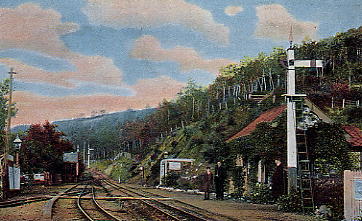 |
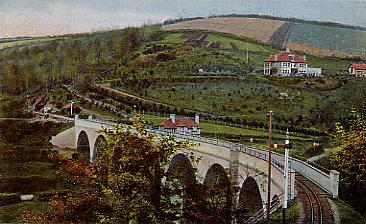
| Chelfham viaduct and station looking north circa-1900 | |
 The
L&BR was constructed as a 1' 11½" gauge single-track line from
Barnstaple across the western end of Exmoor (now a National Park) to a
terminus at Lynton. In Barnstaple the L&BR started from
Barnstaple Town station, which it shared with the standard gauge
London & South Western Railway (L&SWR) line to Ilfracombe. The
terminus at Lynton also served the adjacent harbour town of Lynmouth.
The
L&BR was constructed as a 1' 11½" gauge single-track line from
Barnstaple across the western end of Exmoor (now a National Park) to a
terminus at Lynton. In Barnstaple the L&BR started from
Barnstaple Town station, which it shared with the standard gauge
London & South Western Railway (L&SWR) line to Ilfracombe. The
terminus at Lynton also served the adjacent harbour town of Lynmouth.
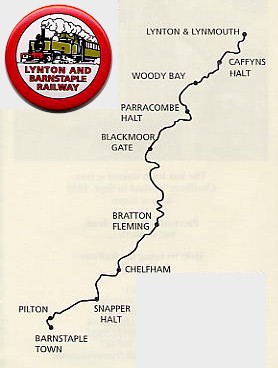
Passing-loops were provided at the four main intermediate stations on the line, namely Chelfham, Bratton Fleming, Blackmore (later re-named Blackmoor) and Wooda Bay (re-named Woody Bay in 1901). The first two of those has small, rectangular single-storey station buildings, whereas the other two and Lynton had larger buildings with a central two-storey section.
Halts were added later at Snapper (1903), Parracombe (1899) and Caffyns (1907). Parracombe was provided with a small pent-roof wooden shelter shortly after opening, but this was replaced in Southern Railway days by a pent-roof sectional concrete shelter. A shelter was added at Caffyns in 1912 and this was built of grey blocks with a tiled pitched roof. A similar style of shelter existed at Snapper, but constructed of concrete.
On the outskirts of Barnstaple, about a quarter of a mile from the Town station, the L&BR had their locomotive and carriage works at Pilton Yard (also known as Pilton Bridge or just Pilton). A signal-box and passing-loop were provided here and these form the subject of a separate page in RailWest.
A prominent feature on the line was Chelfham viaduct, the largest structure on a narrow-gauge railway in the United Kingdom. This viaduct still stands and was restored extensively in 2000.
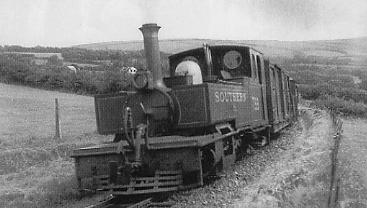 The
railway started its services with three Manning Wardle 2-6-2T locomotives, named
'Yeo' 'Exe' and 'Taw' after
local rivers, but shortly after opening a fourth locomotive 'Lyn'
was purchased. Because of supply problems at Manning Wardle this locomotive was
a 2-4-2T bought instead from Baldwin in America. In later years the Southern
Railway ordered a fifth engine 'Lew' from Manning Wardle and
this was similar to the original three engines. The passenger and goods
rolling-stock were of distinctive designs and all the original stock was built
by the Bristol Wagon and Carriage Works Company. In later years a few vehicles
were built by the L&BR themselves at Pilton, including Brake Van No 23, and in
1927 the Southern Railway purchased more goods stock from J&F Howard Ltd of
Bedford. Click here
to see a picture of Brake Van No 23 nearing completion of restoration in 2003.
The
railway started its services with three Manning Wardle 2-6-2T locomotives, named
'Yeo' 'Exe' and 'Taw' after
local rivers, but shortly after opening a fourth locomotive 'Lyn'
was purchased. Because of supply problems at Manning Wardle this locomotive was
a 2-4-2T bought instead from Baldwin in America. In later years the Southern
Railway ordered a fifth engine 'Lew' from Manning Wardle and
this was similar to the original three engines. The passenger and goods
rolling-stock were of distinctive designs and all the original stock was built
by the Bristol Wagon and Carriage Works Company. In later years a few vehicles
were built by the L&BR themselves at Pilton, including Brake Van No 23, and in
1927 the Southern Railway purchased more goods stock from J&F Howard Ltd of
Bedford. Click here
to see a picture of Brake Van No 23 nearing completion of restoration in 2003.
Further details will be added to this page in due course, but in the meantime please see the Minor Railways Index for details of other L&BR-related pages already on RailWest. For more detailed information about the history of the line, and the progress of current efforts to re-open further sections of it, please visit the web-site of the Lynton & Barnstaple Railway, and also the Barnstaple & Yeo Valley Railway Trust who are working to secure more sections of the former trackbed for future use by the L&BR.
© CJL Osment 2002-26
Map based on original courtesy Tony Nicholson, Chelfham pictures WCRA
collection, 'Yeo' photograph courtesy Lens of Sutton.
 |
Interested in
the Lynton & Barnstaple Railway? Then why not join the Lynton & Barnstaple Railway Trust and help to re-build England's premier narrow-gauge line? |
|
|||||||
| © West Country Railway Archives 2002 Page last updated: 07 September 2026 |
URL:
E-Mail: |
||||||