




 |
Somerset & Dorset Joint Railway Bailey Gate Crossing |
|
|||||||
|
|||||||||
Bailey Gate Crossing was located at the southern end of the 'main line' of the Somerset & Dorset Joint Railway (S&DJR) between the station at Bailey Gate and the junction at Corfe Mullen, where the S&DJR routes to Wimborne and Broadstone diverged. Apart from the crossing-keeper's house and a signal-box this location was simply an intermediate level-crossing on the railway line, although some sidings were provided here during World War 1 to serve a pumping-station for the Admiralty.
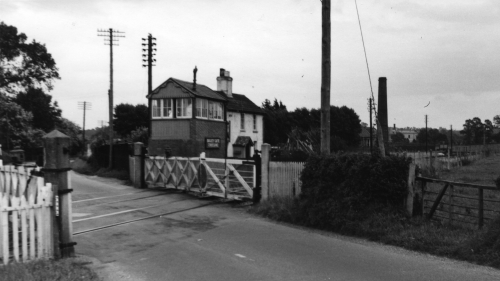
A view of Bailey Gate Crossing in 1957 looking down the line
The southern part of the S&DJR had been constructed by the Dorset Central Railway (DCR), with the first part opening in 1860 as a single-track line running northwest from Wimborne to Blandford. The first station north of Wimborne was at Bailey Gate and between those two places there were three manned public level-crossings:- Lake Crossing, Corfe Mullen Crossing and Bailey Gate Crossing itself. Bailey Gate Crossing was on the main road from Wimborne to Dorchester (later the A31), about half a mile south of Bailey Gate station, whilst the other two crossings were at minor roads. Very little is known about the early signalling on the DCR, but eventually all three crossings were provided with resident crossing-keepers and some form of signalling, although only the latter two are believed to have had actual gate boxes. It is possible that the original installation at Bailey Gate Crossing was little different from that which existed at Lake Crossing.
S&DJR trains originally had to reverse at Wimborne in order to run over the London & South Western Railway (L&SWR) line to Bournemouth. To ease this problem a new single-track 'cut-off' line was constructed eventually, which left the S&DJR route at Corfe Mullen and ran south-eastwards to rejoin the L&SWR at Broadstone. Known officially as the 'Poole & Bournemouth Junction Railway', it was brought into use for goods traffic in December 1885 and for passenger traffic by November the following year. Although the actual divergence from the original DCR route was at Corfe Mullen there was no physical junction there, but instead the Wimborne and Broadstone lines continued north-westwards as parallel single-lines as far as a new junction at Bailey Gate station, so thereafter the level-crossing at Bailey Gate Crossing spanned two parallel single-lines.
[Note: the new line has been labelled variously as the 'Broadstone cut-off', the 'Corfe Mullen cut-off' or the 'Wimborne cut-off' by different historians. It could argued that the Wimborne epithet is the most appropriate, given that the line 'cut off' that part of the original route which went via Wimborne, but equally the Broadstone epithet could be used to describe a line which 'cut off' from the original route to go towards Broadstone. More information about the initial 1885-86 period of the 'cut-off' can be found here in the RailWest page about Bailey Gate station.]
Local instructions for Bailey Gate Crossing appear in various surviving editions of the S&DJR Working Timetable (WTT) Appendix for the period 1886-1905. (Click here to read the instructions from the 1889 edition.) From these it would appear that the gates at the crossing were kept normally across the railway, so the crossing-keeper would have to be close them across the road and clear the signals for the passage of any train. It was the task of the signalman at Bailey Gate to inform the Corfe Mullen crossing-keeper of the approach of any Up or Down train on either line by means of the appropriate bell-code, and a 'repeater' bell on the same circuit was installed at Bailey Gate Crossing for the information of the crossing-keeper there.
| Bell Codes from Bailey Gate to Bailey Gate Crossing | |
|---|---|
| To Call Attention | 1 Beat |
| Up Train left Wimborne | 2 Beats |
| Up Train left Broadstone | 3 Beats |
| Down Train left Bailey Gate for Wimborne | 4 Beats |
| Down Train left Bailey Gate for Broadstone | 5 Beats |
For most of its existence the signalling at Bailey Gate Crossing was controlled from a two-storey signal-box located on the Down side of the line on the Wimborne side of the road, between the road and the crossing-keeper's cottage. As a non-block post for most of its life, it is usually listed as a ground-frame (GF). However, to avoid confusion with the separate GF provided for the Admiralty sidings in later years, and given its similarity to other S&DJR signal-boxes, the actual structure has been described as a 'signal-box' in this page.
The history of this signal-box is something of a mystery. When it was inspected by the Board of Trade in 1905 (The National Archives (TNA)file MT6/1373/4) in connection with the change to double-track working in that year, it was mentioned specifically as an existing box with a 7-lever interlocking frame and a wheel for the gates. Although nothing is known about any early DCR gate-boxes, it would seem likely that any original gate-box at Bailey Gate Crossing would have been little more than a small ground-level hut. It is unclear when that original gate-box might have been replaced, but the opening of the 'cut-off' line to Broadstone in 1885 might have been the catalyst for the provision of a more substantial signal-box. Although the signal-box would have had to control the passage of trains in both directions on both lines, it is possible that only one set of Distant and Home signals were provided for each direction; as their purpose was merely to indicate to approaching trains whether the gates were open for rail traffic or not, then in each direction one set of signals could have applied to both lines.
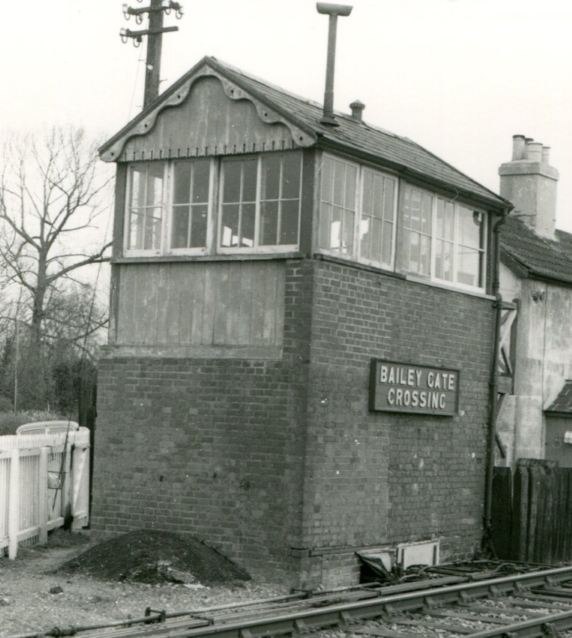 |
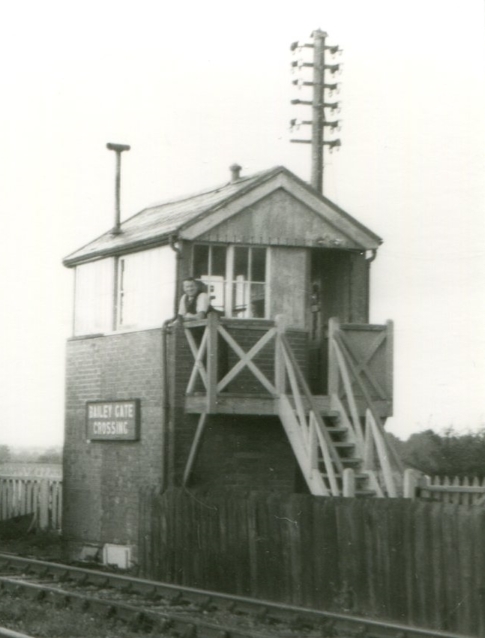
The signal-box had a timber superstructure on a brick base. It is known that the building was extended by 6 feet at the north (Up) end circa-1915 (in connection with the addition of the Admiralty Sidings), and all the known photographs of it date from after that alteration. The superstructure had several features of S&DJR Type 2 boxes, including the decorative 'wavy' barge-boards (on the north end only), decorative edging to the timberwork in the gables above the windows, and vertical boarding, but the windows are completely different. The brick-work has been extended upwards on the front and south end walls, but not the north end (there are no known views of the back wall), so was this part of the 1915 work or a later alteration (possibly because of rot)? It is probable therefore that this was originally a S&DJR Type 2 box, which would support the theory that it might have been constructed originally circa-1885. |
 |
||
| North end of box c.1965 Click picture for larger image |
South end of box c.1965 Click picture for larger image |
The use of two parallel single-lines came to an end in 1905, when a physical junction between the 'old' and 'new' lines was constructed at Corfe Mullen and a new Corfe Mullen Junction signal-box was opened there on 16-April-1905 (TNA file MT6/1373/4). The junction at Bailey Gate was removed and henceforth the two separate single lines from Bailey Gate to Corfe Mullen Junction were worked as ordinary double-track and controlled by the standard S&DJR block telegraph. There was just a single block section Bailey Gate - Corfe Mullen Junction, with Bailey Gate Crossing remaining as an intermediate non-block post of ground-frame (GF) status.
In readiness for this change the existing Up Home, Down Distant and Down Home signals at Bailey Gate Crossing were replaced by new signals which were brought into use on 3-April-1905 (S&DJR Signal Instruction No 180). The replacement Down Home signal included a left-hand bracket for the 'to Wimborne' Distant signal for the new Corfe Mullen Junction signal-box, although that additional arm was not brought into use until the new signal-box was opened.
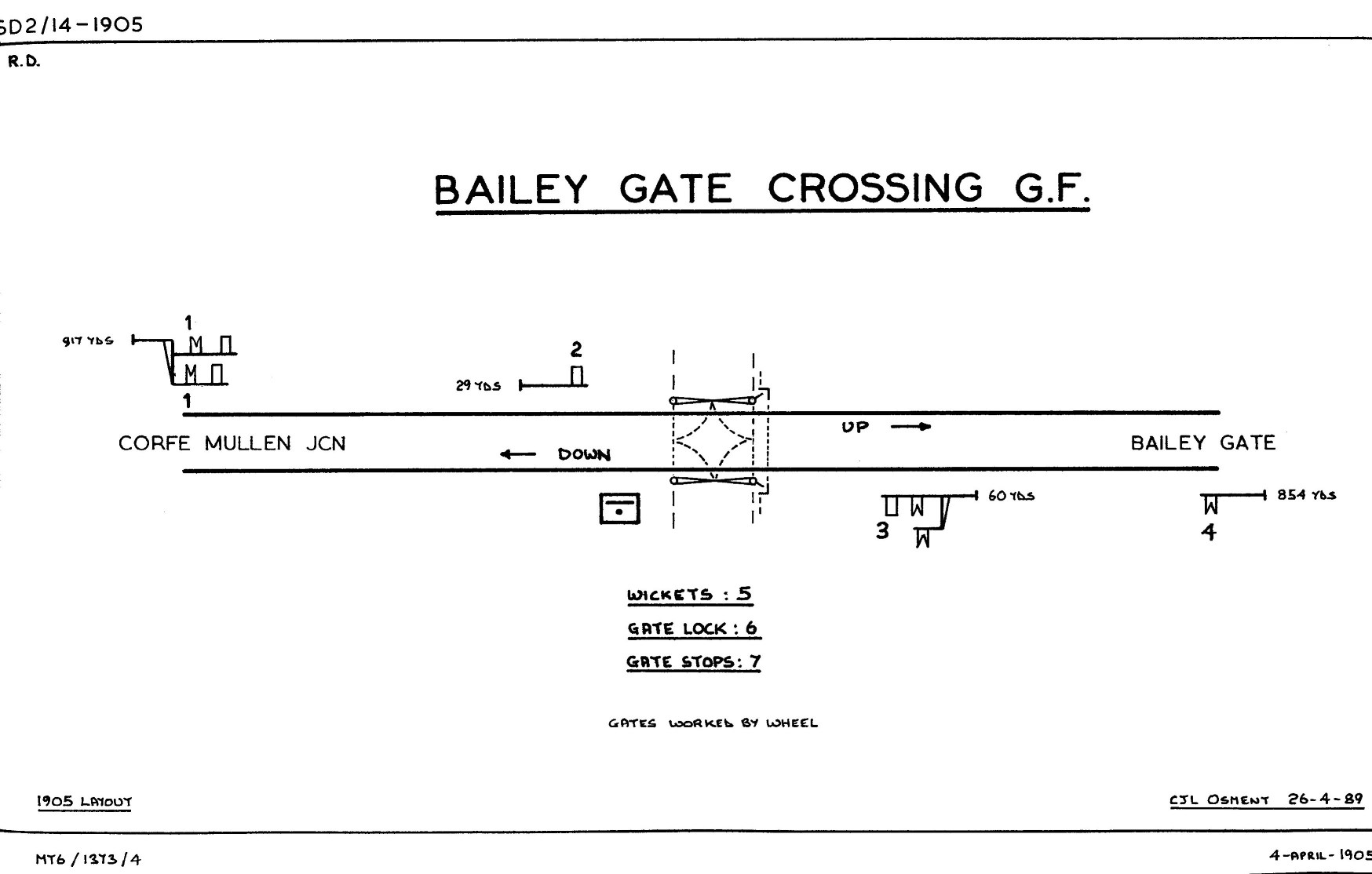
Bailey Gate Crossing GF Diagram 1905
Click diagram for larger image
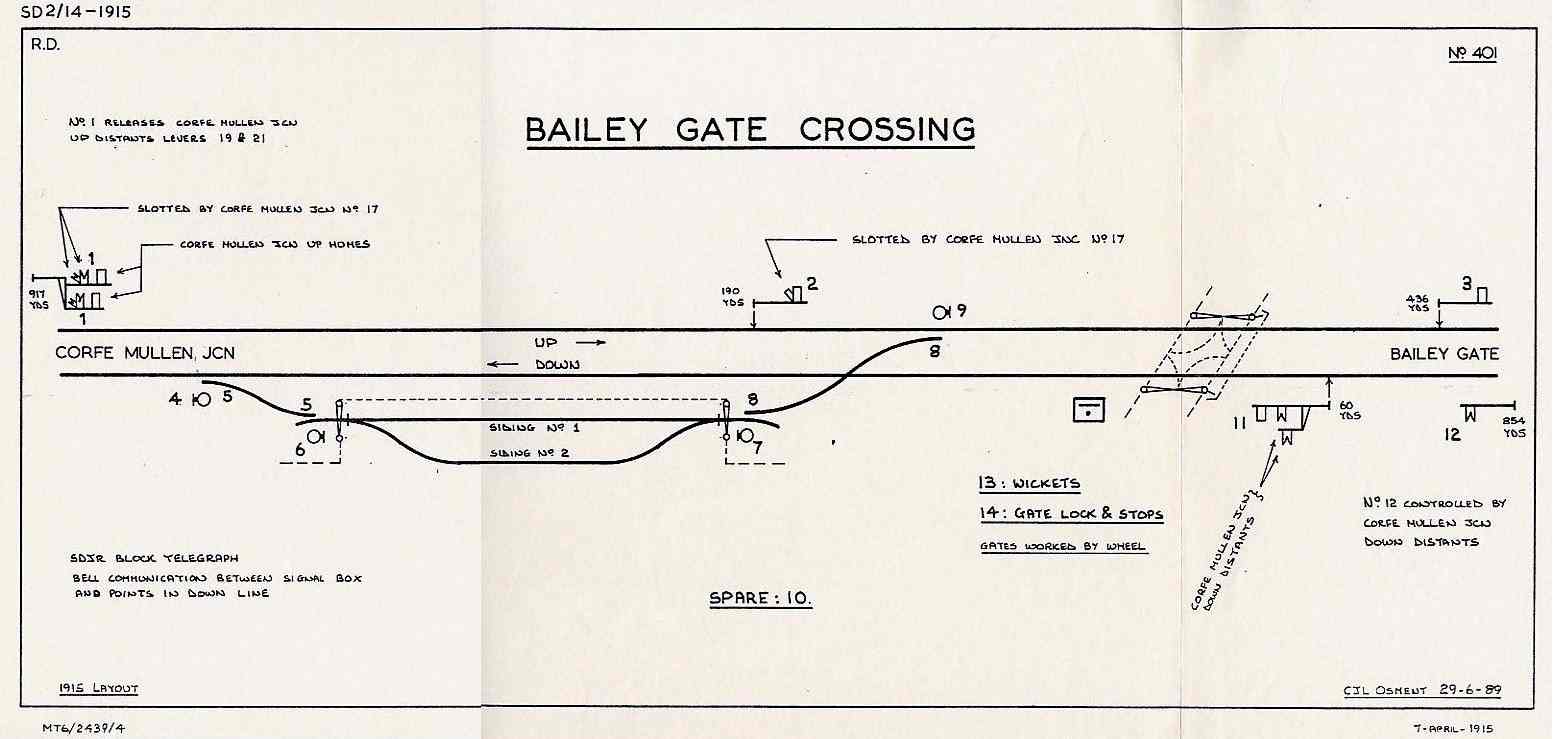
During World War 1 some new sidings were constructed for the Admiralty on the down side of the line between Bailey Gate Crossing and Corfe Mullen Junction and these were connected into both the Up and Down lines (TNA file MT6/2439/4). The precise date for this work is unknown, but it is believed to have been completed during 1915. The new connections were worked from Bailey Gate Crossing, where the lever-frame was increased from 7 to 14 levers; at this time the frame was recorded as being of the Stevens pattern with levers at 4.1/8" centres. The signal-box itself was extended by 6 feet at the north end and upgraded to block-post status, the block sections now being Bailey Gate - Bailey Gate Crossing and Bailey Gate Crossing - Corfe Mullen Junction. The new connection into the Up line meant that Bailey Gate Crossing's Up Home signal (2) had to be moved some distance further south towards Corfe Mullen Junction, after which it was slotted to act also as Corfe Mullen Junction's Up Starting signal and the existing Corfe Mullen Junction Up Starting was removed.
 |
 |
|
| Bailey Gate Crossing Signal Diagram
1915 Click diagram for larger image |
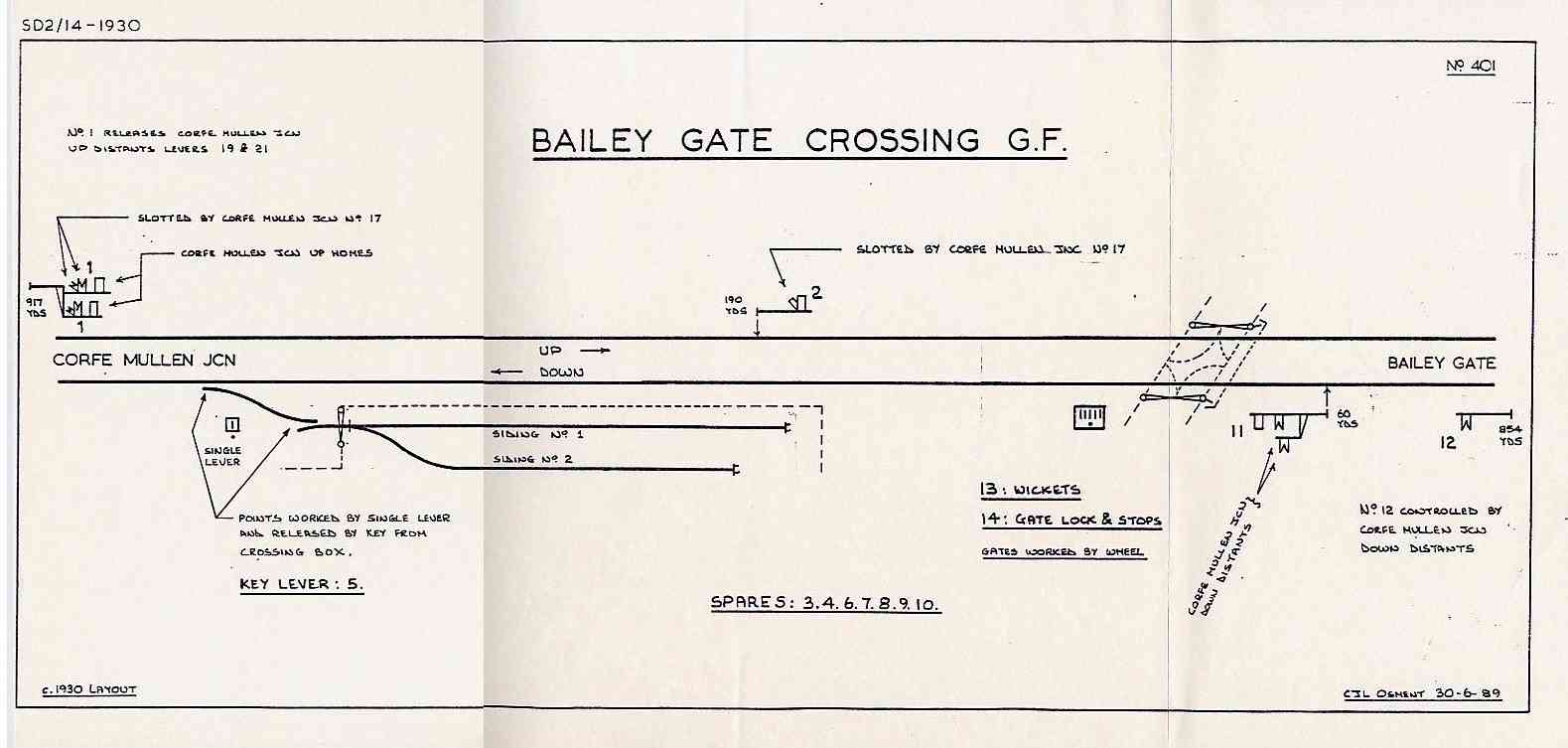
Bailey Gate Crossing GF Diagram 1930 Click diagram for larger image |
However Bailey Gate Crossing did not retain its new block-post status for very long after the end of the War and on 5-April-1923 the box was reduced to GF status again. A relay bell and block indicators were provided in the circuit for the new Bailey Gate - Corfe Mullen Junction block section. The connection from the sidings into the Up line (points 8) and its shunt signals were abolished, but the sidings and connection into the Down line remained in use, as did the arrangement of the combined Bailey Gate Crossing Up Home/Corfe Mullen Junction Up Starting signal. The remaining connection into the sidings (points 5) was disconnected from the signal-box and worked instead from a new 1-lever GF installed adjacent to the points (the shunt signals were abolished); this GF was unlocked by an Annetts Key kept in a lock with lever 5 in the signal-box. These changes were covered by S&DJR Signal Instruction 272.
With the passage of time the rail traffic over the 'cut off' line to Broadstone increased to such an extent that plans were prepared during the 1920s for the doubling of the single-line section from Corfe Mullen Junction to Broadstone Junction. At the same time it was proposed to eliminate Bailey Gate level crossing by replacing it with a road overbridge and as a result of those works Bailey Gate Crossing signal-box would have been closed. However the proposals never came to fruition and so the signal-box remained in use for many more years.
The level-crossing gates were repaired on many occasions after being damaged by road vehicles, although on at least one occasion they were hit by a train. The Down Home (11) and Corfe Mullen Down Distant signals were converted to upper-quadrant arms on 23-September-1953, whilst the same conversion was done to the Up Home signal (2) four years later in 1957. In November/December 1958 the gates layout was altered and there were some associated changes to the interlocking of the associated levers, which resulted in the re-allocation of the functions of some of the levers at the right-hand end of the lever-frame. Lever 10 became the Down Home, 11 became the Down Distant, 12 worked the Wicket gates, 13 worked the Locks on the road gates and 14 now worked only the Stops for the road gates. In December 1959 the Admiralty sidings, points and GF were abolished; Weekly Notice P/EW48 states that this took place on 20th December, but local records quote 12th December.
On 6-March-1966 passenger services ceased on the whole of the S&DJR and most of the line was closed, but a few sections remained open for goods traffic and this included the line from Broadstone as far north as Blandford. During 1966 the Up line was taken out of use and all traffic was worked in both directions over the Down line. The arms and lamps were removed from all the signals and a white marker light was provided on the post of the former Down Distant signal (11). Warning boards worded 'STOP DO NOT PROCEED WITHOUT PERMISSION' were erected on each side of the level-crossing to face approaching trains. Various dates have been quoted for this work, but according to Weekly Notice P/EW27 it took place on 24-July-1966.
It would appear that the signal-box (which had been a GF already since 1923) remained in use simply to control the level-crossing gates and their associated locks, but eventually it was closed on 7-May-1968. The line itself was closed finally on 6-January-1969. The crossing-keeper's house remained as a private residence for many years, complete with the brick base of the signal-box in its garden, but eventually both were demolished in 1999 and a new bungalow was built on the site. The track-bed now forms part of the North Dorset Trailway.
© CJL Osment 2000-2023
1957 photograph John Eyers collection
South Western Circle, other photographs WCRA collection.
|
|||||||
|
© West Country Railway Archives 2000 Page last updated: 04 March 2023 |
URL:
E-Mail: |
||||||