Related pages
- Index - Home
- Track Plan, Map
- Latest News
- Locomotives
- Rollingstock
- Bridges
- Buildings
- Line Side
- Description
- History
- Links
- Basement

|

Description of the line.
The line starts from the the town at Shenanigans Wharf Station, located on Ocean Bay.
All ships off-load their goods, sometimes including, visiting locomotives or rail wagons, onto the oddly named
Grasshopper Siding, the derivation of that name was known to only a few local founders of the railway and is lost in time.
Trains leave the coastal town heading inland over the coastal plain and crossing back and forth over
Goanna Creek before commencing the accent of the foothills.
The first noteworthy bridge, Brumby Bridge, is a Heritage Listed one-of-a-kind eight bay truss built on site by local bridge carpenters.
It is a fine example of simplicity, well-selected timber and skilled timber construction. This structure spans
Brumby Gully,
so named when wild horses were found watering there some days after they broke out of a poorly built split log fenced paddock near the town wharf.
They had been mustered and driven to the wharf, destined for loading on a ship for use by the state military detachment.
All attempts to re-catch these Brumby's failed and they were never seen again.
Travelling through heavily wooded flat country we come to Amber Junction where the line can take either route and still reach our destination.
If we go right at the junction, we come to Finch Haven the station that reflects the large numbers of
Finches that populate this grassland at the start of the foothills. The line starts to climb around Hammock Hill
named for a hammock where a local youth used to lay and read alone. Trains proceed on to Mosquito Flats Deviation.
Then we start of the steep accent on the mountain range ahead.
Back at Amber Junction, there is an option, to bare left via Purgatory Scrub. The crews of descending trains dreaded this last steep grade
before braking to a halt at this station that serves a village of that name. Here the residents are mostly railway fettler's families and this is where
all the raw materials for repairs and maintenance are held in the railway yard and depot. While it may seem at first glance a sleepy and boring little place,
it is quiet and the abundance of rainforest bird life here is truly amazing, to just stop and listen is a wonderful,
unforgettable experience that brightens this area.
Now the trains begin the hard slog up the steep and winding alignment, the terrain becomes more heavily timbered here.
The next locality is called Devil's Pinch and while the line does turn sharply just near the station
(the usual meaning of a 'Pinch' is a tight pass or squeeze) through heavy rainforest, the railway gangs who built the line called it
Devil's Pinch for a different reason. The lush tropical palms in this area have long thorns that spicked the men as they worked through the jungle to
clear the way for the line.
The track continues to climb and heading more Westerly now we come to Mosquito Junction where we rejoin the line heading uphill. Next we go around Possum Bend the last curve on the
final leg of our journey on the approaches to the town of Tabletop.
The end of the tracks actually run out onto Tabletop Wharf on the Barron River. A dam had been constructed on the
outskirts of town that made the river navigable from here and back upstream. Flat bottom boats delivered farm products to the rail head, however,
in recent years, that trade is now carried by road trucks.
While this is the end of the line, it is just the beginning of some popular tourist attractions.
Here disembarking passengers descend the mid platform stairs to enter the unusual sub-terrainian station offices and refreshment rooms.
Hand cut tunnels take passengers either, out into the town streets, out onto the rainforest walks and the Treetops Boardwalk or directly into the world famous Crystal Caverns
that criss-cross beneath the town.
An underground stream slows down within these hot caverns, there are several natural hot pools that are enjoyed by young and old for their
therapeutic, mineral rich indulgences.
The Boardwalks;
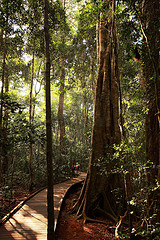 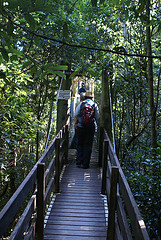 
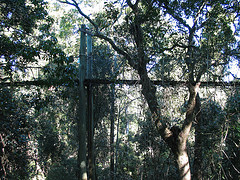
Some of the beautifull rainforest boardwalks offer breathtaking views and wonderful wildlife sounds.
The Crystal Caverns;
 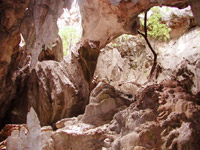 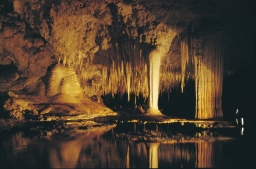
The world famous Crystal Caverns and underground stream with hot pools are enjoyed by everyone.
The Main Street;
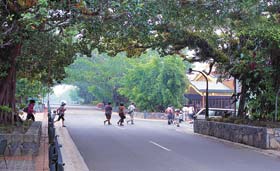 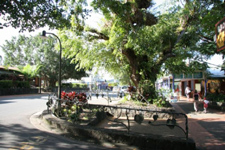 
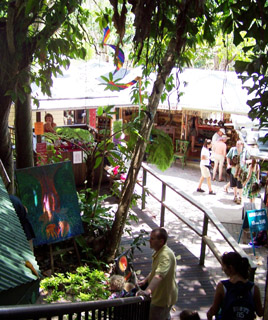
In the town, there are specialty shops, markets, a museum, an insect hot house, and pleasant walks to a mountain top lookout.
There one can look back down to the coast and occasionally through the heat haze you can make out Shenanigan's Wharf on the distant horizon.
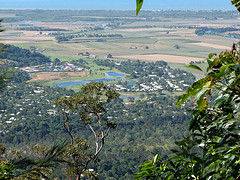 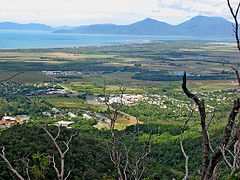 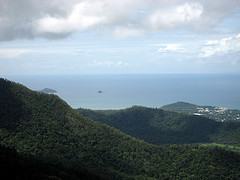
This breathtaking view reminds us all of the natural barrier this terrain imposes and the effort exerted to achieve this awe-inspiring railway.
To ride Home, click on your ticket
|