



 |
Steam Locomotion in the 21st Century The Recent History of Steam Locomotive Development |
Archives of previous steam news entries
Updated 7 February 2022
Progress on Pennsylvania 4-4-4-4 T1 Replica Construction ContinuesThe Pennsylvania Railroad T1 Steam Locomotive Trust,
a group building a new, replica 4-4-4-4, continues to
make impressive progress on the construction of this
locomotive. The latest photos posted show the
first three courses of the boiler complete and welded
to one another. 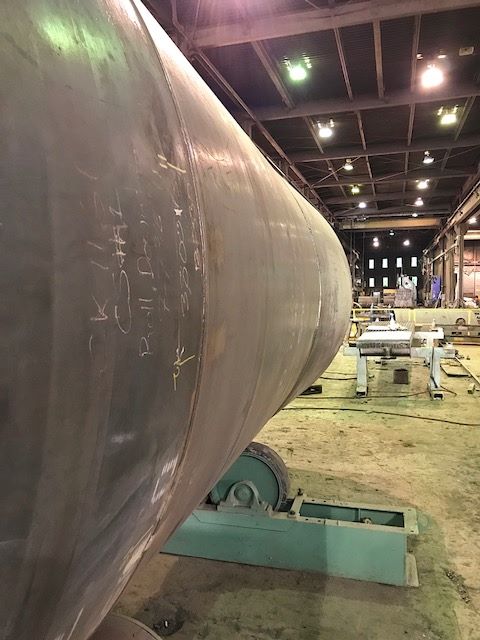 Photo (6/15/18) by Don Morice, former VP and fireman of Frisco 4-8-2 no. 1522
The group has also acquired the sole remaining 8-axle
Pennsylvania Railroad "long distance" tender,
originally used behind an M1 4-8-2. The upper
section of this tender will be modified to match those
used behind the T1's. Availability of this
tender in relatively good condition represents a huge
saving in effort and money for the group.
|
||||||||||||||||||||||||||||||||||||||
Read more at the group's
webpage at https://prrt1steamlocomotivetrust.org,
or follow them on Facebook.Several Recent Steam Modernization Projects Around the WorldReports on steam modernization projects from around
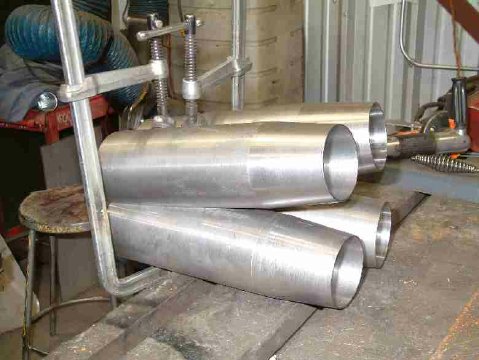
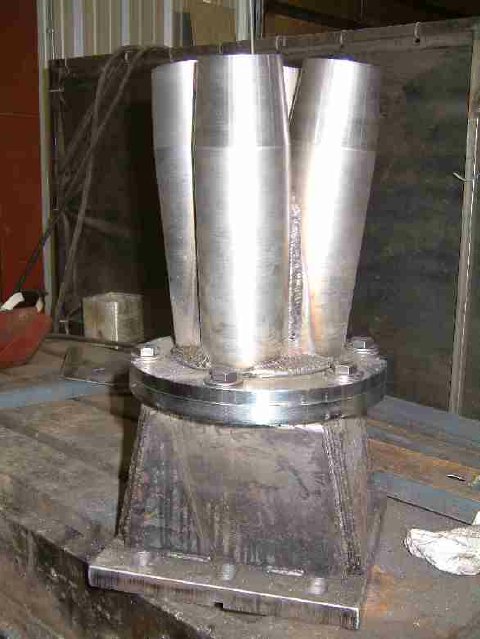
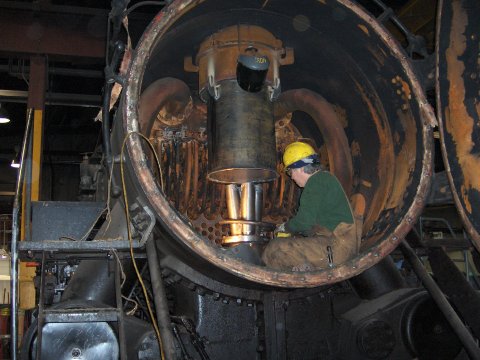
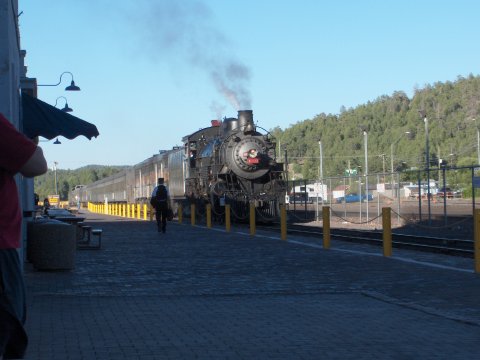
the world have shown up recently. Dr. Jos Koopmans recently designed a new exhaust
system for 4-6-0 no. 6023 King Edward II in the UK and
another for Essex Terminal 0-6-0 no. 9 in
Canada. Both these locomotives are reportedly
performing well. DLM recently commissioned an oil firing conversion to
Puffing Billy Railway 2-6-2 14A in Australia.
The oil firing system is similar to those fitted to
the new construction 0-4-2T rack engines built by DLM
predecessor SLM in the 1990's for service in
Switzerland and Austria. The Lempor exhaust
system previously fitted to 2-6-2 6A by Nigel Day was
moved to 14A as part of the conversion. A second "austerity" class 0-6-0T, no. 19, was fitted
with a Lempor exhaust at the Scottish Railway
Preservation Society in the UK. No. 7 was
previously fitted with a Lempor a few years ago.
The performance of both locomotives is reported to be
significantly improved with the new exhaust systems. More details on these projects are provided
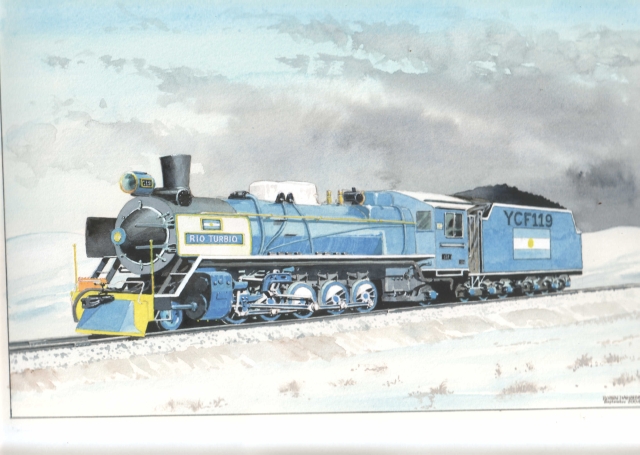
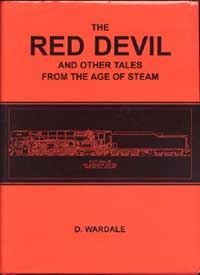
here: http://www.trainweb.org/tusp/last30/last30.html Book News from Camden Miniature Steam ServicesThe following news comes from Adam Harris of Camden Miniature Steam Services, a bookseller in the UK who specializes in steam as well as a variety of other interesting subjects: (1) Famed French steam locomotive designer André Chapelon's book "La Locomotive a Vapeur" (English version) is now available as a 'Digital Edition' - see: https://www.camdenmin.co.uk/collections/digital-books/products/la-locomotive-a-vapeur This isn't an ebook, but a downloadable file which can be read on any computer, laptop, or even, if your eyesight could cope, on a iPhone or similar. The UK price is £29.95 but this includes VAT, so anyone outside the EU doesn't pay this, and the price is £24.96. No delivery charge and instantly available from our website when payment made. Actually, as it is a very large file, 'instantly' available isn't quite correct, as the download time is quite long, depending on the speed of the customer's internet connection. (2) Dave Wardale's book 'The Red Devil and Other Tales from the Age of Steam' is now Out of Print again, and we cannot currently supply it. It is possible this will be made available as a digital edition at some point in the future. New Build Steam (updated)Some time ago I stumbled across another great steam-related website, "New Build Steam". Following the success of the new 4-6-2 "Tornado" in the UK, numerous other projects have popped up to build new steam locomotives. The site was recently updated (November 2016) to a new format and it looks as if updates will be made more regularly. The site lists 21 new build steam projects currently under construction, I believe all in the UK, and it's worth noting this only includes the standard gauge locomotives. Another 3 locomotives are currently in the planning stage. Read more at the website: Big News from ArgentinaFollowing over 10 years of effort, steam is once again set to return to Argentina's Ramal Ferro Industrial de Rio Turbio (RFIRT). Located in the far south of South America, the RFIRT operated a fleet 20 advanced steam locomotives hauling immense quantities of coal from the late 1950's until the mid-1990's. Ing. L. D. Porta served as manager of the railway for several years, and performed signficant development work there improving the line's steam locomotives. The RFIRT mainline trains have been diesel-hauled since November 1996 when the last steam locomotives were retired and stored. The RFIRT's locomotives are of the 2-10-2 wheel arrangement and were built by Mitsuibishi Heavy Industries in Japan. An initial order of 10 locomotives had been received and placed in operation when Ing. Porta arrived at the line in the late 1950's. These locomotives were modernized under his guidance and later, in the early 1960's, a second series of locomotives was built by Mitsuibishi incorporating the modifications made to the first locomotives as well as other improvements. Recently, two of the line's locomotives were shipped from the port of Rio Turbio to Buenos Aires where they are currently being rebuilt. The locomotive number 116 (originally number 107) of the first series of locomotives and locomotive number 119 of the second series of locomotives are being rebuilt. In addition, a Sentinal steam wagon, used to haul coal prior to the completion of the railway, is being rebuilt. The locomotives will not only be overhauled, but all Porta-designed modifications many of which had been removed or disabled by later railway management will be reinstated. A rapid pace has been set for the work and it is hoped that the locomotives can be completed by August 2015. Photos of the work can be seen at the CSR's Flickr site at: https://www.flickr.com/photos/csrail/sets/72157650305202348/ UPDATE, November 2015- The restoration of locomotive #119 has been completed and the locomotive has been returned to the RFIRT. Once returned to Rio Turbio, the locomotives will initially be used to power passenger trains, using new passenger cars which are currently under construction in Argentina. Read more about the project at the CSR 130 Project's News page here: http://www.csrail.org/index.php/news-information Read more about the locomotives of the RFIRT here: http://www.trainweb.org/tusp/rt_2_10_2s.html Developments from CSR 130 ProjectThe Coalition for Sustainable Rail (CSR) has been retained by the Harzer Schmalspurbahnen, GmbH (HSB) of Wernigerode, Germany, to design modifications for a 1918-built steam locomotive. The steam engine number 99-5906, is an 0-4-4-0T "Mallet"-type steam locomotive that has been modified many times over its service life.
Image courtesy of the Coalition for Sustainable Rail Members of the project travelled to Germany in the summer of 2012 where they installed temporary instrumentation and collected detailed data from the locomotive in normal operation. This data is being used to engineer a new Lempor exhaust system as well as a "Master Mechanic's" spark arrestor arrangement. The new components will be constructed in the HSB's shops this spring (2015). Read more about this project here: Modernized Exhaust for German Narrow Gauge Steam Locomotive New Book on SAR Class 25 4-8-4'sModern steam engineer Phil Girdlestone has recently published a book on the famous Class 25 4-8-4's of the South African Railways titled Camels and Cadillacs: A History of the South African Railways 25 Class Condensers and 25 NC 4-8-4's. The book is available from Camden Miniature Steam Services at this link: Group Spins Off from 5AT ProjectThe Advanced Steam Traction Group, established in 2012 following the closure of the 5AT Project, recent introduced their own website. The projects noted below (Developments from the 5AT Group) are actually projects of the AST Group. Visit their website at: Reprint of "the Fire Burns Much Better"Dutch engineer and steam enthusiast Jos Koopmans has announced the release of a second edition of his book The Fire Burns Much Better which is being sold through Camden Miniature Steam Services. The book provides a comprehensive history of steam locomotive exhaust development from the birth of the steam locomotive through the latest development, and includes Jos' work to develop a comprehesive theory for explaining the function of steam locomotive exhausts. This second edition contains corrections, clarifications and amendments, many made in consultation with leading steam locomotive designers. Additional information is available at Camden's page: http://www.camdenmin.co.uk/collections/books-published-by-camden/products/the-fire-burns-much-better-second-edition-to-be-published-late-april Developments from the 5AT GroupThe 5AT Group in the UK, originally formed to oversee the detailed design and construction of David Wardale's 5AT "Advanced Technology" steam locomotive, has recently branched into a couple of other projects. In collaboration with the Keighley and Worth Valley Railway in the UK, the 5AT group has installed a Lempor exhaust system on the recently overhauled USATC S160 No 5820 'Big Jim'. The locomotive has recently re-entered service and is performing satisfactorily. The group plans to do detailed testing this summer to measure the performance benefits of the new exhaust system. Visit the 5AT page for more information, including a link to a youtube video of the locomotive in operation and a PDF presentation on the exhaust system: http://5at.co.uk/index.php/news/44/269/5AT-Group-and-KWVR-install-Lempor-Exhaust.html In other news from the 5AT Group, the Clan Group has invited the 5AT Group to perform a Feasibility Study to suggest and evaluate improvements that might be incorporated into their locomotive. The Clan Group is working on a new-build Clan Class locomotive No 72010, Hengist. More information on this project is avaiable here: Union Pacific "Big Boy" 4014 Restoration
Probably the biggest steam news since the debut of the Rocket was announced last year; the Union Pacific Railroad has acquired one of the eight remaining "Big Boy" 4-8-8-4 steam locomotives from the Southern California Chapter of the Railway and Locomotive Historical Society. The locomotive, number 4014 had been displayed at the RailGiants Train Museum at Fairplex at the Los Angeles County Fairgrounds in California. This locomotive was deemed to be in the best condition of any of the remaining Big Boy locomotives. A crew from the Union Pacific has worked for the last few months preparing the locomotive for towing to the steam shop in Cheyene, Wyoming. Bearings were checked and relubricated, parts of the machinery have been removed and stored, and the locomotive has been thoroughly inspected. The locomotive has been moved approximately one mile across a parking lot using panel track and now sits adjacent to Metrolink tracks. On January 26, the temporary tracks will be joined to the Metrolink tracks to allow the locomotive to begin its move. From here, the locomotive will be towed to Union Pacific's Colton Yard. In the spring, the locomotive will continue to Cheyene where it will undergo a 4 to 5 year restoration. The Union Pacific has posted regular video updates on the project to youtube; these videos can be accessed at this link: http://www.youtube.com/playlist?list=PLh3l5IvpX5haUFK5n7yqfs2vIoq_wGTVe Here's a good story from a local newspaper on the locomotive: Group Seeks to Build Replica
Pennsy T1 4-4-4-4 Locomotive
|
||||||||||||||||||||||||||||||||||||||
Things Are Heating Up Again on the RFIRT (updated Nov. 2, 2004)
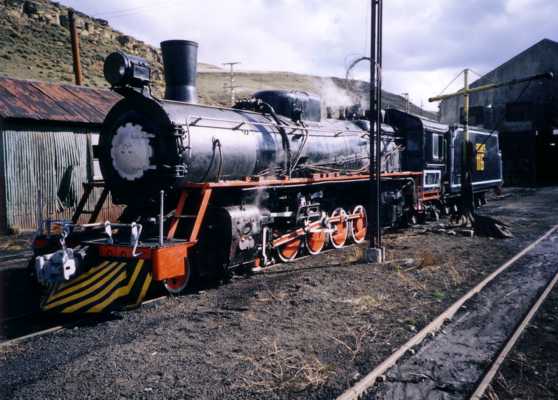
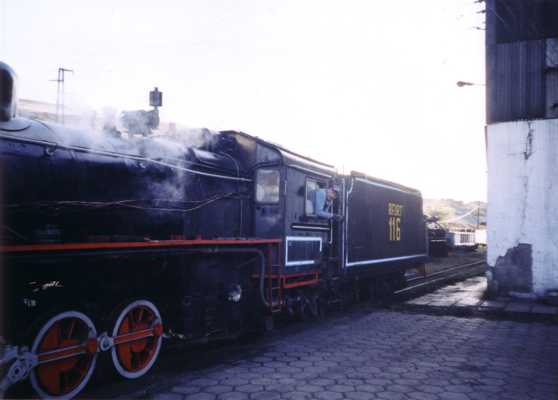
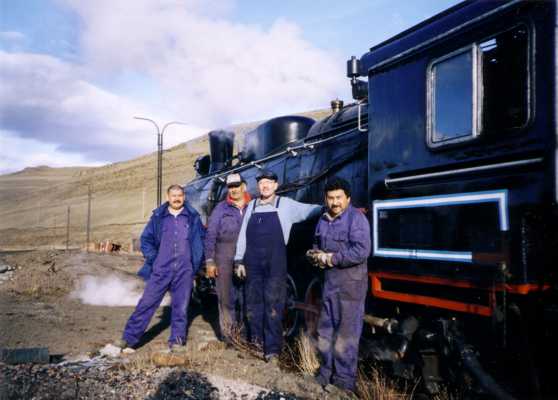
Hot off the Presses- October 27, 2004News Release from Shaun McMahon- RFIRT.pdf (Adobe PDF document) The linked PDF News Release above details present plans for the RFIRT and its steam locomotives. Background info follows below. Photos of Chilean steam locomotive added below November 2, 2004 Shaun McMahon has recently moved from the FCAF to duties on the RFIRT (Rio Turbio railway), home of Porta's fleet of modern 2-10-2's. From the time of Porta's arrival in the late 1950's, these 2-10-2's moved millions of tons of coal from the mines to the port of Rio Gallegos where the coal was loaded onto ships. Porta moved back to Buenos Aires in the 1960's, but maintained close contact with the railway for many years, ensuring that "his" engines were maintained to his specifications. Unfortunately, in later years things were not as well maintained and the performance of the steamers suffered. Eventually, the railway was dieselized in the 1990's, but a significant number of the Sante Fe type engines remained in servicable condition. Plans are presently underway to establish a steam-powered tourist train on the railway which may eventually run into neighboring Chile. It is hoped that steam traction will also be returned to use on the coal trains. The government of Argentina is presently investing in modernizing the coal mining operations which will no doubt benefit the railway as well. One of the steam locomotives has already been restored to service (no. 116, seen above and below), with plans for additional work on it as well as work on some of the other remaining 2-10-2s, including updating them with the latest Porta modifications. Shaun writes: "Steam testing of 116 took place on September 29th/30th September. The locomotive was evaluated for its present state of repair and general condition including boiler. A few kilometres were run around the works yard at Rio Turbio. Some mechanical and boiler work needs to be completed before the loco enters traffic on the initial passenger service between Rio Turbio and 28 de Noviembre during December of this year. The next locomotive to enter the shops is scheduled to be 119 which will undergo a general machanical repair and conversion back to GPCS followed by 120 later on in 2005. 120 will be rebuilt and further modified so as to produce the prototype locomotive for the "Advanced Santa Fe" class. The photos show 116 in steam with members of RFIRT staff standing alongside. Then author also took the chance to begin initial thermodynamic testing of the locomotive in unmodified state so as to evaluate conditions in preparation for future re modification to GPCS."
No. 116 During Tests
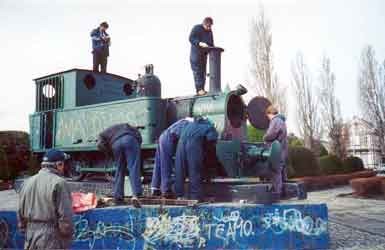
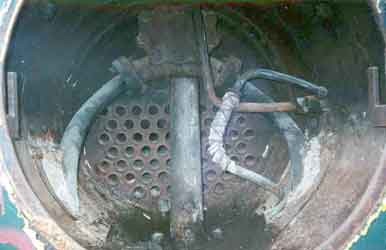
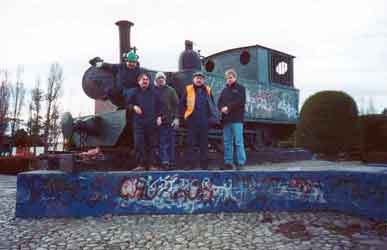
Crew Standing Next to No. 116 The following photos were added November 2, 2004. Shaun describes them: "I am attaching photos of the Chilean based Avonside built locomotive as mentioned in the text concerning TOR/RFIRT. These were taken when we went to inspect the loco in Puerto Natales back in August of this year prior to carrying out a review, specification and costing of the potential work. The team working on the engine are from Rio Turbio RFIRT locomotive and rolling stock depot. The smokebox photo shows up "the worst cannot exist" front end arrangement (similar to FCAF Camila in pre-modified times) that of course is to be rectified as part of a modification scheme."
Chilean Locomotive Under Inspection by RFIRT Crew
"Worse could not exist" Front End Arrangement
RFIRT Inspection Crewphotos courtesy of Hector Alavarado and Shaun McMahon FCAF Celebrates 10th Anniversary
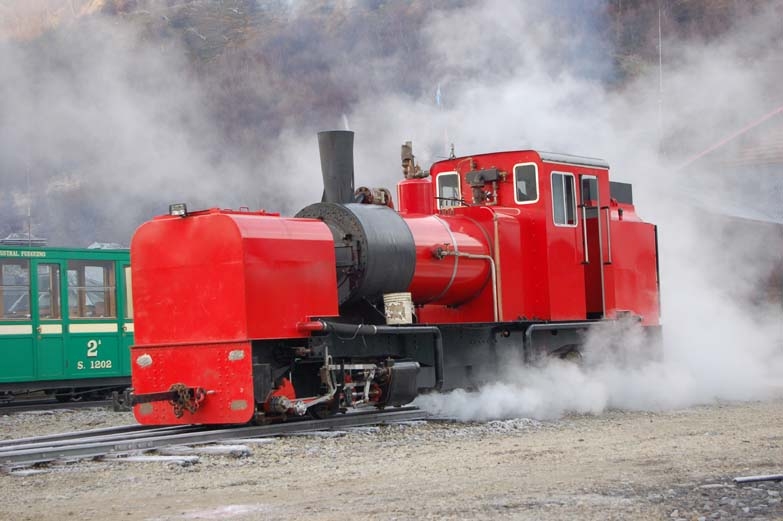
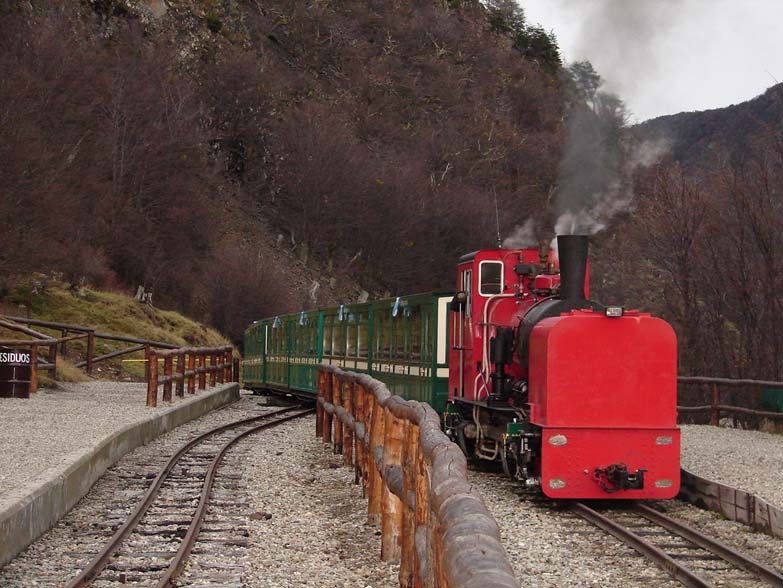
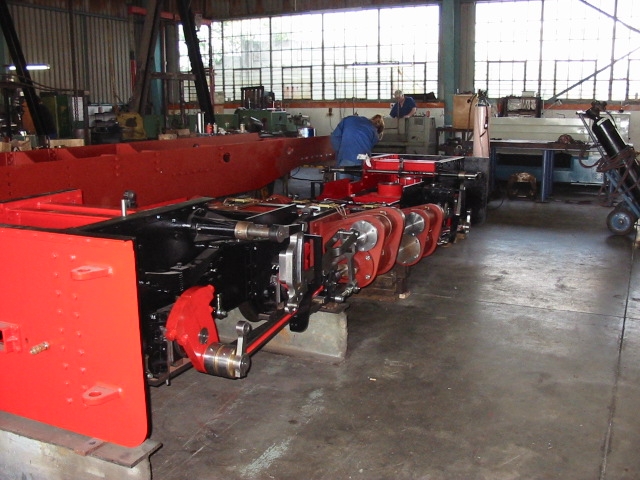
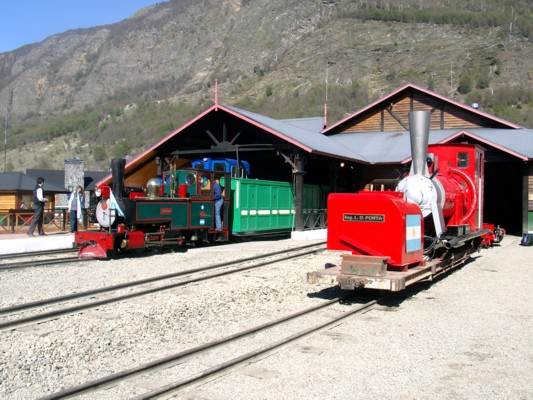
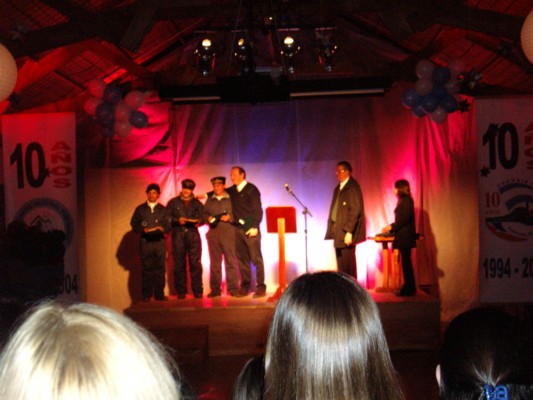
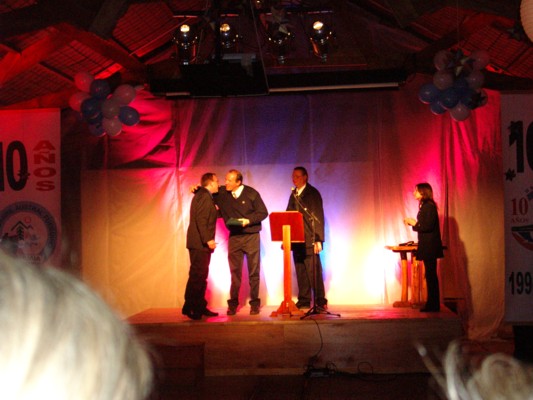
This report comes from Shaun McMahon and Martyn Bane (who is visiting Argentina at present): "On 11th October 2004 FCAF celebrated 10 years of operation. Locomotives No.3 (left) and No.2 (right) can be seen in the works yard at Estacion fin del Mundo. Camila underwent winter maintenance during May/August of this year which included replacing a broken driving axle and connecting rod both of which had failed in traffic during early May 2004. Some improvemets were alos carried out to the Lempor exhaust arrangement and the layout of cab instrumentation. Full gas emision evaluation is to be carried out during the coming high season with respect to both FCAF steamers. No.2 passed through shops immediately after Camila and can be seen in part complete state, having been reduced to essential components. Further mechanical work was carried out to the power units along with a full repaint. A fair amount of outstanding mechanical maintenance has had to left out of the work schedule so as to get the engine back in traffic in time forthe high season which is just about to begin in Ushuaia during the latter end of this month (October 2004). Stage 2 work to No.2 is still scheduled to take place during 2006. "
Awards were presented to current
and former FCAF staff and management
during the 10th ceremony at Estacion
fin del Mundo, these were given for
"exceptional contribution to the
development of the railway during
the first 10 years of its operation
and initial construction".
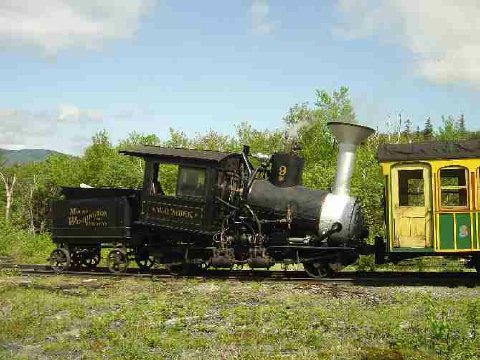
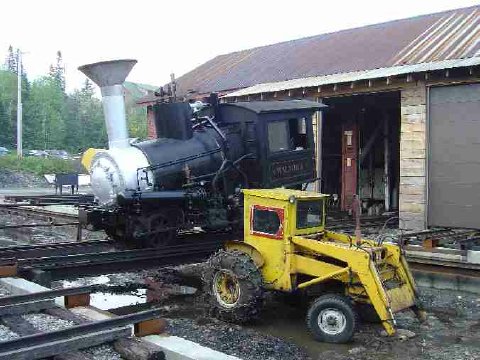
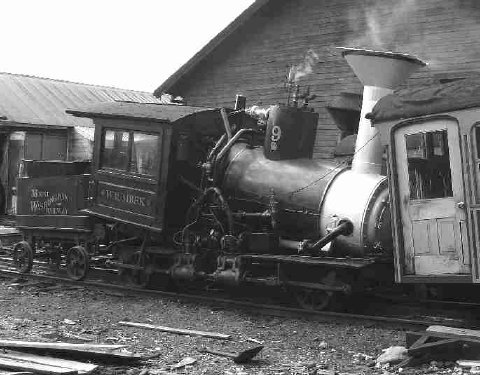
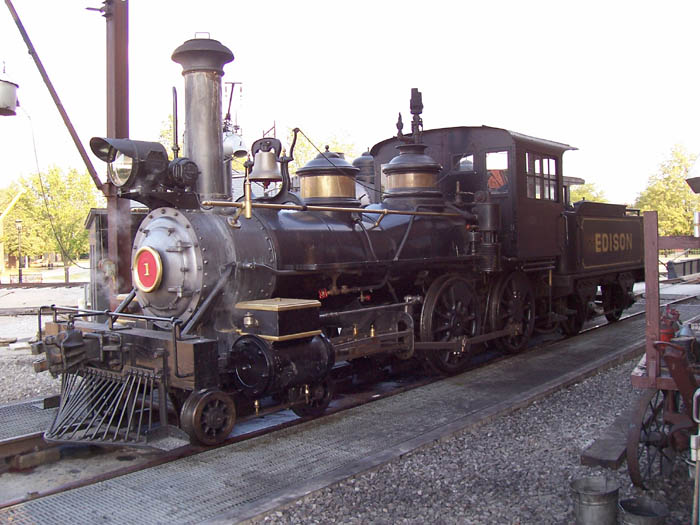
FCAF 10th Anniversary photos courtesy of Martyn Bane Nigel Day Returns to Mt. Washington Cog Railway in New Hampshire (update November 2, 2004)As a result of his successful installation of a Lempor exhaust system on Mt. Washington locomotive No.9 Waumbek, Nigel Day is returning this month (September 2004) to do additional work on Mt. Washington's locomotives, chiefly to improve combustion conditions. Preliminary reports on No. 9 indicate impressive fuel savings compared to the unmodified locomotives. (Sept. 16) Martyn Bane has just updated his pages with further info on Nigel's work at Mt. Washington. Further modifications were carried out on No. 9 earlier this year, prior to Nigel's arrival. Nigel left the UK for New Hampshire on September 13 and expects to spend several years at Mt. Washington improving their fleet of steam locomotives. For photos and more details of the Lempor installation on No. 9, see Martyn Bane's website at: http://www.martynbane.co.uk/modernsteam/nday/mw/ndaymwhome.htm More information on the Mt. Washington Cog Railway and its locomotives is available at: November 2, 2004- A very nice article on Nigel at Mt. Washington by Dave Lathrop was posted to the Railway Preservation News website November 1, 2004. Read it at: http://www.rypn.org/briefs/november2004/041101.htm Partial Lempor Exhaust Installed on Steamer at Greenfield VillageThis story comes from Jason Sobczynski. A steam locomotive at Greenfield Village, a part of the Henry Ford Museum in Dearborn, Michigan, was recently outifitted with a partial Lempor exhaust system. The locomotive fitted with the Lempor style funnel is the "Edison" . This locomotive was built at Ford Motor Company's "Fordson" locomotive shop (located within the Rouge complex) using parts (cylinders, wheel centers, bearing boxes, domes and bell, and not much else) and tender from an 0-4-0 constructed in the 1860's. She is for all intents and purposes a Ford Motor Company 4-4-0. The loco received a new funnel fit inside of a new stock-appearing stack. The funnel was built to the proportions obtained from L. D. Porta's "Lempor Theory" on the Ultimate Steam Page. The funnel consists of a straight lower "mixing chamber" section and a tapered upper "diffuser" section. The locomotive is reported to steam remarkably better than prior to the modification. The funnel was designed by the assistant railroad manager and fabricated by an outside fabrication shop. Jacob installed the funnel as well as fabricate and fit some related parts. As to the success of the installation, here's how Jason puts it: "While I had not fired the Edison prior to the installation of this funnel I can attest to the steaming capabilities of the loco now...and I am told by others that the difference is like night and day. "
Interestingly, this exhaust is very similar to what is now installed on the modern SLM rack steam locomotives operating in Austria and Switzerland, which were built in the 1990's. Initially fitted with full Lempor systems, the 4-nozzle exhaust stand was replaced with a single exhaust nozzle when the locomotives were found to have "excess" steaming capacity. (The single nozzle was used to save cost; an altered 4-nozzle system would provide even better performance.) It's great to hear of a second successful Lempor exhaust installation in the U.S. For more on Greenfield Village, see: http://www.hfmgv.org/village/railroadjunction.asp Thanks to Jason Sobczynski for the information and photograph. Another Proposed Steam Locomotive WebsiteRussell Brown has recently posted a new website with his proposal for an alternative steam locomotive design based on the Garratt concept, called the Paragon Steam Locomotive. The proposed design would use a combination of a piston engine with compound expansion of the steam through a turbine powering a generator, driving some of the locomotive's wheels via electric motors. The site contains detailed information on various aspects of the design, including a diagram of the locomotive arrangement. Read more at: http://www.alternativesteam.com/index.html Recent StoriesA1 Trust Announces Boiler Supplier ChosenThe A1 Trust group that is constructing a new, full-size 4-6-2 steam locomotive in England, recently announced that Dampflokwerk Meiningen has been chosen to supply the boiler for the locomotive. This is the last major outstanding component required to complete the locomotive. An intense search had been underway for several years to find a suitable supplier for the boiler, and it was hoped that it could be built in the UK. The Trust finally determined that Dampflokwerk Meiningen of Germany was the best choice for the project. The new boiler will differ from the original A1 boilers in being of all-welded construction and having a steel rather than copper firebox. Read more at the A1 Trust's website at: Read more about Dampflokwerk Meiningen at their website at: http://www.dampflokwerk.de/english/index.htm New Webpage on Proposed SteamersClive Collins wrote me a few months back about his webpage on a proposal for a new mainline steamer for the UK. His design would be based on a previous UK 4-6-2 design with significant improvements. His design is at least in part a response to the 5AT Project including features which he believes would be better-suited to modern-day steam. Read more at his page at: http://www.freewebs.com/thefutureofsteam/ Webpage on Steam "Alternative History"As a reader of science fiction, one of my favorite categories is so-called "alternative histories"- stories which explore answers to "what if?" questions ("What if the South had won the Civil War?", "What if President Kennedy hadn't been assasinated?", etc.). Norman Clubb of Germany has an interesting webpage which presents answers to the question "What if steam motive power had survived in Germany to the present?" His page covers the mythical Ruhnian State Railways (RSR) and their cooperating rival, the Kroplihne Railway (RK) and includes numerous well-done graphics on an array of steam locomotives which would have been developed in the 1950's through the present. Check out his very interesting webpage at: |
||||||||
George W. Carpenter Receives Engineer-Historian AwardThe American Society of Mechanical Engineers (ASME) awarded George Carpenter it's 2003 Engineer-Historian award in London last summer for his contributions to the historiography of the steam locomotive engineering. Carpenter has written over 40 papers and other publications, and translated Andre Chapelon's massive work La Locomotive a Vapeur into English. Read more at ASME's website at: http://www.asme.org/history/newslett.html#16 Exhaust Improvements on the Talyllyn RailwayJos Koopmans of the Netherlands forwarded this report from Wales regarding the application of his work on steam locomotive multiple-jet exhaust systems to locomotive No. 6 on the Talyllyn Railway (website http://www.talyllyn.co.uk ). The modifications were carried out by John Scott, Julian Stow and Peter Mintoft. Interestingly, the nozzle configuration used consisted of 3 exhaust nozzles, chosen for ease of fabrication. Read about it below (Adobe PDF format). Notes on Modifications to Draughting on No 6 2004 Outlook2003 seemed to be a pretty dismal year for new steam developments, the worst news being the death of Ing. L. D. Porta. However, some good things have happened and 2004 promises to be a better year for steam development. Nigel Day has recently introduced the Lempor exhaust system to the United States, David Wardale seems to be making good progress on the 5AT project in the UK, Phil Girdlestone has some interesting projects in the works, and Shaun McMahon continues to fine-tune operations at the FCAF. Hopefully I'll have much to report in 2004. Update on Overhaul Progress on the Duke of GloucesterThe official site for the British steam locomotive "Duke of Gloucester" has recently been updated with information on the progress on the comprehensive overhaul the engine has been undergoing for several years. The Duke is a 3-cylinder 4-6-2 with Caprotti rotary cam poppet valves which was saved from certain destruction by an enthusiasts group in the UK. The present overhaul includes several significant improvements. Read more at: Report on Roller Bearing Conversion Failure on GSMR No. 1702The Great Smoky Mountains Railway, a tourist line in North Carolina operates former U.S. Army Transportation Corps 2-8-0 No. 1702. In 1997/1998, the railway's mechanical department took the progressive step of converting all the axles on the engine to roller bearings. The job required some innovative engineering to make work, as the small pedestal openings in the engine's frames were not designed to accomodate roller bearings. This was dealt with by using relatively small outside diameter roller bearing assemblies. To provide sufficient diametrical clearance for the bearings, the diameter of the driving axles had to be reduced. This was done by pressing off the drivers and turning the end portion of each axle down. The roller bearing assembly, mounted in a suitably modified driving box, was then pressed on, a bushing was pressed on to restore the original axle diameter at the end, and the driver was pressed back on. The roller bearings were expected to last for 15 years. Unfortunately, the roller bearings failed after only five of seasons of operation and a decision was made to restore the engine's original friction bearings (at least on the driving axles). Many people were interested in the reasons for the failure but little information has been published. Last week, Ryan Scott, Operations Manager at the Great Smoky Mountains Railroad, posted this information to the Railway Preservation News Interchange Board (http://www.rypn.org/index.html) in response to an inquiry by me. Mr. Scott notes that the following is his opinion and not necessarily the offical opinion of the GSMR: |
||||||||
|
There were a few "flaws in the slaw", so to say, that led to earlier-than-expected replacement of the roller bearings. 1. The rollers were Timken "AP" bearings. In other words, they were sealed for life with grease. They could not be "flushed" periodically like any other true steam locomotive roller bearing. The ability to change the oil periodically may have helped. Also, the use of oil instead of grease will let some of the loose metal particles collect at the bottom of the bearing box, instead of continuing to grind the remaining bearing just like grinding compound. 2. The rollers were not housed in a common box, as in standard locomotive roller bearing boxes. In roller bearing locos, such as the NKP 765, the left and right boxes on a particular axle were actually all one box. There are two halves to the box, and upper and a lower. Thus, as the box encountered the frame during lateral movement, both bearings were loaded exactly the same, because they were located in a precise machined "common" box. Also, with the common box, the spring rigging cannot induce moments on the bearing in the same axis as the rail. Also, the bearing designs themselves differ from the standard loco bearing to the AP bearings. 3. The AP bearings were designed to be used in two to three axle trucks that had a much smaller wheelbase than a steam locomotive. In this case a 2-8-0 with 57 inch drivers. Also, they were meant for smaller wheels and higher speeds, say 36 inch wheels and 45-60mph. At the higher speeds the AP bearings would heat up enough to evaporate whatever water might pass the seals in weather changes, and in the case of a steam loco, steam cleanings. The AP bearings just couldn't handle the lateral load that a 2-8-0 on a curvy RR will create. The conversion to Roller bearings on this loco was an experiment. Unfortunately, as with any experiment, we are sometimes disappointed with the data that we are presented with after starting the experiment. Couple that with the fact that AP bearings are meant to last for "life", with "life" being measured in the length of time it takes to wear out the wheel on the same axle. On a steam loco, it is MUCH more involved to remove a roller bearing than on a freight car axle. One must dismount/mount the wheels which over time will "wear" the interference fit between the axle and wheel, and also requarter the crankpins after each of these "lifetime" replacements. Thus, axles and crankpins last much longer with true RR roller bearings or friction bearings. The #1702 has been converted back to friction bearings on all drive axles for many of the reasons above. For all of those contemplating a roller bearing conversion think long and hard about the costs versus benefits both short and long term. Ryan Scott |
||||||||
|
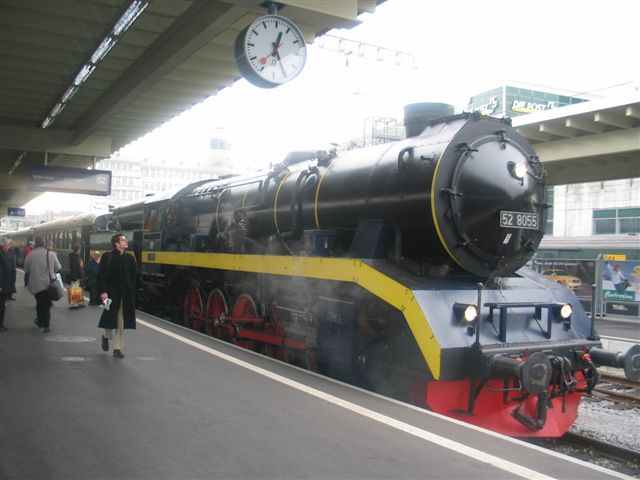
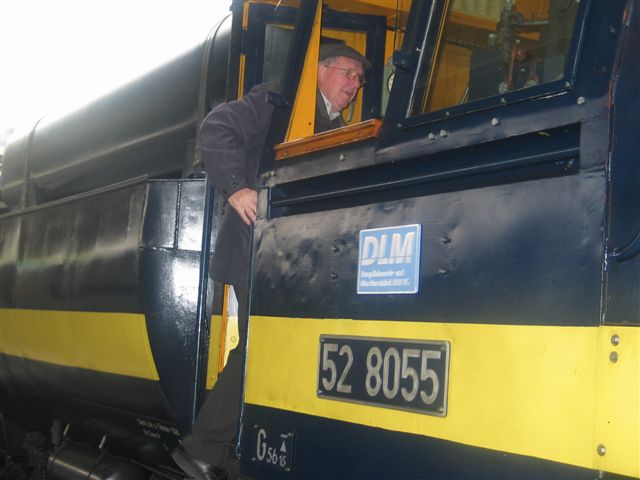
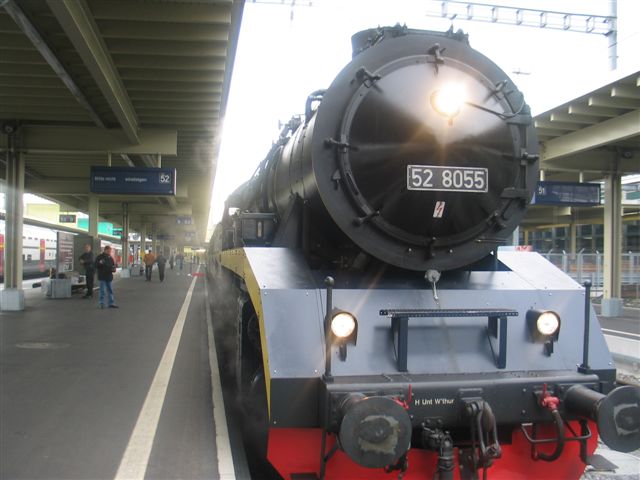
Because the stock axles and axle boxes were extensively modified to accept the roller bearing assemblies, new friction bearing axle boxes had to be cast and machined to return the engine to its original condition. The conversion back to friction bearings was completed as a cooperative project between GSMR, Steam Operations Corporation, and TVRM. Thanks to Ryan Scott for allowing me to re-publish his post here. New Steam for DHR (updated 9/9/04)UK publication Steam Railway magazine (no. 291) includes an update on three new locos being built for the Darjeeling Himalaya Railway at the Golden Rock works in India. Indian Railways published tenders for these engines several years ago and then re-issued the tenders about a year later. SLM worked hard to interest IR in new modern locomotives incorporating the improvements successfully used on SLM's new steam rack engines built for Switzerland and Austria. SLM successor DLM also lobbied hard for new locomotives but IR was not willing to make the large investment required. Several other groups also expressed an interest in providing new-design locomotives. After all this time, it appears IR opted to have copies of the original ~1895 design Class B steam locomotives produced locally. While the construction of any new steam locomotives in 2003 is good news, it is a disappointment that evidently no modern features have been included in these engines. The first locomotive is reported as being nearly complete and it is hoped it will be on the DHR in January 2004. This locomotive has been given the name Snow Chariot. Work on the second and third locos has not yet started. Snow chariot's boiler is one of 5 ordered in 1998, evidently as replacements for the existing Class B locomotives. The other boilers are reported as being on number 794 at Matheran, on 787 for oil burning trials, one for number 791 which is stripped for overhaul at Tindharia and one as yet unallocated. Later reports say the first "new" steamer suffered immense steaming problems, likely due to its highly unorthodox oil-firing arrangement which used a diesel generator to supply power to run electrically driven fuel pumps, combustion air blowers, air compressors, and a myriad of lights in the cab. The engine was reportedly sent back to Golden Rock for modifications. Recently, it was reported that the second new locomotive was completed and that both engines would be delivered to the DHR in the near future. It will be interesting to see if the complex locally developed oil firing system can be made sufficiently reliable for daily service. Modernized Steam Locomotive NG52 8055 Purchased by DLMSwiss Steam locomotive manufacturer DLM recently announced that they have purchased the modernized steam locomotive class NG (for "next generation") 52 number 8055 from Eisenbahnfreunde Zollernbahn (EFZ). 8055 was modernized by DLM predecessor SLM under the direction of Roger Waller with assistance from L. D. Porta. The locomotive required an extensive rebuild, in addition to the many modifications made to improve performance, efficiency, and reliability. These modifications included increased superheat, a streamlined steam circuit, Lempor exhaust, light oil firing, the application of sealed roller bearings to all axles, rods, and valve gear components, centralized lubrication, and more. The locomotive was successfully tested in Switzerland, and once some teething problems were worked out, it was transferred to Germany where it was intended to be used to pull the world-famous Orient Express passenger train. Unfortunately, German authorities refused to allow the engine to operate because some features which had been allowed in Switzerland were not recognized in Germany. Now that the engine is back in the hands of the men who designed and built it, it is planned to use the engine as a test bed for additional steam locomotive improvements. It is also expected that the locomotive will reguarly operate on passenger excursion trains in Switzerland. Update
December 3, 2003 Update
December 19, 2003
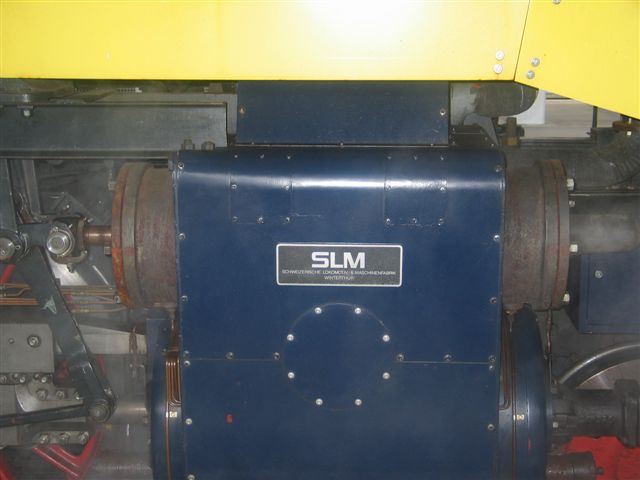
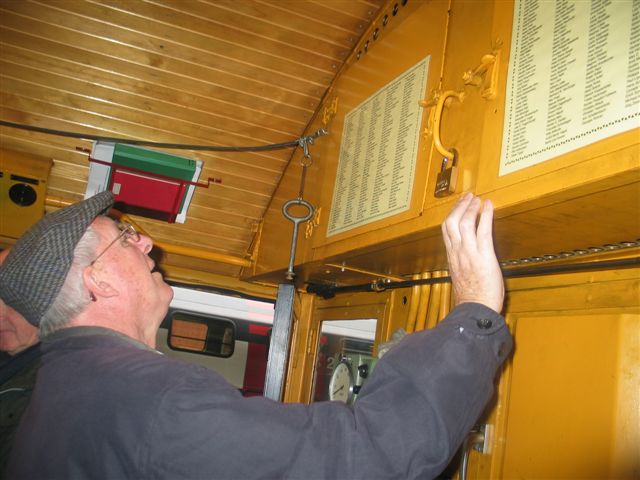
DLM Modernized Steam Locomotive "NG" 52 8055 on display in Zürich Hauptbahnhof
Detail of
Right-hand Cylinder Showing Heavy
Insulation and
52 8055 Cab Showing New DLM Plate
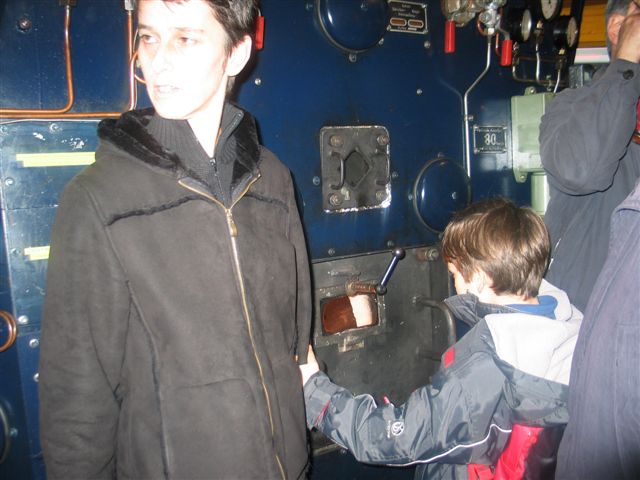
A Youngster Getting a View Inside a Very Hot Firebox
Front View of 52 8055 For more information, see the press release (PDF format) at: DLM Press Release on 8055 and DLM's webpage at http://www.dlm-ag.ch. |
||||||||
Dr. Ken Walker of the Darjeeling Himalaya Railway Supporters Association of Australia recently reported further news on new steam locomotives for the DHR. Global tenders for 3 new "state-of-the-art" steam locomotives had been issued several years ago and it was known that DLM (and formerly their predecessor SLM) was very interested in supplying the locomotives.
In early March, it was announced that the Southern Railway's Golden Rock workshops at Tiruchirappalli had been awarded a contract to provide the new locomotives. Evidently, the Chittaranjan Locomotive Works also offered a proposal which was not accepted. While several international companies had made proposals, DLM was the only company whose qualifications were considered satisfactory. Unfortunately, DLM's price was considered too high and was not accepted. It is understood that DLM is still pursuing options to at least assist in the design of the new engines.
While the Golden Rock workshops has recently completed the successful rebuild and conversion to oil-firing of several of the SLM 0-8-2RT steam locomotives for the Nilgiri Railway, there is concern that the new locomotives for the DHR will merely be new oil-fired versions of the ~1890 design 0-4-0T locomotives used on the DHR for the past ~110 years.
While any new steam locomotive constructed in the year 2002 is good news, I certainly hope that this opportunity to apply proven modern steam technology to new steam locomotives is not missed. DLM, based on their extensive experience with new rack steam locomotives built (by SLM) n the 1990's, was confident that new-design steamers could be built which, while retaining the traditional appearance of the existing engines, would out-perform not only the existing steamers, but the diesels as well.
This story will be updated as more details emerge.
Note- I have no financial interest in either of these book sources.
Kirklees Light Railway's Modernized Steam Fleet
The 15 inch gauge Kirklees Light Railway in Huddersfield, Yorks, UK is a passenger hauling railway with recently constructed coal-fired steam motive power. Over the last 3 years, a simplified form of the GPCS has been fitted to three of these locos, one built with the system from new, principly as a means of reducing emissions as most of their summer running is with open coaches. The modifications have been a great success. Clinker has been eliminated, much appreciated by the drivers as a fifty minute round trip in an hourly schedule doesn't allow much time for fire cleaning. Fox, a 2-6-2T, and Badger, a 0-6-4ST, have both been fitted with Lempor type exhaust within the existing chimney outline and large radius bends in the breeches pipe along with a Kordina. Owl, an 0-4+4-0 Avonside type geared loco (similar to U.S. design Heisler locomotives except with V-4 vs. V-2 engines) has had the GPCS fitted from new. While the locomotives are not, unfortunately, super-efficient due to comparatively low boiler pressure (170 psi), saturated steam and a far-from-ideal steam circuit, they are consistent, reliable, clean and easily operated by a pool of crews with varying driving techniques.
According to the railway's website at http://www.kirkleeslightrailway.com/ , plans are to incorporate the GPCS on the line's other steam locomotive, an 0-4+4-0 Kitson Meyer articulated named "Hawk" in the near future. Hawk is already equipped with a multiple jet exhaust nozzle.
The Kirlees Light Railway's sensible application of coordinated modifications to a fleet of intensely utilized steam locomotives clearly illustrates the value of modernization of existing steam locomotives in tourist service. The cleanliness, efficiency, and availability of these locomotives has been significantly improved through relatively minor modifications.
much thanks to Ian Screeton for this information
Former Southern Pacific #4449 Repainted into "American Freedom Train" Colors
John Craft's "Steam Central" webpage(http://www.steamcentral.com) reports that former Southern Pacific Railroad 4-8-4 #4449 is being repainted into its "American Freedom Train" colors which feature red, white, and blue stripes, replacing the engine's famous "Daylight" red and orange stripes it wore during its days in passenger service. 4449 was first restored for mainline service in the U.S. in the mid-1970's for use on the American Freedom Train, which was organized for the U.S. bicentenial celebration in 1976. This train toured the U.S. throughout 1976 and introduced a whole generation to big steam railway power. 4449 was the first, large, "modern" steam locomotive restored for service in the U.S., and it lead the way for later restorations of other mainline steam locomotives in the 1980's and 1990's. 4449 qualifies as a "modernized" steam locomotive as it was modified with firebox circulator tubes during the 1980's (a modification devised by the Southern Pacific but never made to 4449).
Read more about the engine at the Friends of 4449 website at http://www.4449.com
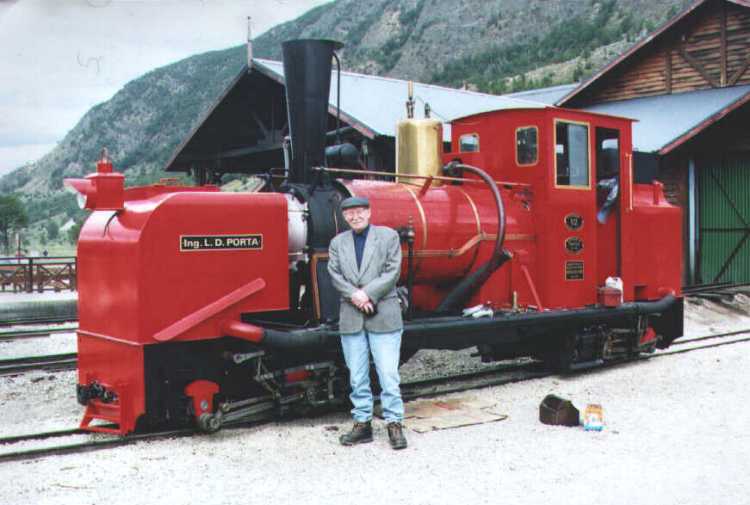
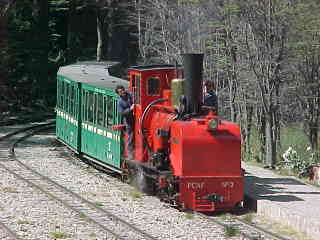
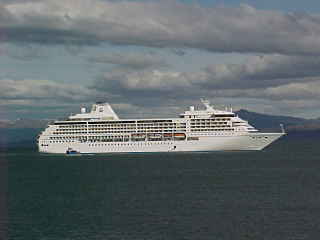
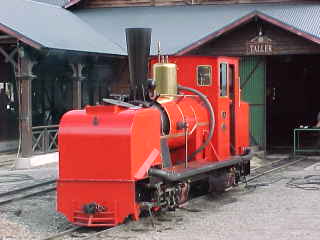
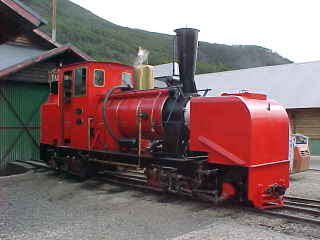
Heavily rebuilt Garratt locomotive FCAF No. 2, recently renamed "L. D. Porta", re-entered service on Saturday, January 19, 2002. Shaun McMahon says the locomotive performed well. As you can see below, passenger cruise ships are thankfully still visiting Ushuaia despite the economic crisis in Argentina. The situation has caused the FCAF some problems, but they are working through them. No. 2's return to service was held up for a few days by a tempermental air pump, but Shaun had it straightened out by Friday and was able to put No. 2 in service on Saturday. Fine tuning of the locomotive remains, as well as lagging of the cylinders and some steam pipes. Comparitive testing of the locomotive's "before" and "after" performance will also be done to confirm the degree of performance improvement afforded by the modernization. Shaun will be forwarding further reports on the engine as time allows.
The following comes from Shaun
McMahon, Technical Manager of the Ferrocarril
Austral Fuegino in Ushuaia:
Today (December 11, 2001) at 18.00 (Argentine time)
FCAF KM Class Garratt locomotive No.2 (formerly known
as "Nora") was duly named 'Ing. L.D. PORTA' at a
ceremony at Estacion fin del Mundo attended by over 70
invited guests, including the Provincial Governer and
Mayor of Ushuaia, where L.D. Porta himself delivered a
very interesting speech reflecting upon the role of
modern steam in the modern world and in particular
Argentina and Cuba. At the same time he mentioned the
fact that the rebuild and modernisation of No.2
represented the first stage of the development of FCAF
as a serious comercial tourist railway, the second
stage will now commence and probably take another 3
years to complete. The locomotive was christened by
Mrs. Helen M. McMahon who is here in Ushuaia on a vist
from North Wales in the traditional way by cracking a
bottle of champagne on the pilot beam!
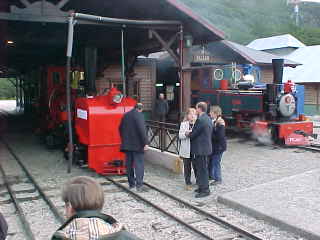
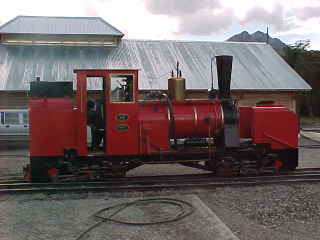
Shaun has sent numerous additional
photos of the work on No. 2 which I will add to the
page as time alllows.
Swiss steam locomotive builder DLM has recently added Adobe PDF versions of pamphlets to their webpage to provide more information on their products. Pamphlets for rack steam locomotives, reciprocating steam ship powerplants, the electric pre-heating device for steam locomotives, and a new narrow gauge 2-8-2T steam locomotive are included.
Visit DLM's webpage at: http://www.dlm-ag.ch/ , and click on "Pamphlets" on the menu at the left side of the page.
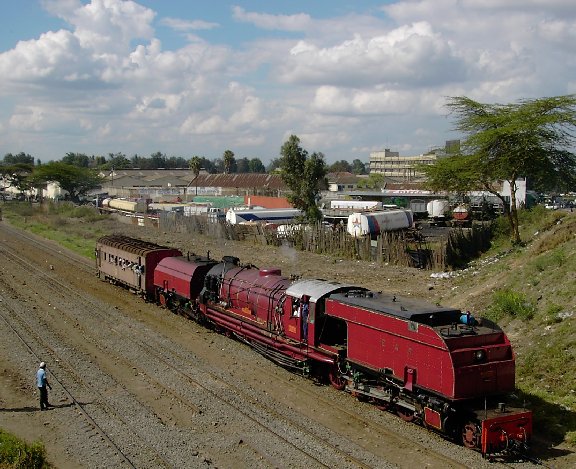
Former EAR #5918 on Test Run in Kenya
(AP photo courtesy of Trevor Heath)
Former East African Railways 59th Class Beyer Garratt No. 5918 completed a successful test run this week after overhaul by current and retired railway employees. A massive 4-8-2+2-8-4 Garratt, 5918 will pull excursion trains between Kenya and Uganda (see story below). The 59th Class Garratts were built in the early 1950's, and incorporated roller bearing axles, roller bearing "big ends" on the main rods, massive boilers, and oil firing (with provision for conversion to coal if necessary). In the late 1950's, a Giesl ejector exhaust system was tried on 60th class No. 6029 (a somewhat smaller 4-8-4+4-8-4 Garratt) and results were so successful that virtually all modern steamers on the EAR were so fitted, including the entire 59th Class. Despite some alleged controversy regarding the improved performance of these locomotives, official EAR timetables in 1962 actually listed different scheduled times for trains powered by standard and Giesl-equipped locomotives, partly due to increased power and partly due to reduced requirements for fuel and water stops due to increased efficiency. Dusty Durrant, famed steam locomotive enthusiast who passed away last year, actually worked for the EAR during the time these engines were fitted with Giesls. It's a pity that Dusty is not around to see this engine restored to steam.
For up-to-date information on this
project, join the Steam in Kenya mailing list at:
http://groups.yahoo.com/group/Steam_in_Kenya
Andreas Schwander has an update of the latest from DLM:
Here is some news from DLMs from the DLM web-page. They plan to increase their equity by issuing a new series of shares by the end of the year. They intend to do that while expecting some major orders in the near future.
People interested in buying shares can contact DLM (look at the web-page www.dlm-ag.ch ) and receive documentation.
Also the Montreux (the paddlewheel boat which was converted from diesel back to steam power) with its new steam engine seems to be roaring success on lake Geneva and the modernized HG 2/3 (rack steam locomotive) is quite successful with its runs to Zermatt.
It's now a unique chance to your own little piece of maybe the one and only company in the world that seriously invests into research and development of the reciprocating steam engine!