




 |
Lynton and
Barnstaple Railway The Signals |
|
||||||
|
||||||||
This page describes the Signals of the former narrow-gauge Lynton & Barnstaple Railway (L&BR) and provides a detailed Signal Register for the line. Please see the separate Introduction to L&BR Signalling page for general background information and details of other pages on RailWest about the signalling of the L&BR. Click here for more general historical details about the L&BR and a Bibliography.
 |
 |
|
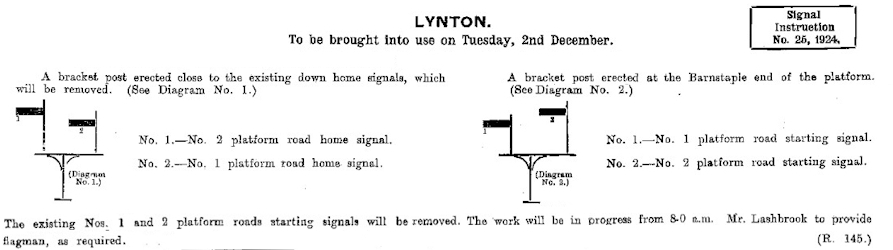
| Southern Railway replacement of all the signals at Lynton in 1924 | ||
Railway photography was becoming quite common by the time that the L&BR was opened, so fortunately there is a fair photographic coverage of the early installations before any significant changes were made. Most of the signals were situated in the immediate vicinity of stations (or level-crossings, in the case of Pilton) where they were quite likely to be captured on film. With the exception of the short-lived distant signals at Bratton Fleming, there were no known signalling installations remote from any places with easy and frequent public access. Nevertheless it has not been an easy task to research more than a reasonable proportion of the full extent of L&BR signal changes.
Although remarkably almost every known L&BR signal has appeared in at least one photograph, there can be many years between photographs of the same signal in its different forms, so it is not possible to be very precise about the date of change from pictorial evidence alone. A good example of this problem is the Down Starting signal at Woody Bay, of which there is no known dated photograph between 1915 (original form) and 1927 (replacement version). Far too often any photograph of the required period frustratingly has the signal hidden behind a train! Many signals appear only in the background of some photographs and without access to the original negative and a high-power magnifier it has not been possible in all cases to determine whether there had been any change from its original form.
Fortunately the archives of the Signalling Record Society contain an almost complete set of Southern Railway (SR) Signal Instructions, some of which relate to L&BR signal replacements, and details from those have been included in the RailWest L&BR Signal Register. However it important to note that these Signal Instructions merely describe the relocation and/or renewal of signals and usually do not give any specific information about the type of arm or post used, nor is every L&BR signal alteration covered in the available Instructions (the Down Starting at Woody Bay being one missing example).
When the L&BR was opened in 1898, the whole line was signalled throughout by a single contractor, Evans O'Donnell (EoD) of Chippenham (see Footnote below). Therefore the L&BR had a common set of signals supplied at the outset and on the basis of the available evidence it is reasonable to assume that all those signals were to a common EoD design. The signalling was quite simple and only main running signals were installed; the L&BR never had any 'ground signals' for shunting purposes. Shortly after the opening of the railway some additional signals were added to provide Starting signals at the intermediate station passing-loops, but all these appear to have been to the same design as the original signals.
 Stop
signals. With the exception of the double-armed Down Home
signal at Lynton, all the original
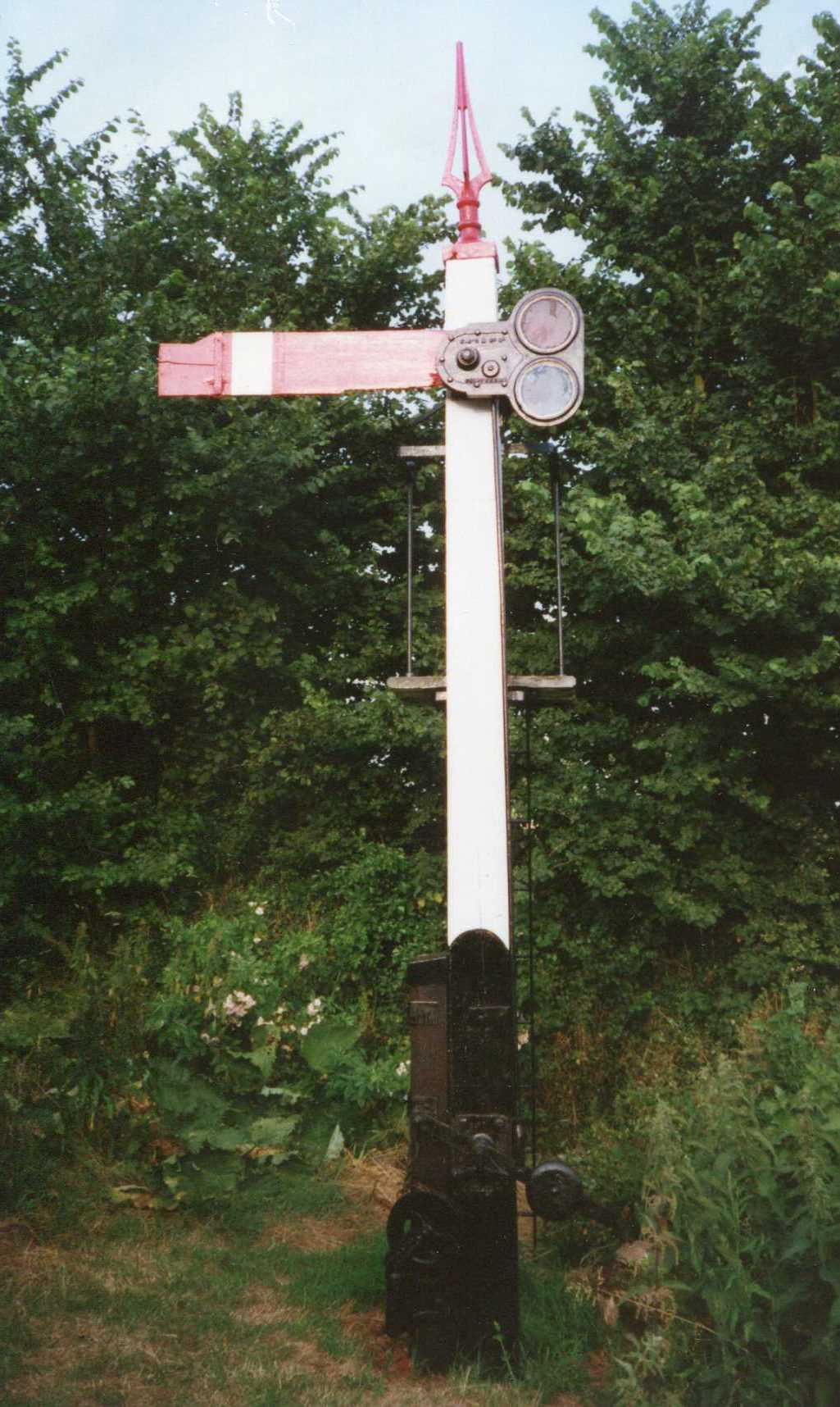
'Stop' signals appear to have consisted of a single lower-quadrant (LQ) arm
on a straight wooden post, which varied in height depending upon the
requirements of each individual location. The EoD signal posts were capped with a
distinctive form of 'arrow-head' metal finial, which consisted of a square base with a central, cylindrical stem
supporting the actual 'arrow-head', the main body being a cruciform shape
with open 'wings' leading to a solid spike at the top. (Note: on some other railways EoD
fitted finials in which the 'wings' of the arrow-head were solid rather than
open.) The primary purpose of such finials was to protect the top end of the
signal-post from rain so that it did not rot, but Victorian engineers liked
to make practical objects look decorative as well! The
photograph on the right (click for larger image) shows the former EoD Up Starting
signal from Chelfham, now preserved privately (the post was shortened during its railway
life). Various combinations of "E,O'D & Co Ld", "Chippenham" and "L&BR" were
cast into the face of the spectacle plate, the upper surface of the finial base,
and other metal fittings.
Stop
signals. With the exception of the double-armed Down Home
signal at Lynton, all the original
'Stop' signals appear to have consisted of a single lower-quadrant (LQ) arm
on a straight wooden post, which varied in height depending upon the
requirements of each individual location. The EoD signal posts were capped with a
distinctive form of 'arrow-head' metal finial, which consisted of a square base with a central, cylindrical stem
supporting the actual 'arrow-head', the main body being a cruciform shape
with open 'wings' leading to a solid spike at the top. (Note: on some other railways EoD
fitted finials in which the 'wings' of the arrow-head were solid rather than
open.) The primary purpose of such finials was to protect the top end of the
signal-post from rain so that it did not rot, but Victorian engineers liked
to make practical objects look decorative as well! The
photograph on the right (click for larger image) shows the former EoD Up Starting
signal from Chelfham, now preserved privately (the post was shortened during its railway
life). Various combinations of "E,O'D & Co Ld", "Chippenham" and "L&BR" were
cast into the face of the spectacle plate, the upper surface of the finial base,
and other metal fittings.
The signal arm consisted of a wooden 'blade' attached to a casting which incorporated the two-aspect spectacle plate (see Footnote below). The casting was placed on the end of the arm pivot, which passed through the post. On the right-hand side of the post behind the spectacle casting was a bracket supporting an oil lamp, which was positioned so that the light from the lens in the front of its casing shown through the 'red' aspect when the signal arm was in the 'on' position. A smaller lens at the rear of the lamp casing enabled the signalman to check that the signal lamp was alight when he could see only the back of the signal from his signal-box, as was the case with the various 'Home' signals. Fixed on the rear end of the signal arm pivot was a back-light 'blinder', which moved to obscure the rear lens when the arm was 'off', thus enabling the signalman to check the correct operation of the signal arm at night. Curiously some of the EoD 'Starting' signals seem to have been fitted with back-light blinders as well, some of which appear to have been positioned so as to obscure the light in both 'on' and 'off' positions, but the reason for this is unknown.
On the front of a signal post near its base was a straight 'weight-lever', which was pivoted on a casting attached to the post. The wire from the signal-box lever was attached to one end of the weight-lever, while the actual weight was on the other end. Attached between the pivot and the weight was a metal 'down rod', which ran up the post and connected to the spectacle casting just to the right of the arm pivot. When the signal-box lever was pulled the wire pulled down one end of the weight-lever and thus raised the other end, an action which pushed up the down-rod and hence the spectacle casting, thereby lowering the signal arm to the 'off ' position and moving the 'green' aspect in front of the lamp. When the signal-box lever was replaced, the weight of the spectacle casting and the weight-lever would pull in the slack in the signal wire and the signal arm would rise back to the 'on' position. On some of the L&BR signals the weighted end of the weight-lever projected to the right of the post and the down-rod was on the right-hand side of the post, whereas on other signals it projected to the left of the post and the down-rod ran diagonally across the face of the post. The reason for that difference is unknown, but it may have arisen perhaps because of a need to keep the moving weight clear of an adjacent walking route.
Distant signals. As far as is known from the limited information available, only two 'Distant' signals were provided in the original EoD installation; both were at Bratton Fleming and existed only for a short period from their installation in 1898 until removal by early 1899. No photographs of them are known and as they were sited some distance away from the station it is unlikely that they would have been visited by photographers. It may be a reasonable assumption that they were of a similar EoD style to the Stop signals, including the use of red arms and lights, but one can only speculate as to whether the arms had 'V' notches cut in the left-hand end and white chevrons on the face instead of white bands (as was the practice on many other railways by that date).
There seems to have been a long period during the early life of the L&BR without any substantial change to the signals. There was no major work on the line that would have required substantial changes to the signalling installations, and an extensive signal replacement programme seems unlikely as the original EoD signals would have been only 25 years old by the time that the Southern Railway (SR) acquired the L&BR in 1923. A few signals do appear to have been re-located at various times (eg the Down Starting at Barnstaple Town was moved from the platform to outside the run-round loop - and then back again!), but there was no known renewal work that resulted in any actual changes in signal style or design until after 1922. Thereafter however a number of signal replacements took place quite early in the period of SR ownership, although ironically most of the signal renewals on the L&BR took place during the last few years prior to the closure of the line. By the time that the railway closed in 1935 the Up Starting signal at Chelfham was the sole surviving EoD signal and even that had its post shortened at some time - this signal is now preserved privately.
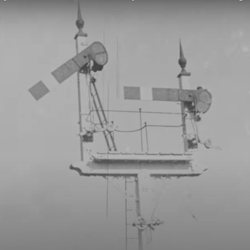
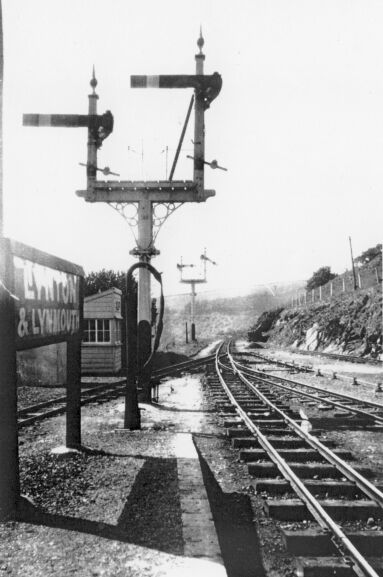 The first signal replacements for which records are known took
place on 2-December-1924 (SR Signal Instruction No 25 of 1924), when the double-armed Down Home and both Up Starting signals at Lynton were replaced by two 2-doll bracket signals
(see picture on the right - click for a larger image). These
bracket signals had LQ arms on wooden posts with ball-and-spike finials (different from
the EoD type) and in style they were identical to signals previously used by the London & South Western Railway (L&SWR).
It has been suggested that these signals might have been second-hand and
certainly there are resemblances to bracket signals that were removed about that time from
elsewhere on ex-L&SWR lines in Devon. However, noting similar work done
elsewhere on the SR during its early years, it is probable that that
they were simply a new construction by a SR Signal Department still working to ex-L&SWR designs.
The first signal replacements for which records are known took
place on 2-December-1924 (SR Signal Instruction No 25 of 1924), when the double-armed Down Home and both Up Starting signals at Lynton were replaced by two 2-doll bracket signals
(see picture on the right - click for a larger image). These
bracket signals had LQ arms on wooden posts with ball-and-spike finials (different from
the EoD type) and in style they were identical to signals previously used by the London & South Western Railway (L&SWR).
It has been suggested that these signals might have been second-hand and
certainly there are resemblances to bracket signals that were removed about that time from
elsewhere on ex-L&SWR lines in Devon. However, noting similar work done
elsewhere on the SR during its early years, it is probable that that
they were simply a new construction by a SR Signal Department still working to ex-L&SWR designs.
By the mid-1920s a couple of other L&B signals had been replaced in a similar style, but just as ordinary straight posts, namely the Down Starting at Woody Bay and the Down Home at Pilton (which also acted as the Down Advanced Starting for Barnstaple Town). Unfortunately there are no firm dates known for those changes and the photographic record is very limited; the Pilton Down Home was rarely photographed and there is no known dated coverage of the Woody Bay Down Starting between 1915 and 1927. It is not possible therefore to determine yet if those changes occurred before or after the SR took over the line, but on the basis of the ex-L&SWR style it would seem possible that the work was done by the SR circa 1923-25.
Subsequently the posts of any new signals on the L&BR were mainly L&SWR-style steel lattice or SR-style rail-built, with a couple of known examples of concrete posts used circa-1927. In almost all cases the replacement arm was still LQ (in the ex-L&SWR style), but the new Up Home provided at Woody Bay on 19-December-1934 (SR Signal Instruction No 47 of 1934) was the solitary L&BR example with an upper-quadrant (UQ) arm and almost certainly this was the last signal to be replaced on the line.
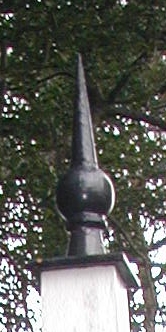
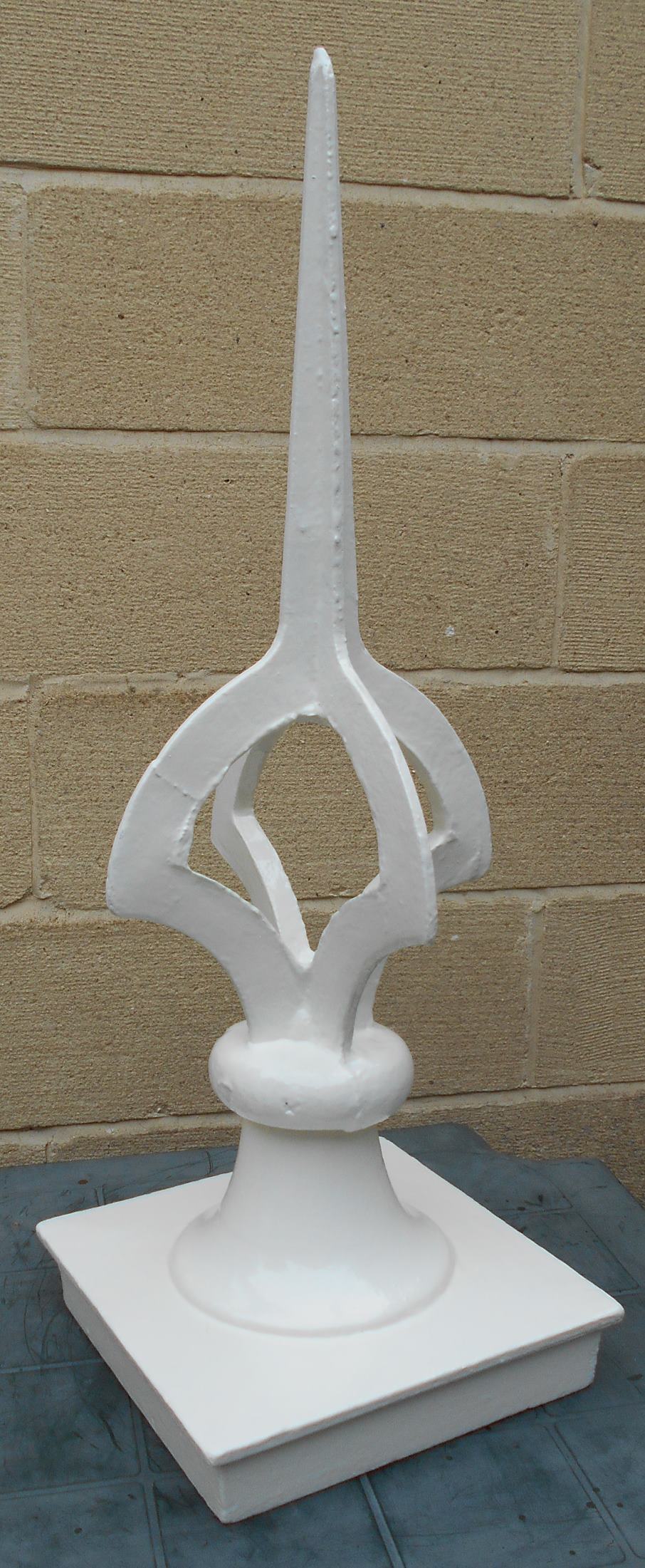 All the known
replacement signals with wooden posts had finials of the 'ball-and-spike' type previously used by the L&SWR
(with a ball that was 'solid' rather than pierced), similar to the one which can
be seen now (2026) on the replacement Down
Starting signal at the re-opened Woody Bay station (see picture on the left).
Lattice post signals had an open cruciform style of metal finial (see picture on the right),
which was the standard design used by the L&SWR and SR for such posts (but see
Footnote
below regarding its EoD connection). Some L&SWR examples had the
manufacturer's details cast into the upper part of the base, around the centre
column, but it is not known if any of the L&BR finials had this feature. The rail-built posts had a simple low
pyramid-shaped cap, while the concrete posts had no actual finial at all,
but instead the top of the post was cast in a pyramid (or possibly curved) shape.
All the known
replacement signals with wooden posts had finials of the 'ball-and-spike' type previously used by the L&SWR
(with a ball that was 'solid' rather than pierced), similar to the one which can
be seen now (2026) on the replacement Down
Starting signal at the re-opened Woody Bay station (see picture on the left).
Lattice post signals had an open cruciform style of metal finial (see picture on the right),
which was the standard design used by the L&SWR and SR for such posts (but see
Footnote
below regarding its EoD connection). Some L&SWR examples had the
manufacturer's details cast into the upper part of the base, around the centre
column, but it is not known if any of the L&BR finials had this feature. The rail-built posts had a simple low
pyramid-shaped cap, while the concrete posts had no actual finial at all,
but instead the top of the post was cast in a pyramid (or possibly curved) shape.
There is some uncertainty as to the construction of the 'boards' fitted to all the various LQ signal arms replaced during the SR era. It is known from photograph evidence that both the Up Starting at Pilton and the Down Home at Chelfham had 'corrugated' metal boards (horizontal folds in the metal to improve the rigidity of the board). It had been assumed that most of the LQ arms had wooden boards, but comparison with replacement work elsewhere on the SR during the mid/late 1920s suggests that there may have been some examples of plain metal arms (ie not corrugated). However it is highly probable (but not proven) that the UQ arm on the replacement Up Home at Woody Bay also had a corrugated metal board.
Annett's Shield. Some of the replacement signals were fitted also with an Annett’s Shield, which was a semi-circular plate fixed by a bracket to the signal post to project up in front of the 'green' spectacle of a LQ arm when the arm was in the 'On' position. This shield ensured that no stray light from behind the 'green' spectacle could be viewed accidentally as a false 'Off' indication when in fact the signal was 'On', and this was quite a common feature on ex-L&SWR LQ signals. On UQ arms the 'green' aspect was in front of the post when the arm was 'On', but as lattice and SR-type rail-built posts were relatively 'open' structures it would appear that the SR fitted a rectangular plate to the front of such posts immediately behind the arm; it may well be the case therefore that the 1934 replacement Up Home at Woody Bay was so fitted.
Based on information from the RailWest L&BR Signal Register it is possible to put many (but not yet all) of the L&BR signal replacements into chronological order. The replacements for which official dates are known are listed below:-
| Chronology of L&BR Signal Replacements with Known Dates | ||||||||||||||||||||||||||||||||||||||||||||||||||
|---|---|---|---|---|---|---|---|---|---|---|---|---|---|---|---|---|---|---|---|---|---|---|---|---|---|---|---|---|---|---|---|---|---|---|---|---|---|---|---|---|---|---|---|---|---|---|---|---|---|---|
|
|
|||||||||||||||||||||||||||||||||||||||||||||||||
It will be seen that in general the style of replacement signal post changed over time from wood to lattice to rail-built, but there are some curious exceptions. For example, the Chelfham Up Home was erected with a wooden post 15 months after lattice had been used for the Barnstaple Town Up Home, yet only a day later lattice was used again for the Blackmoor Down Starting. Similarly lattice was used for the Blackmoor Up Home only 3 weeks after the Barnstaple Town Down Starting was given a rail-built post. Perhaps these variations were merely a reflection of the fact that probably the SR Signal Department was using suitable second-hand materials recovered from elsewhere as an economy measure?
The paint scheme for L&BR signals is a tricky subject, almost worthy of a whole web-page by itself! Apart from a set of hand-tinted colour postcards of the L&BR circa-1900, which provide a useful guide but can not be relied upon as an authentic colour source, there are no known records of the actual colours that were used for the original EoD signals. Also the painting scheme seems to have varied over the years, with different black&white photographs from different dates and places showing a variety of arrangements of 'light' and 'dark' colours. The vagaries of early photographic film reproduction, differing contrasts and the accumulation of dirt and smoke over the years merely add to the confusion. It is presumed that in SR days the painting of signals on the L&BR was done by the local former L&SWR signal department, so it is probable that they continued to work to ex-L&SWR practice initially. The SR eventually defined a standard paint scheme for all its structures and other lineside equipment, including signals, but photographic evidence from elsewhere across the ex-L&SWR area suggests that often it was subject to the whim of 'local interpretation'. For example, some SR painting gangs apparently considered finials to be part of the post and painted them white, whereas other gangs considered them a 'fitting' and painted them a dark colour.
Signal posts were painted mostly white, but with a dark colour (probably black) used on the bottom part of the post up to about 4' to 6' above the ground. On the wooden posts there was usually a decorative curved top edge to this dark paint, whereas the later lattice and rail-built posts had a straight edge. In theory concrete posts were not painted, but both the known L&BR examples appear to have a dark colouring (with curved top) at the bottom of their posts by the time that the line closed in 1935. The 'boards' of signal arms were painted red, with a broad white band near the left-hand end, with the reverse being white with a black band in a corresponding position. It is unclear what colour the spectacle casting was painted originally on the EoD signals, other than that it was a dark colour. Under the SR colour scheme the casting was supposed to be dark grey, certainly on the L&SWR-style replacement LQ arms. The SR scheme for UQ arms required the main part of the spectacle casting (in line with the board) to be red, with only the upper pivot section being dark grey, but sadly there is insufficient evidence to determine exactly how they painted the sole UQ arm on the line (the replacement Up Home at Woody Bay). SR signal lamp cases were meant to be black, the rest of the 'fittings' being dark grey.
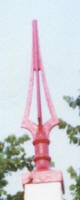 As regards the EoD finials, a picture of the Down Starting at
Barnstaple Town in 1898 shows that the
central 'wings' were a light colour, whereas the spike, stem and base were
all dark. However a view of the same signal in 1925 shows the 'wings' to be dark, as
was the base, but the stem and perhaps the spike appear to be lighter. The
circa-1900 'postcard' view of the Up Starting at
Chelfham suggests
that the base was dark, with the rest of the finial a lighter colour, the
same scheme appearing in a photograph of the Down Home at Chelfham
circa-1914. On the other hand, two views of the Up Starting at Chelfham post-1926
clearly show that finial to be all dark. A view of the Down Starting at
Bratton Fleming in SR days (probably 1925) shows a similar scheme to that at
Barnstaple Town at that time, alternatively dark/light/dark/light from the
base upwards, the same scheme being used on the Up Starting in later L&BR
days. It also appears to have been the case on the Down Starting at
Blackmoor in July 1925. Exactly what 'light' and 'dark' colours were used is
unknown, although it is assumed that the light colour was white. The dark
colour may have been red or black, or perhaps a different
colour at different times?
As regards the EoD finials, a picture of the Down Starting at
Barnstaple Town in 1898 shows that the
central 'wings' were a light colour, whereas the spike, stem and base were
all dark. However a view of the same signal in 1925 shows the 'wings' to be dark, as
was the base, but the stem and perhaps the spike appear to be lighter. The
circa-1900 'postcard' view of the Up Starting at
Chelfham suggests
that the base was dark, with the rest of the finial a lighter colour, the
same scheme appearing in a photograph of the Down Home at Chelfham
circa-1914. On the other hand, two views of the Up Starting at Chelfham post-1926
clearly show that finial to be all dark. A view of the Down Starting at
Bratton Fleming in SR days (probably 1925) shows a similar scheme to that at
Barnstaple Town at that time, alternatively dark/light/dark/light from the
base upwards, the same scheme being used on the Up Starting in later L&BR
days. It also appears to have been the case on the Down Starting at
Blackmoor in July 1925. Exactly what 'light' and 'dark' colours were used is
unknown, although it is assumed that the light colour was white. The dark
colour may have been red or black, or perhaps a different
colour at different times?
In SR days the ball-and-spike finials on the replacement wooden post signals all appear to have been in very dark colour (possibly black rather than dark grey) for most of their life, although there is one photograph of the replacement signals at Lynton which appears to show the dark colour on the 'ball' and the base of the finial only, with the rest of the 'spike' being white. It is possible also that the 'ball' may have been red initially, as there is evidence for that practice in some similar ex-L&SWR signals elsewhere. The situation for finials on lattice posts is less clear, as in many photographs the detail is indistinct, but there is an indication that some may have been painted at some time in a mixture of light and dark colours. All the 'pyramid caps' on the rail-built signals appear to have been a dark colour. The tops of the concrete posts were not painted. It is probably a fair assessment to say that the colour scheme for finials appears to have gone through a number of variations during the life of the railway.
An attempt has been made to compile a Register of all known L&BR signals, with details of the various changes, and the available information is set out in the table below. The following should be noted:-
| Key to L&BR Signal Register Codes | ||
|---|---|---|
| C = Concrete post | AS = Signal fitted with Annett’s shield | |
| L = Lattice post | LQ = L&SWR-style lower-quadrant arm | |
| R = Rail-built post | RHS = Signal located on right-hand side of the line | |
| W = Wooden post | UQ = SR-style upper-quadrant arm | |
| L&BR Signal Register Locations Index | |||
|---|---|---|---|
| Barnstaple Town | Bratton Fleming | Lynton | Woody Bay |
| Blackmoor | Chelfham | Pilton | |
| LYNTON & BARNSTAPLE RAILWAY SIGNAL REGISTER | ||||
|---|---|---|---|---|
SIGNAL |
No |
ORIGINAL |
NEW |
REMARKS |
| BARNSTAPLE TOWN | ||||
| Up Home | 1909 | L+LQ | Signal replaced 20-Jan-1925 (SR SI 2/1925). Slot from SR box added (post-1923?). | |
| Down Starting | R+LQ+AS | Moved from platform to RHS of loop during L&BR days. Replaced by new signal on platform 28-Aug-1929 (SR SI 33/1929). Slot from SR box added (post-1923?). | ||
| Down Advanced Starting | 1920s | W+LQ (+ ring LQ post-1927) |
Slot(s) on Pilton Down Home(s). Altered by Aug 1926. Second (ringed) lower arm added 30-Aug-1927 (SR SI 22/1927). Extra slot(s) from SR box added (post-1923?). | |
| PILTON | ||||
| Up Home | L+LQ | |||
| Up Starting | 3 | L+LQ* | *corrugated arm. Altered by 30-Aug-1926. | |
| Down Home | 1920s | W+LQ (+ ring LQ post-1927) |
Slotted by B/Town Down Advanced Starting. Altered by Aug 1926. Second (ringed) lower arm added 30-Aug-1927 (SR SI 22/1927). Extra slot(s) from SR B/Town box added (post-1923?). | |
| CHELFHAM | ||||
| Up Home | 6 | RHS | W+LQ | Replacement signal on left-hand side of line 13-Apr-1926 (SR SI 14/1926) on side of cutting. |
| Up Starting | 7 | 1924* | *reduced in height by 1924. [Transferred to Clannaborough after closure (picture).] | |
| Down Starting | 1 | 1920 | C+LQ | Signal replaced 9-Aug-1927 (SR SI 20/1927) |
| Down Home | 2 | 1920 | L+LQ*+AS | *corrugated arm |
| BRATTON FLEMING | ||||
| NOTE: All signals abolished 16-June-1931 when Bratton Fleming signal-box ceased to be a block-post (SR SI 20/1931) | ||||
| Up Distant | 7? | Signal fixed/removed? Lever re-used for Up Starting signal. | ||
| Up Home | 6 | c1924 | L+LQ | RHS on top of embankment. |
| Up Starting | 7 | |||
| Down Starting | 1 | 1929 | ||
| Down Home | 2 | Signal replaced 6-Oct-1926 (SR SI 32/1926) 8 yards nearer station | ||
| Down Distant | 1? | Signal fixed/removed? Lever re-used for Down Starting signal. | ||
| BLACKMOOR | ||||
| Up Home | 6 | RHS 1904* | L+LQ+AS | *on top of embankment. New 30' signal provided 17-Sep-1929 (SR SI 35/1929) on left-hand side of line sited at ground level 10 yards further out. |
| Up Starting | 7 | 1924? | C+LQ | Altered by 11-Aug-27 |
| Down Starting | 1 | 22/7/25 | L+LQ+AS | Signal replaced 14-Apr-26 (SR SI 14/1926) |
| Down Home | 2 | 11/8/27 | ?+LQ+AS | Altered by 1935 |
| WOODY BAY | ||||
| Up Home | 6 | 8/9/33 | R+UQ | RHS, replaced 19-Dec-34 (SR SI 47/1934) |
| Up Starting | 7 | 1930s | R+LQ+AS | Altered by 1933 |
| Down Starting | 1 | 1915 | W+LQ | Altered by 1927. Same finial pattern as 1924 signals at Lynton. |
| Down Home | 2 | c1925 | R+LQ+AS | Altered by 8-Sep-1933 |
| LYNTON | ||||
| Up Main Starting | W+LQ | Originally two separate posts. Replaced 2-Dec-1924 by 2-doll bracket on platform between Main and Bay lines (SR SI 25/1924). | ||
| Up Bay Starting | W+LQ | |||
| Down Main Home | W+LQ | Originally 2 arms on one post. Replaced 2-Dec-1924 by 2-doll bracket on RHS (SR SI 25/1924). | ||
| Down Bay Home | W+LQ | |||
The firm of Evans O'Donnell was founded in 1894 in Chippenham by Arthur Evans and John O'Donnell, and registered as Evans, O'Donnell & Co Ltd the following year. John O'Donnell had been previously the patent agent and London representative for Dutton & Co of Worcester. In 1890 Dutton & Co supplied the signalling for the new City & South London Railway (the first deep-level 'tube' line in London), and then in 1892 a new signalling installation at Douglas on the narrow-gauge Isle of Man Railway. Both installations used a particular Dutton design of spectacle plate casting, which appears to have been adopted (with some slight variations) by EoD for their work on the L&BR in 1898. EoD also supplied the L&SWR with the style of finial used by them on lattice-post signals, but that design had appeared previously in Dutton drawings by 1889. It may well be the case that the components used for the various replacement signals on the L&BR during the SR period originated from a number of different contractors.
© CJL Osment 1999-2026
Ackowledgements for information from Bob Barnard, Edward Dorricott, the late Colin Pealling, Keith Vingoe and the Signalling Record Society.
All images from WCRA collection.
 |
Interested in the Lynton
& Barnstaple Railway? Then why not join the Lynton & Barnstaple Railway Trust and help to re-build England's premier narrow-gauge line? |
| Introduction | Research Issues | Original Signals | Signal Replacements | Signal Painting | Signal Register |
|
|||||||
| © West Country Railway Archives 2010 Page last updated: 03 September 2026 |
URL:
E-Mail: |
||||||